
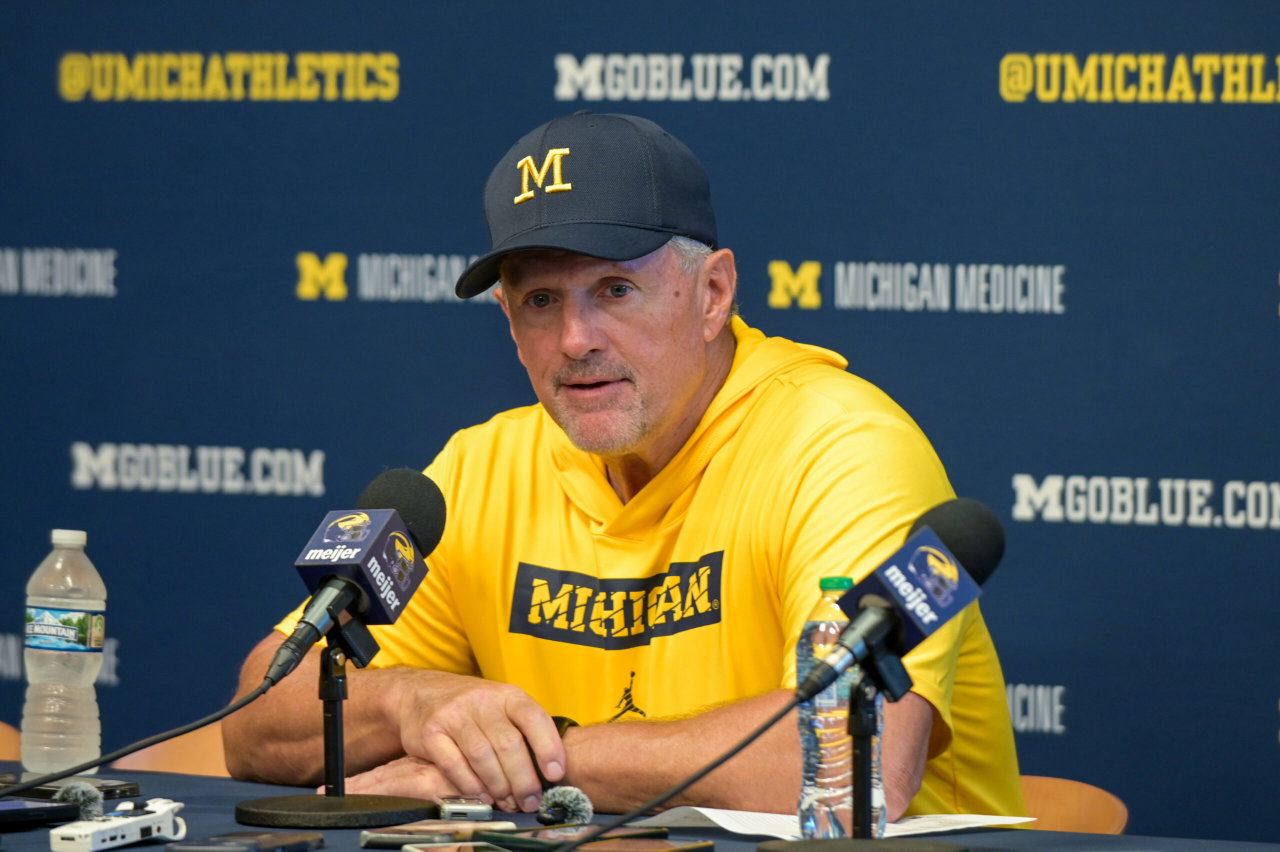
Kyle Whittingham went all-in on Jason Beck, bringing him over from Utah and making him the highest-paid offensive coordinator in the country at $3 million a season. Michigan expected to see magic. Instead, the Wolverines have gone from bad to downright helpless. A disastrous start forced a quarterback change, the offensive line has continued to crumble, and the team doesn’t seem to have any answers. The numbers tell the story: Michigan ranks 132nd in the FBS in total offense and has gone scoreless in the first half of each of its last three home games.
Watch What’s Trending Now!
There’s little left to suggest this offense knows how to get itself out of this mess. Yet, there needs to be an attempt, and in its latest quest to manage its blunders, the program has fired Beck. Whittingham confirmed it, saying:
“The results have not matched our desired outcome, and I felt that a change in leadership was required for our offense. We need to put our offensive players and the entire team in the best possible position to be successful.”
Jim Harding will take over as interim offensive coordinator for the rest of the season, but Beck won’t even get the chance to finish his first year in Ann Arbor. Whittingham had hinted at changes after the disappointing loss to Michigan State, saying he would take a closer look at certain positions and the play-calling situation. But few expected Beck to be gone before the season wrapped up. Michigan’s 5-4 record, however, appears to have left the program with little patience for waiting things out.
“We appreciate the hard work and effort that Jason has dedicated to the program,” Whittingham said in his statement. “Jason is a great man and coach, and unfortunately, it did not work out the way that we wanted it to at Michigan. We wish Jason and his family nothing but the best in the future.”
Michigan’s decision to move on from Beck comes with a hefty price tag. A copy of his contract, obtained by the Detroit Free Press, shows that he could be owed as much as $10.1 million in buyout money. That number, however, isn’t set in stone. Several provisions in the contract could reduce the final payout.
Michigan’s 15-6 loss to Michigan State was the final thread
It’s hard to imagine a worse time for Michigan’s offense. The firing took place shortly after the Wolverines had lost 15-6 to Michigan State, their first defeat to the Spartans since 2021. They managed only 192 yards all afternoon, threw away possession four times, and converted just two of 10 third downs. Freshman quarterback Tommy Carr was sacked five times, the running game went nowhere with 2.1 yards per carry on 26 attempts, and the passing attack couldn’t do much better, finishing with 138 yards.
While head coach Whittingham was evidently disappointed after the game, his team had been experiencing offensive struggles all season. Here are some sad stats the Wolverines had to face after the Michigan State game:
- Total offense: No. 132 (out of 138)
- Scoring offense: No. 126
- Rushing offense: No. 109
- Passing offense: No. 125
- Total number of first downs: No. 124
- Red zone offense: No. 129
Quarterback instability only compounded the problems. Bryce Underwood opened the season as the starter but completed just 58.1% of his passes (72 of 124) for 924 yards, five touchdowns, and six interceptions before being benched. Freshman Tommy Carr took over, but the offensive struggles persisted.
Across five appearances, Carr completed 67.0% of his passes (63 of 94) for 641 yards, two touchdowns, and three interceptions. Against Michigan State, he went 14 of 26 for 138 yards and threw two interceptions. Even the ground game failed to provide relief. Michigan ranks No. 109 nationally, averaging 128.7 rushing yards per game despite having Jordan Marshall, Bryson Kuzdzal, and highly rated recruit Savion Hiter in the backfield.
Beck’s play-calling also attracted criticism, particularly his use of the six-offensive-lineman “Rhino” package. Rather than consistently exploiting power-running opportunities between the tackles, the scheme frequently featured outside runs, raising questions about how effectively Michigan was using its personnel.
What comes next for Whittingham and Michigan?
The Wolverines enter their final three regular-season games at 5-4 overall and 2-4 in Big Ten play, with Oregon, UCLA, and Ohio State still ahead. Harding faces the immediate challenge of getting more production from a unit that has struggled throughout the season.
The situation also puts Whittingham under increasing scrutiny in his first year at Michigan. He arrived on a five-year, $41 million contract after spending 20 years in Utah. According to the terms reported by the Detroit Free Press, firing him without cause could trigger an estimated $24.75 million payout, representing 75% of the $33 million remaining on his deal over the next four years.
That leaves Michigan facing an uncomfortable financial reality. The program could owe millions to an offensive coordinator who lasted just nine games, while its head coach carries an even larger potential termination cost.
For Whittingham, the immediate priority is salvaging the final stretch of a disappointing season. But with three difficult opponents remaining and Michigan’s offense among the nation’s least productive, the pressure to deliver results is only intensifying.