
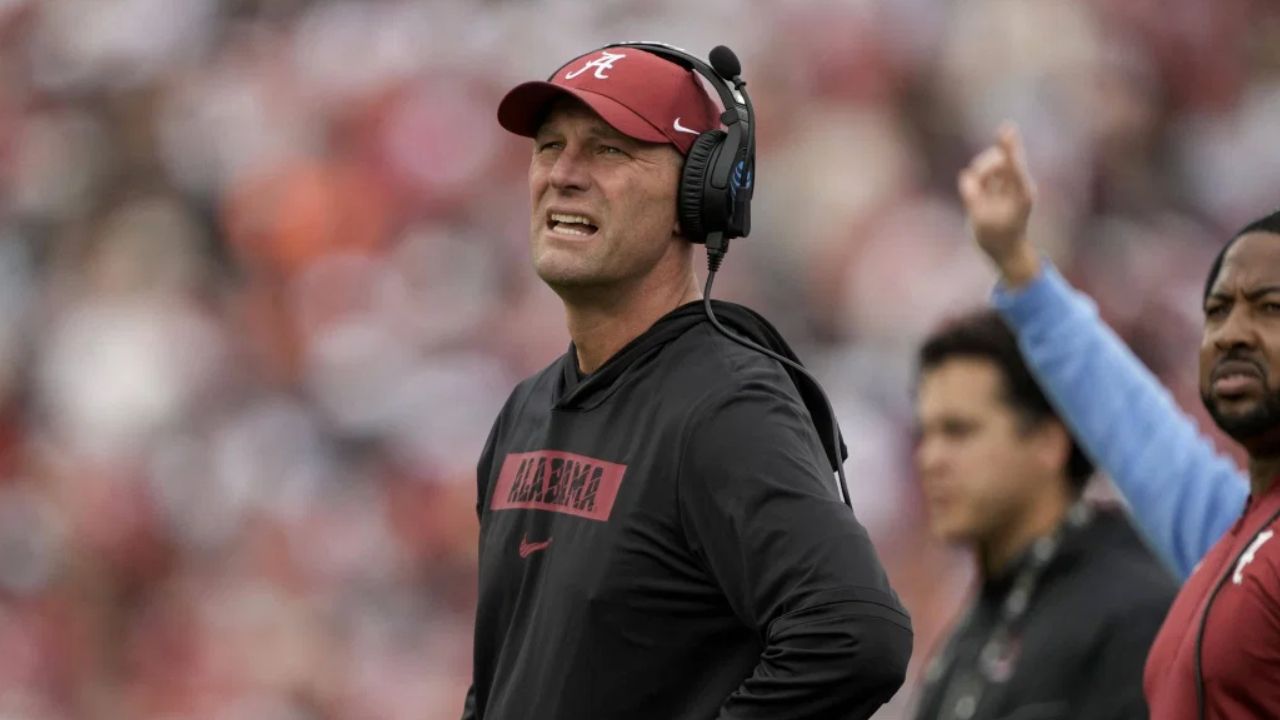
When Ryan Grubb returned to Alabama in 2025, he wasn’t walking into a finished offense. He was rejoining Kalen DeBoer after a year with the Seahawks and taking over a unit that would have to keep evolving around a new quarterback. A year later, Alabama had only three returning offensive starters, with Keelon Russell entering his second college season and a string of younger pieces filling out the unit.
Watch What’s Trending Now!
That made Russell’s development one of the defining threads of Alabama’s offseason. DeBoer had pointed to the quarterback’s jump in his understanding of the offense after his first year, while Grubb’s job was to keep the young group around him from carrying more than it needed to. The challenge was playing that process out inside Bryant-Denny Stadium, where expectations around Alabama’s offense have never been particularly patient. That patience was tested Saturday. The Crimson Tide eventually erased a 21-6 deficit and pulled away for the win, but the early struggles left plenty for Alabama to clean up before its next game. Defensive coordinator Kane Wommack was especially frustrated with his unit and didn’t sugarcoat his feelings when discussing the secondary on Monday.
“They’re pissed, and they should be pissed,” Wommack said. “They did not do their job at a high enough level, and they are very capable of doing that. And they’re disappointed in themselves.”
The frustration came after Florida State repeatedly found big plays through the air. The Seminoles finished with 471 total yards, including 377 passing yards from quarterback Ashton Daniels. Florida State also produced nine plays of at least 20 yards, while converting 8-of-14 third downs against an Alabama defense that had allowed only one third-down conversion through its first two games. And the film offered an even harsher number for Wommack’s unit.
For Wommack, the problem wasn’t something that could simply be pinned on one player. “It was not; the blame cannot be put on any one person,” he said. “We had nine explosives…When you do that, though, all it takes is one guy here and one guy there, and then you have a truly highly disappointing day,” Wommack said.
The larger breakdown was just how far the explosive-play count had jumped. Alabama had allowed six passes of at least 15 yards across its first two games against East Carolina and Kentucky. Florida State produced 10 such completions by itself, along with three runs of at least 10 yards.
That made Saturday a sharp departure from the defense’s opening two weeks, when Alabama had surrendered only two such runs combined. Florida State also had four players finish with at least 50 receiving yards, with Duce Robinson accounting for 135 of them.
The Alabama defense did eventually make enough plays to help secure the victory. Bray Hubbard intercepted Daniels late in the fourth quarter, and the Crimson Tide held Florida State to just 15 points after halftime. Ivan Taylor also made one of the more important defensive plays of the afternoon, intercepting Daniels and later making a touchdown-saving tackle in the run game. Zabien Brown, meanwhile, held Robinson to two catches for 23 yards on four targets when matched against him, even as Robinson found more success against Dijon Lee.
Wommack’s frustration, then, wasn’t about a defense that never recovered. It was about how often Alabama had to recover in the first place.
While Wommack was focused on the defensive mistakes, Grubb was looking at what happened on the other side of the ball.
Alabama’s offense started slowly against Florida State, opening the game with two straight three-and-outs while the Seminoles jumped out to a 21-6 lead. That brought some boos from the Bryant-Denny Stadium crowd. But Grubb wasn’t interested in letting those early reactions define his players.
“I was proud of the guys, and they just didn’t have any quit,” Grubb said. “They’re a really resilient group. I’m super proud of that.” Then came the line that grabbed everyone’s attention.
“You know, we had some boo birds,” Grubb said. “I told the guys, I said, ‘Shoot, guys, if you’d have quit as fast as some of your fans, shit, we wouldn’t have won that game.’”
The comment became a story of its own. Grubb later apologized to Alabama’s fan base, saying his “passion for my players” affected his choice of words and that he “should have worded” the earlier statement more carefully. For Grubb, though, the players’ response remained the point.
“For a bunch of 19-year-olds to go out there and just 21-6 and not flinch, I was fired up,” he said. And the numbers backed up his argument.
After its sluggish opening, Alabama’s offense found another gear. The Crimson Tide scored on nine straight possessions, turning a 15-point deficit into a 50-36 victory. Alabama finished with 567 total yards, including 320 through the air and 247 on the ground.
The turnaround had started before the second lightning delay, too. Alabama put together a 75-yard, 12-play drive that consumed 7:06 and ended with Russell finding freshman Cederian Morgan for a touchdown. After the delay, the offense kept rolling, with Russell connecting with Ryan Coleman-Williams for a 46-yard touchdown and then finding Kaleb Edwards for a 16-yard score with 22 seconds left in the half. Alabama had gone from down 21-6 to leading 26-21 by halftime.
Keelon Russell was at the center of that turnaround. The sophomore quarterback completed 23 of 30 passes for 320 yards and three touchdowns while adding 56 rushing yards and another score. Lotzeir Brooks also recorded his first 100-yard receiving game at Alabama, finishing with eight catches for 101 yards.
Brooks was more than just a 100-yard receiver. Russell targeted him 11 times, four more than any other Alabama receiver, and Brooks came through on several important downs. He converted a third-and-17 with a 15-yard catch and later moved the chains again on third-and-5. The 101-yard day gave Russell another dependable target without Alabama having to rely solely on Ryan Coleman-Williams.
That comeback also explains why Grubb wasn’t overly concerned about the boos.
Alabama had been in trouble, but the young offense responded instead of folding. Head coach Kalen DeBoer echoed that confidence after the game, saying the team has repeatedly shown that its players have each other’s backs when adversity hits.
But DeBoer also acknowledged the part of the story that Grubb’s comments couldn’t erase: “We obviously got to start faster.” He pointed to penalties, missed assignments and a lack of execution as the small mistakes that had again put Alabama in a hole.
Still, the slow starts are becoming something Alabama has to address.
This was not the first time Alabama had needed a second-half reset. A week earlier at Kentucky, the Crimson Tide went into halftime trailing 17-13 before shutting out the Wildcats in the second half and scoring 32 unanswered points on the way to a 45-17 win. Against Florida State, the deficit was larger and the comeback began earlier, but the pattern was familiar.
Alabama will need to make that adjustment quickly with South Carolina coming to Bryant-Denny Stadium next Saturday.
For now, Alabama is 3-0 and has already survived a game that could have gone badly after falling behind 21-6.
But Wommack’s frustration shows the defense can’t simply move on because the final score looked comfortable. Florida State’s 471 yards and 13 combined big plays were a significant departure from what Alabama had allowed through its first two games, while Grubb’s comments, and subsequent apology, added another layer to an offense that has now needed dramatic turnarounds in consecutive weeks.
There were enough positives to make the 50-36 win meaningful. Russell produced 376 all-purpose yards, Alabama rushed for 247 yards, the offense scored on nine straight possessions after its opening two drives, and the defense forced three interceptions. But those numbers don’t erase the stretches that forced Alabama to chase the game.
That is the tension Alabama now carries into South Carolina: the Crimson Tide has already shown it can respond when things go wrong. Its coordinators are making clear that the next step is making sure it doesn’t have to wait for things to go wrong before playing at that level.