
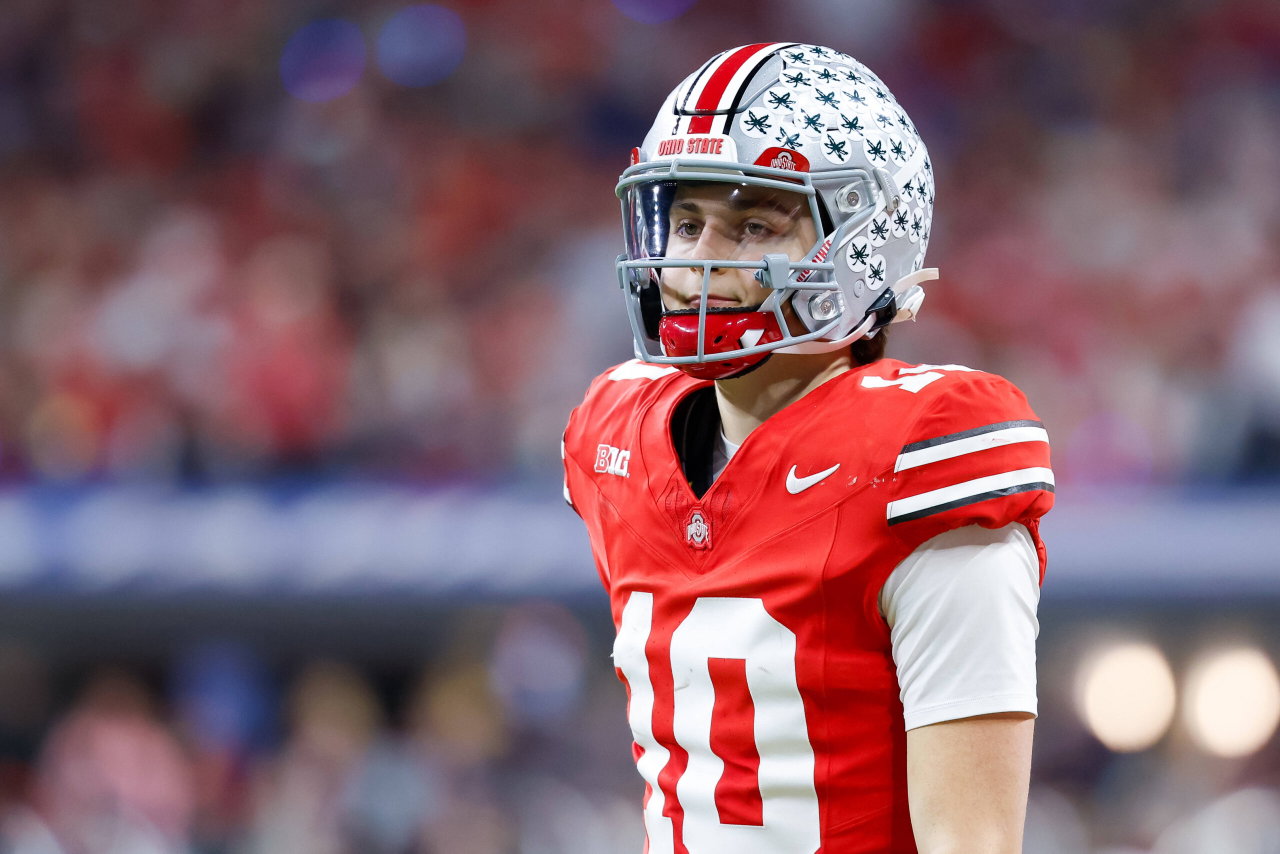
Ohio State entered its biggest game of the season against Indiana already dealing with an offensive setback nobody saw coming. Ja’Kobi Jackson, one of the Buckeyes’ most efficient running backs, suddenly landed on Wednesday’s availability report despite playing against Maryland just days earlier. There had been no warning, no major injury concerns, and no indication Ohio State was about to lose a key offensive weapon. But footage of Jackson limping late against Maryland soon surfaced, exposing what initially looked like a minor issue as something far more serious.
Watch What’s Trending Now!
Now, the situation is considerably more serious. Jackson, a seventh-year senior who transferred from Florida this offseason, has undergone surgery for a Lisfranc foot injury. Through six games, he had rushed for 354 yards and six touchdowns on 59 carries, averaging a team-best 6.0 yards per attempt. He had also recorded at least 10 carries in three consecutive games before suffering the setback.
“Ja’Kobi Jackson underwent surgery for a Lisfranc injury but hopes to return by the Michigan game, a source told Eleven Warriors,” Eleven Warriors reported on X on October 21.
The injury occurred during the fourth quarter against Maryland and is expected to sideline Jackson for several more weeks. His recovery timeline makes the November 28 rivalry showdown against Michigan a potential comeback opportunity, although medical clearance will ultimately determine his availability.
Offensive coordinator Arthur Smith offered little clarity when questioned Tuesday. “We’ll just have to see on that,” Smith said.
Jackson also addressed his setback on Instagram, writing, “Sometimes God allows His strongest soldiers to face the hardest battles,” before reminding followers that “you are never fighting alone.”
His absence has already forced Ohio State to reconsider its running back rotation. Against Indiana, Bo Jackson handled a career-high 52 snaps but managed only 56 rushing yards on 18 attempts. Isaiah West and Legend Bey provided additional depth, though neither has established himself as a consistent replacement for Ja’Kobi’s production.
The challenge became particularly evident against an Indiana defense ranked fourth nationally against the run, surrendering approximately 75 yards per game and just 2.3 yards per carry. Despite struggling offensively and allowing four sacks and two interceptions, Ohio State escaped Bloomington with a 19-15 victory, snapping the Hoosiers’ 22-game winning streak.
For Ryan Day, however, the victory came at another significant cost.
Julian Sayin’s Injury Adds Another Concern for Ohio State
Starting quarterback Julian Sayin suffered a throwing-arm injury during the fourth quarter against Indiana, leaving Ohio State facing uncertainty at the most important position on the field.
Day initially indicated Sayin would miss several weeks before delivering a far more concerning assessment. The Buckeyes are now preparing for the possibility that their starting quarterback could miss both the remainder of the regular season and the postseason.
Although Sayin has not officially been ruled out for the year, the potential consequences are enormous. Before his injury, he had completed approximately 68% of his passes for 2,007 yards, 19 touchdowns and four interceptions, establishing himself as the centerpiece of Ohio State’s passing attack.
True freshman Luke Fahey replaced him in Bloomington but failed to complete either of his two passing attempts. Fahey had earned the backup position ahead of sophomore Tavien St. Clair during preseason competition, and the coaching staff now faces the challenge of preparing an inexperienced passer for a demanding Big Ten schedule.
Still, Day has expressed confidence in the freshman’s ability to handle the responsibility, describing him as athletic, competitive and confident under pressure.
Star receiver Jeremiah Smith also publicly supported Fahey following the victory.
“Next man up. Fahey did a great job today,” Smith said.
Smith, who tied Braylon Edwards’ Big Ten career record with 39 touchdown receptions during the contest, will be particularly important as Ohio State attempts to maintain its passing production without an established starter.
The quarterback change also makes the depleted backfield a more pressing concern. An effective rushing attack could prevent opposing defenses from concentrating on an inexperienced passer. Instead, Arthur Smith must develop an offensive approach with fewer proven options available to create balance.
Ohio State’s upcoming schedule offers little room for experimentation. Following its bye week, the Buckeyes travel to face No. 19 USC on October 31 before meeting Oregon, Northwestern and Nebraska ahead of their regular-season finale.
That makes the extra preparation time especially valuable. Day has indicated that both Fahey and St. Clair will receive significant practice repetitions as the staff evaluates its quarterback options and adjusts its offensive approach.
The larger concern is whether Ohio State can maintain its championship ambitions while dealing with injuries at two critical positions. The Buckeyes have enough talent to compete, but replacing established production becomes considerably more difficult against opponents capable of exploiting offensive weaknesses.
For Jackson, the immediate priority remains rehabilitation following surgery. For Day, the challenge is keeping Ohio State competitive through a difficult stretch without knowing when his injured starters will be available.
And with the Michigan rivalry approaching, the Buckeyes could find themselves fighting for their postseason ambitions long before their injured running back has an opportunity to contribute again.