
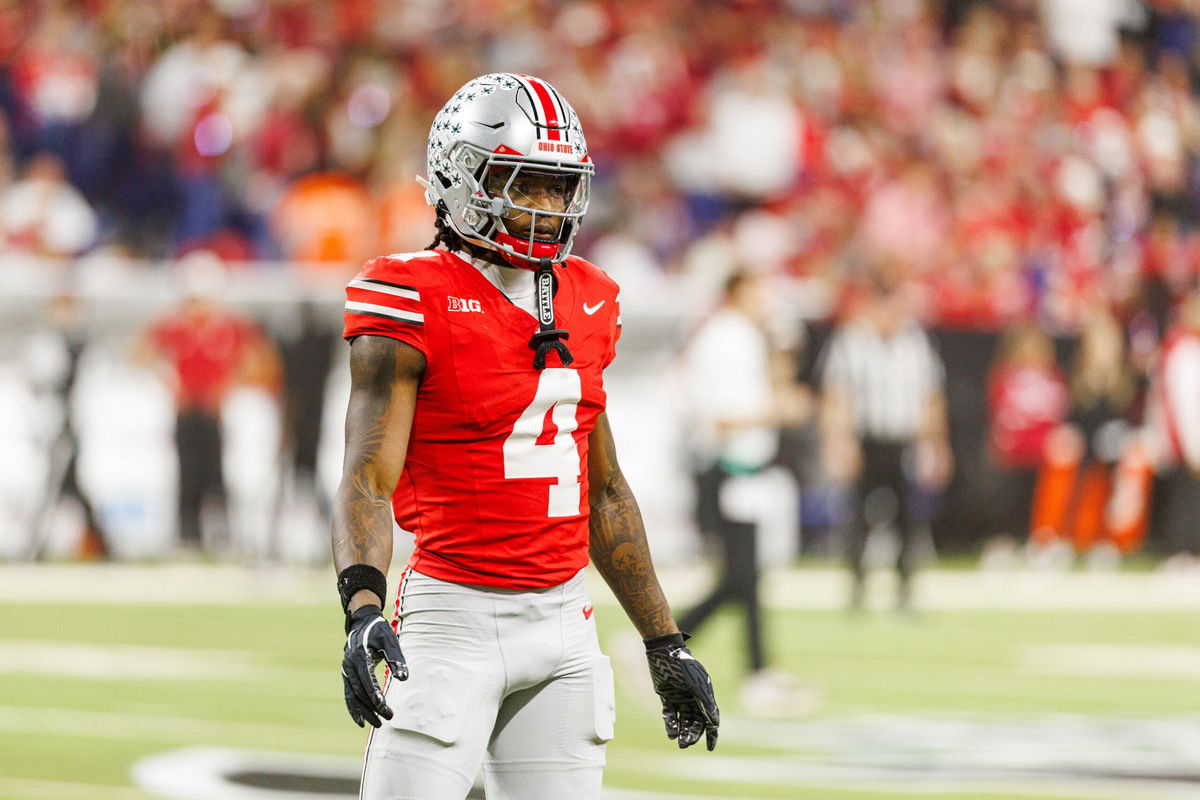
Ohio State has evolved over the last decade into the de facto WR-U. Last season, the Buckeyes had elite talents like Jeremiah Smith and 4th overall pick Carnell Tate on the roster. Despite that, the Columbus program’s receiving unit wasn’t elite in one key metric. Instead of trying to evade that, Jeremiah Smith called it out and vowed to improve this year.
Watch What’s Trending Now!
“No goals for myself,” Jeremiah Smith said about his 2026 goals at the Bill and Doug Show on July 29. “Just being more dominant in the run game. And then, yards after the catch. That’s been the biggest emphasis for the whole receiver core for this offseason and for myself. We were the worst in the country with YAC. So, I think you’re going to see a big difference in that when the ball is in the receiver’s hands this year, for sure.”
While Jeremiah Smith and Co. together notched 3,755 receiving yards, most of it came through direct catches. OSU was the 15th-worst team among Power-4 opponents in YAC, averaging a meager 5.19 YAC. LSU, for instance, which had a disappointing season last year, was 48 spots ahead of OSU in the metric. Jeremiah Smith, who had averaged 6.5 YAC as a freshman, regressed to just 4.3 YAC last year.
“I mean, the ball coming off center, we got to catch it,” Smith said. “No matter how you put the ball, it’s really up to us, you know, to make guys miss.
And as I said, we were the worst in the country at that, and that’s not the Ohio State standard at the receiver position.”
One of the major reasons the OSU WRs lagged in YAC was their inability to turn short passes into long routes. They failed to break tackles and also were lacking in flocking together in spaces. On the contrary, receivers went down easily after initial contact, which contributed to the low YAC in 2025. Another reason was also the lack of a running game.
While OSU has a reputation for producing RBs like Quinshon Judkins, its running game ranked 72nd nationally last year. The unit could only notch 154.36 rushing yards per game, which meant the team also struggled to generate high YAC on the perimeter. Instead, the receivers were isolated on physical DBs, and those long runs were rare. This year, however, it’s going to change.
OSU’s offense in 2026
For the 2026 season, after Hartline departed to become USF’s head coach, Arthur Smith came in as OC. Throughout his NFL stints, Smith has always prioritized heavy play-action and multi-tight-end set schemes. He regularly crowds the line of scrimmage, and defenses bring up safeties to stop those physical runs. That would predictably clear the middle of the field and give Jeremiah Smith the chance to average significant YAC.
“There has to be more opportunities to catch and carry the football,” OSU’s WRs coach Cortez Hankton said to 247Sports. “So we catch a six-yard hitch, we have to be able to take it to the house. We catch a dig, we have to be able to take it to the house. And that has to be our mindset and mentality. That’s why I tell the backs, ‘Okay, we don’t have the ball. What are you doing when you don’t have the ball? You should be sprinting to go throw a block.”
Apart from Jeremiah Smith, Brandon Inniss, and Chris Henry Jr manning the WR positions, the program will also have a live run game this year. Sophomore Bo Jackson will finally have a dominant season, while Ja’Kobi Jackson (transfer from Florida) will provide that added edge to help the WR unit. Most importantly, OSU won’t primarily rely on contested catches this year. It will have those shallow drags, meshes, and tunnel screens to manufacture incredible YAC. Hopefully, it all works out for Ryan Day this year.