
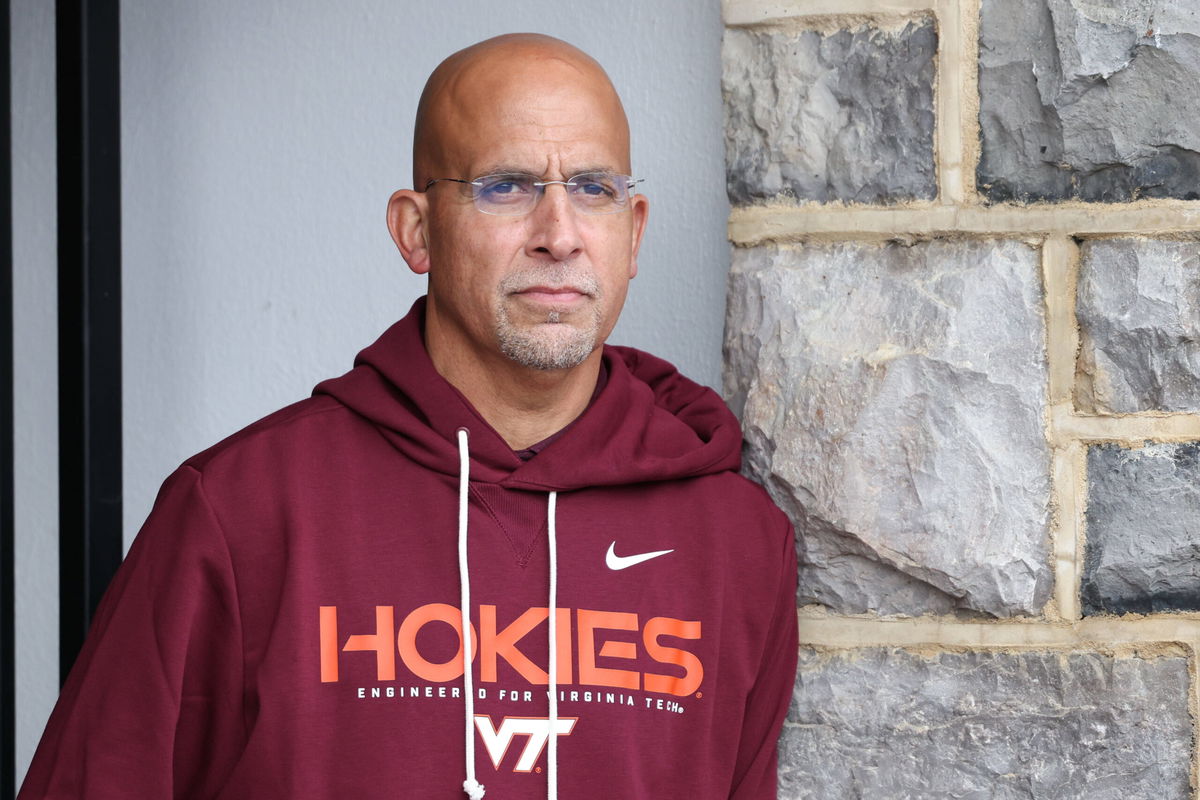
For nearly a decade, Virginia Tech has been chasing the version of itself that once felt almost impossible to lose. Frank Beamer’s retirement ended one of the strongest runs in college football, and the two coaches who followed him never managed to make that standard feel permanent.
Watch What’s Trending Now!
By the time James Franklin arrived in November 2025, the Hokies were already changing course. The school had approved a $229.2 million athletics investment plan just weeks before Franklin was hired, setting up a major shift in how the department would operate.
Now, Franklin is offering his clearest explanation yet for what he believes went wrong. “Schools with great tradition and history, and they held on to that tradition, and they held on to that history so tightly for so long that they stopped evolving and stopped growing,” Franklin said on the ACC Digital Network. “Modern athletic departments have changed dramatically in the last 15 years. And if you haven’t changed with them, then you get left behind.”
“The reality is it was so much more than just those coaches, right? The university as a whole has to embrace and make some philosophical changes,” Franklin added.
Franklin inherited a program that had not been able to sustain the standard set by Beamer. The legendary coach went 235–121–2 across 29 seasons, won seven conference championships and reached the 1999 BCS National Championship. Virginia Tech also made 23 straight bowl appearances during Beamer’s tenure, part of a 27-year streak that finally ended in 2020.
After Beamer retired in 2015, Justin Fuente initially kept the program competitive, winning 10 games and the ACC Coastal Division in 2016. But Virginia Tech slipped to 6–7 in 2018, its first losing season since 1992, and Fuente was fired in 2021. Pry followed with a 16–24 record before his dismissal after an 0–3 start in 2025.
In November 2025, Franklin said, “Coach Beamer built a baseline of success here that proved Virginia Tech can compete with anyone in the country. But the competitive environment of 1999 or 2010 is not the competitive environment of today.” He added, “To honor tradition, you have to support the current program with the operational capacity required in modern college football. Respecting history means funding the future.”
The numbers show why Franklin’s comments carry weight. Before the overhaul, Virginia Tech’s $122 million athletic department budget ranked 14th among 17 ACC schools, while the university ranked last among its public ACC peers in discretionary operating funds. On September 30, 2025, the Board of Visitors approved a $229.2 million bridge investment plan for athletics through FY2029.
That investment was already in motion before Franklin was hired. The Board approved the plan six weeks before his November 15 appointment, after athletic director Whit Babcock and the university administration had identified a growing gap between Virginia Tech and its ACC peers.
The changes are already visible inside the football operation. Franklin signed a five-year, $41.75 million contract, while Virginia Tech increased its assistant coaching salary pool from $4.5 million under Pry to $9.5 million and its support-staff pool from $3.4 million to $6 million. The annual recruiting budget also jumped from $1.2 million to $3 million.
Franklin acknowledged the difference in April. “Facilities and budgets create the foundation, but games are won through operational execution on the field,” he said. “The university administration executed their part of the equation by securing the necessary resources. The responsibility now falls squarely on our coaching staff and players to turn that institutional investment into wins.”
Virginia Tech has also changed how it plans to handle the business side of college athletics. In June 2026, the Board of Visitors approved Hokie Ventures, an independent 501(c)(3) entity capitalized with a $15.2 million internal loan to manage corporate partnerships, NIL licensing and direct athlete revenue sharing.
The Brent Pry situation offers another look at Franklin’s approach. Pry went 16–24 as Virginia Tech’s head coach and was fired after the 0–3 start in 2025. Less than three months later, Franklin brought him back as defensive coordinator. “Brent Pry is an elite defensive coordinator with a proven track record operating our defensive system,” Franklin said. “His tenure as head coach here did not achieve the win totals expected, but that does not negate eleven years of top-tier defensive performance under my leadership at Vanderbilt and Penn State.”
Virginia Tech has now changed the resources around its football program. Franklin’s job is to make sure those changes show up where they matter most: on the field. The Hokies secured the No. 22 recruiting class nationally for 2026, but the bigger test is whether the investment, expanded staff and new operating structure can finally turn the program’s post-Beamer reset into sustained success.