
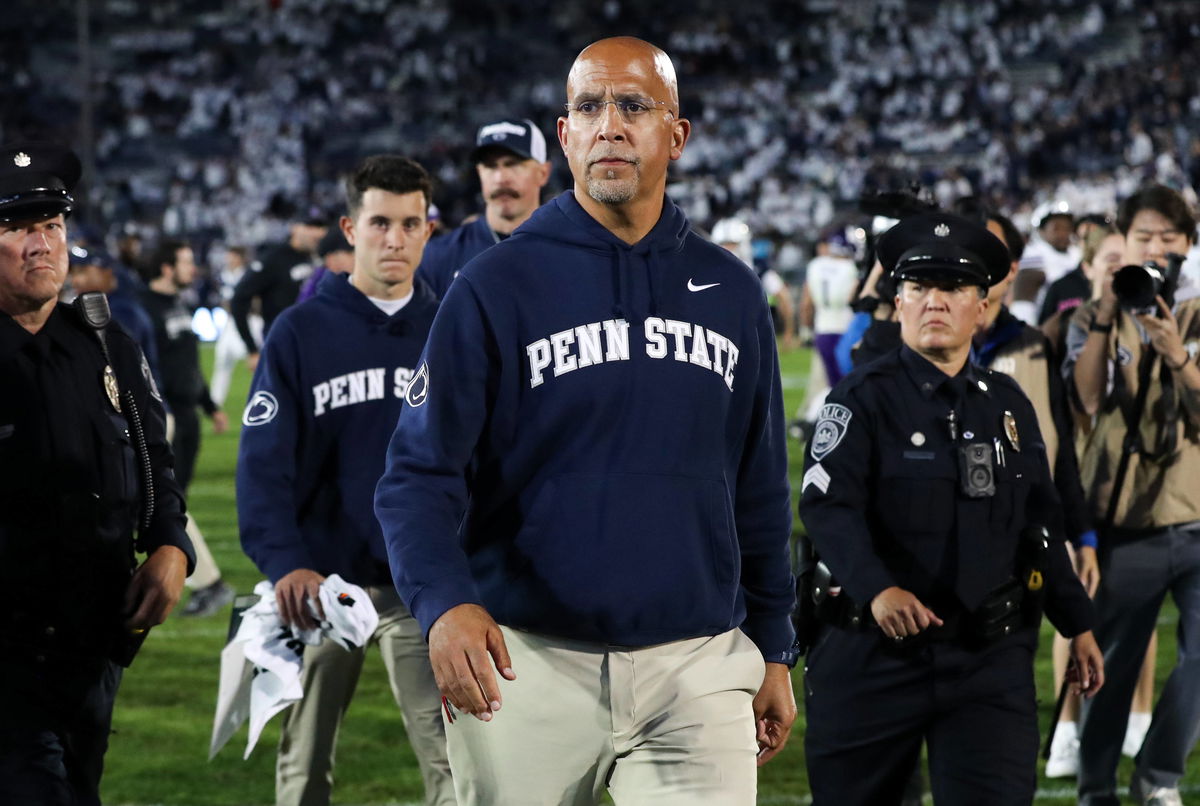
Ohio State won the 2024 national title thanks to great coaching in the playoffs. However, it also helped the Buckeyes that they had $20 million to assemble the roster. James Franklin didn’t have the same luxury at Penn State.
Watch What’s Trending Now!
The Lions made it to the playoffs in 2024 with a roster assembled for $7 million. That seems remarkable considering programs are now spending $35 million to build their teams. But that ability to build a great team despite lacking significant funds didn’t help Franklin when things went south last season. The former Lions head coach now believes that the Happy Valley program wasn’t always ‘honest’ with him.
Franklin, in his interview with On3‘s Pete Nakos, said he was kept in the dark about other programs’ roster spending at Penn State. Trying to find what his Big 10 rivals were spending seemed like a “taboo.” It was only after he was fired last year and when other programs approached him for his services that he got a clearer picture. During the whole process, the programs were transparent about their roster spending and laid out extensive investment plans.
“Now they’re telling me exactly what they had, exactly what they think they want to do moving forward, and now I’m getting information that I was never able to get,” Franklin said. Despite that, Franklin carries no regrets or hard feelings toward Penn State. “I don’t want to ever sound like sour grapes, because I’m very appreciative of my time.”
Trying to win with $7 million was like swimming with both hands tied behind the back. And Franklin was probably doing just that at Penn State. That realization was the reason the former PSU head coach accepted the Virginia Tech job, even if he had to forgo a large portion of his $49 million buyout money.

NEW: James Franklin tells @PeteNakos his track record is selling his Virginia Tech vision📈 “We’re not a first-time head coach trying to share a story that there’s no evidence for. We’ve got a ton of evidence. We’ve done it in the SEC, we’ve done it in the Big Ten, and we’re Show more

“The first thing that has to happen is you’ve got to give yourself even a chance to be competitive, and what was happening here in the past compared to what we’re doing now, is that it’s given us a chance to be competitive,” Franklin added. “There’s a difference between being competitive and saying you want to legitimately compete for championships. There are only a handful of schools that year in and year out are really trying to win a championship.”
In 2025, Franklin did get a competitive NIL budget at Penn State, but it was still far less than the programs that were in the NIL arms race since 2021. Ideally, the results might have taken one or two more years to come; instead, Penn State piled on the pressure, not giving him time to adjust. Suddenly, the conversations in the locker room weren’t about winning the next game. But about the NIL rankings, expectations, and the pressure of making it to the playoffs.
“We made some philosophical tweaks and changes to be more aggressive and maybe more aware of these types of things,” Franklin said to ON3’s Andy Staples in April. “We allowed the players to have conversations and allowed the staff to have conversations that we typically hadn’t had in the past.”
Amid that pressure, Penn State’s locker room fractured, and everything Franklin had built over the last 11 years started to fall like a house of cards. While most people saw those Oregon, UCLA, and Northwestern losses as the reasons behind Franklin’s firing, the reality was more complex. A lot happened in the background, and Penn State lost a head coach it had cherished for more than a decade. But now, Franklin is at Virginia Tech, and the environment is wholly different.
James Franklin lays out his plans for Virginia Tech’s future
Virginia Tech’s hiring of Franklin was part of its ‘Invest to Win’ plan, which included an annual salary of $8.2 million. Through its plan, VT plans to invest a whopping $229 million in the athletic department over four years, and Franklin is promised a top NIL budget to build his roster. Additionally, Franklin’s impact at Virginia Tech is looking quite intense after he pulled off a 20th-ranked recruiting class in just a month after arriving in Blacksburg.
Because of Franklin’s impact in such a short period, donor confidence is also at an all-time high. The program has already received two massive donations of $20 million and $75 million after Franklin arrived, and much more seems to be in the pipeline. Now, entering a new chapter at Virginia Tech, Franklin wants to avoid the mistakes he made at Penn State.
“It’s easy to point the finger at Justin Fuente and point the finger at Brent Pry, but were they getting the same resources that we’re getting?” Franklin added. “Are people open to making philosophical changes here and not just doing things because that’s how they’ve always done them? I want Coach Beamer to watch the games on TV.
“I want Bud Foster. I want Michael Vick. I want Bruce Smith. I want all those great players to watch us and say, ‘That’s Virginia Tech football. That’s what it’s supposed to look like.’”
He intends to be much more involved in the offense and has welcomed the old guard (Brent Pry) to his staff. Hopefully, it all should work out for Franklin in Blacksburg with patience and hard work. The program’s last 10-win season came in 2016, a year in which the Hokies also reached the ACC title game.