
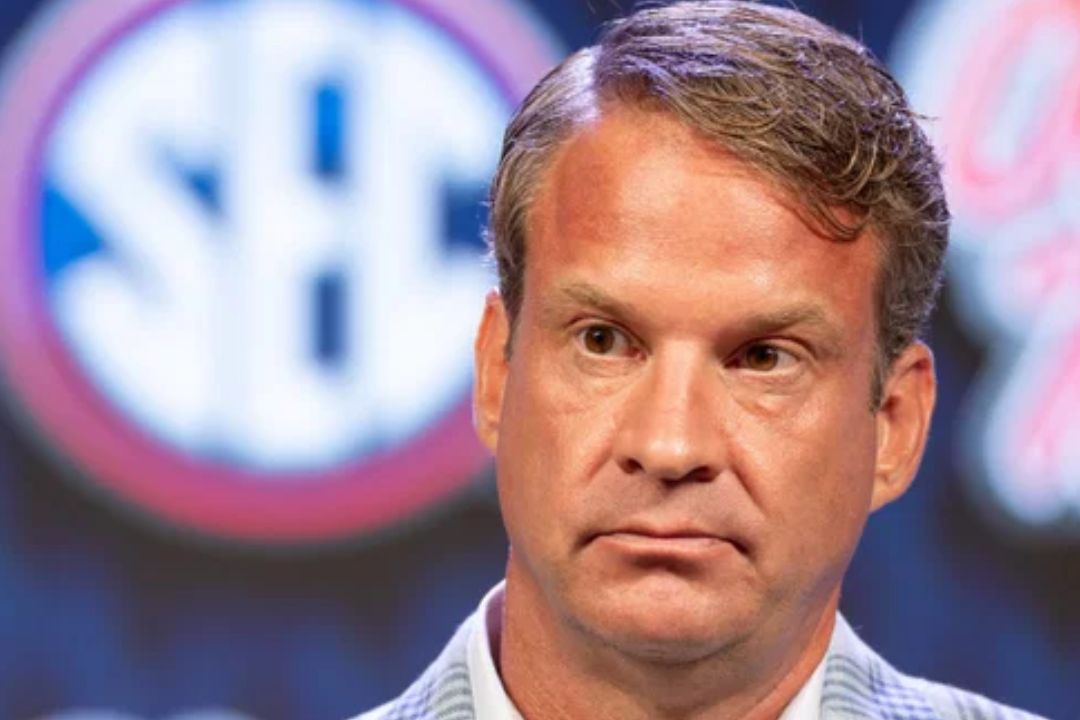
For years, Lane Kiffin looked like the most talented coach in college football who still carried a giant question mark behind his name. That question followed him from job to job. When LSU handed him a seven-year deal worth roughly $90 million, even athletic director Verge Ausberry admitted he wondered whether Kiffin was truly ready for one of the hardest jobs in America. Ausberry had already watched Kiffin for years and kept returning to the same thought.
Watch What’s Trending Now!
“I was watching his team, and I watched his team over the years, and Lane tells you at times when people brought him to me, I was like, you know, is he ready for the position? Is he ready for the job?” Verge Ausberry said on the Bayou podcast with Tyrann Mathieu. “He talks about his personal life and how he matured as a person to be able to lead a program like LSU.”
The doubts didn’t come from football knowledge. Kiffin’s offensive record was never a question. The concerns came from his past. At the Oakland Raiders, owner Al Davis fired him after a public feud in 2008. In Tennessee, he stayed only one season before leaving for USC, angering fans in Knoxville. Then came the infamous airport firing by USC in 2013 after a 3-2 start. Around college football, Kiffin developed a reputation for drama, short stays, and headlines.
His years under Nick Saban at Alabama changed that image. Kiffin rebuilt his reputation as offensive coordinator from 2014 through 2016 and helped modernize Alabama’s offense. Later, he won conference titles at Florida Atlantic before transforming Ole Miss into one of the SEC’s most consistent contenders.
Across six seasons in Oxford, Kiffin won 55 games, led the Rebels to multiple 10-win campaigns, and guided the program to multiple College Football Playoff appearances, cementing himself as one of the conference’s most successful coaches. Suddenly, people saw a different coach. Older. Calmer. More patient. Ausberry, though, still needed convincing.
“It takes a special person to lead this program,” Ausberry said. “LSU is a two-hand on 18-wheeler type job. Not only the excellent O’s but everything that’s involved with it. And we talked about the culture of the program, talked about the people. Talking about connecting to the former players, connecting to the alumni, the donors, the base. So it [takes a] special man to lead this program, and it’s a tough program to lead. Expectations here are to win.”
The actual hiring process was surprisingly short. Ausberry said the formal interview lasted only about one hour and twenty minutes. The real evaluation had happened long before that meeting. LSU had watched Kiffin’s teams for years. Administrators studied how his Ole Miss program operated. How players responded to him and how he handled pressure in the SEC. After the interview, both sides stayed in constant contact until LSU finalized the agreement.
But you know, Kiffin was not LSU’s only option.
Lane Kiffin wasn’t the only person LSU was considering for the head coaching job
Multiple reports linked LSU to coaches like Dan Lanning, Mike Norvell, and James Franklin during the search. LSU also understood that Florida was aggressively pursuing Kiffin, believing any delay could cost them one of the hottest coaching candidates on the market.
Ultimately, LSU decided Kiffin was worth making one of the biggest financial commitments in college football. The Tigers weren’t simply paying for an elite play-caller, they were investing in a coach they believed had matured into someone capable of leading one of the sport’s premier programs.
Kiffin has consistently produced elite offenses and developed quarterbacks throughout his coaching career. Ole Miss finished among the nation’s top offensive teams multiple times under his leadership, and LSU believes its resources can help elevate those results even further. LSU can also offer support Kiffin never had in Oxford, including a larger NIL structure and deeper recruiting infrastructure. Reports indicated the school committed more than $25 million annually toward roster building and NIL efforts to keep the program competitive in the modern recruiting landscape.
The contract itself reflected just how determined LSU was to land Kiffin. Along with the seven-year, $91 million commitment, the deal reportedly included a substantial guaranteed buyout and performance-based incentives, showing the program’s confidence that he was the right coach to restore LSU to national championship contention, despite all the previous doubts.