
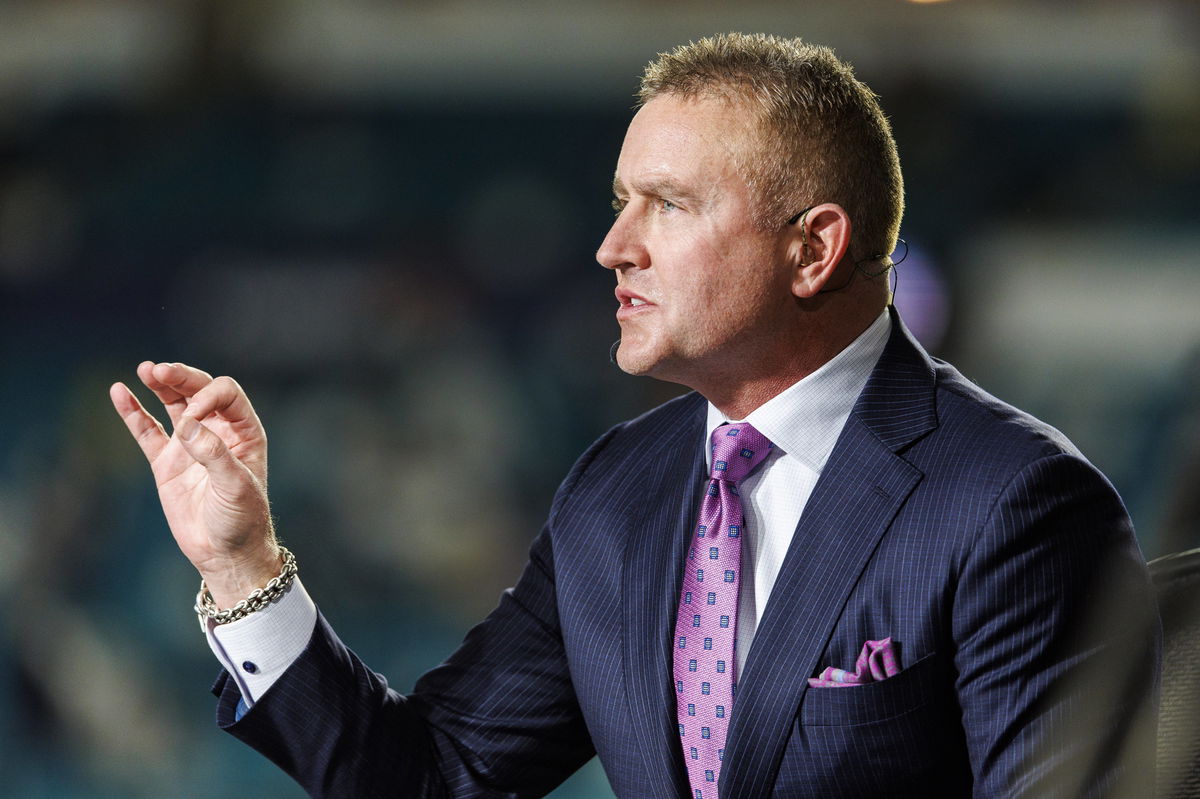
Texas is currently leading the Vols 10-3 in the first half at the Neyland Stadium. There have been no in-game communication issues so far. However, the same can’t be said for ESPN’s Kirk Herbstreit, who hasn’t had a smooth sailing in the booth today. First, he was mocked for his botched makeup. Now the audio is giving him a hard time.
Watch What’s Trending Now!
The ABC/ESPN broadcast booth suffered a major audio failure early in the first quarter of the ongoing Texas vs. Tennessee matchup. In a bizarre twist of irony, the blunder occurred right as Kirk Herbstreit and play-by-play announcer Chris Fowler were talking about in-game issues with communication.
“Trying to respond to that, I apologize for the audio problems,” Herbstreit said during the game as the audio went static. “I don’t know if you’re hearing that on the air, but it’s incredibly staticky. Michelle will try to get that fixed as soon as possible.”
The technical breakdown completely derailed the broadcast during a critical moment. There was only 9:54 left in the first quarter, and Texas was leading 7-0. The live broadcast feed was suddenly plagued by heavy static and completely garbled audio.
As production staff scrambled to fix the issues behind the scenes, Fowler’s microphone picked him up. They were instructing a helpless Herbstreit to “be quiet for a minute” until they could successfully restore clean audio to the booth.
Fortunately, the audio issues were soon resolved, and Fowler and Herbstreit didn’t seem to have similar woes in the second quarter of the game.
Before the game started, there was a lot of noise about the communication, something which also happened in the national championship game. These issues facing Texas and Tennessee stem entirely from Secret Service electronic security protocols.
Texas head coach Steve Sarkisian detailed what goes on during the game. Whenever a sitting U.S. president moves within a venue, federal security details temporarily scramble nearby wireless frequencies to prevent tracking or remote security risks. The wireless jamming completely severs the coach-to-coach headset channels.
The frequency blocks disrupt the coach-to-player radio signals built into the helmets of quarterbacks and defensive captains. This prevents coaches from verbally feeding play calls to their players on the field as the play clock winds down. Coaches are provided with no advanced alerts prior to a frequency drop.
If the president arrives, departs, or leaves his luxury box to move around the stadium, it will hinder the comms. However, Laura Rutledge cleared up that the teams and secret services have found a common ground.
“Well, Chris, you mentioned some of the communication could be affected when President Trump moves in this stadium,” Rutledge said on the broadcast. “But I have confirmation from both teams, Texas and Tennessee, that they’ve worked with the Secret Service to make sure that their radio frequencies are cleared with the Secret Service. They think that the comms should be perfectly okay, coach to coach.”
Stadium logistics were also impacted. The University of Tennessee opened the gates at Neyland Stadium 30 minutes earlier than normal. This had to be done to accommodate extensive Secret Service perimeter screening. This created long wait times outside before kickoff.