
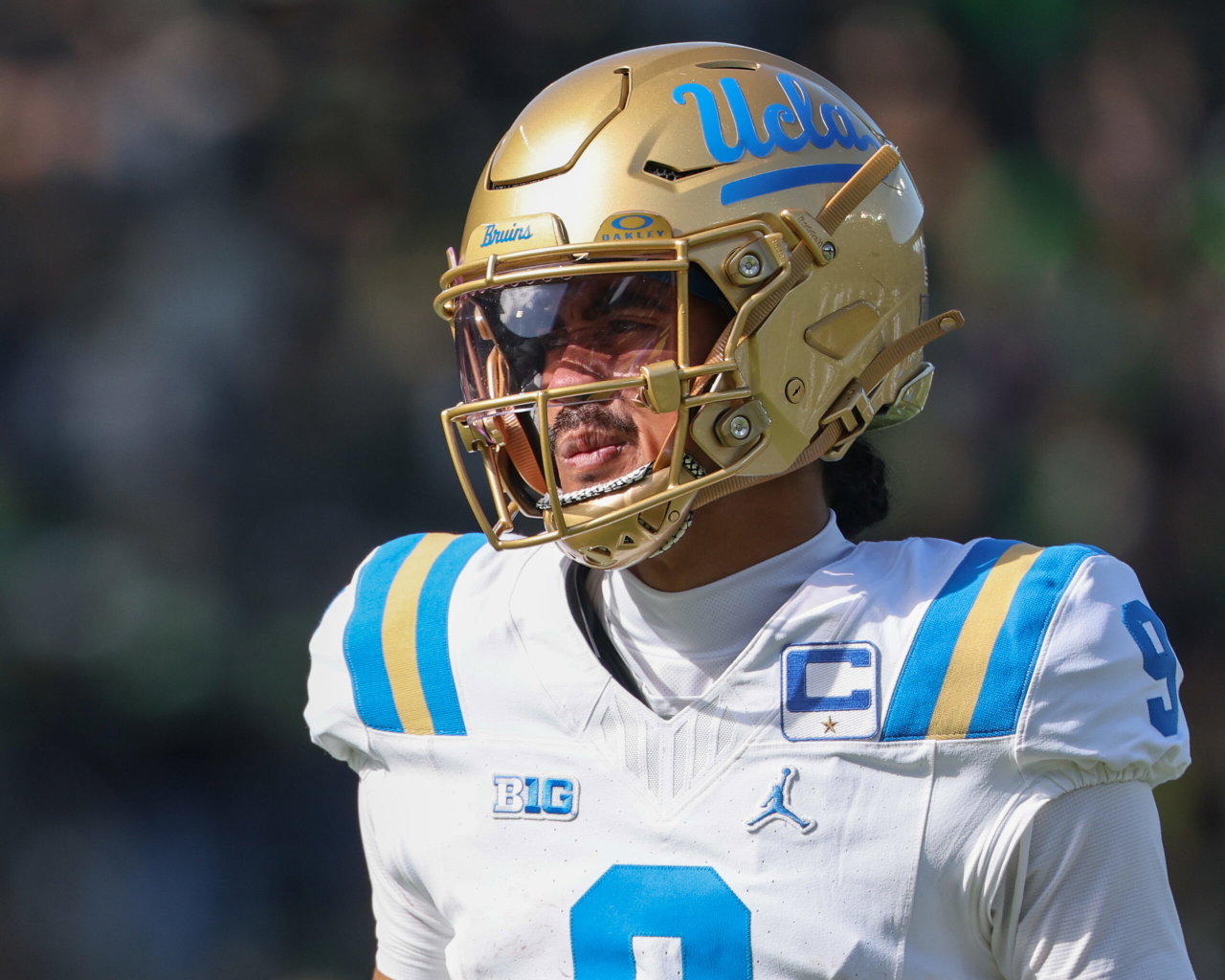
With 37 seconds left in the first half, Nico Iamaleava scrambled on first-and-10 from Oregon’s 27-yard line, picking up five yards before Bear Alexander and Jerry Mixon brought him down at the 22. On the stat sheet, it was an unremarkable gain. UCLA had moved deeper into Oregon territory with time left to add to its lead, and the play appeared to be another step in the drive.
Watch What’s Trending Now!
Then the possession unravelled. Backup Ty Dieffenbach came in for the next snap but threw an incompletion. Iamaleava returned on third down and threw an interception in the end zone, his second pick of the half and third turnover of the game. UCLA had come away without points. Yet the five-yard scramble that preceded those plays would draw attention for something the box score never recorded. Replays appeared to show Alexander twisting Iamaleava’s helmet before making a striking motion toward the quarterback’s head after he hit the turf.
“Nico Iamaleava took a BEATING,” the Brandon Walker College Football Show posted on X on October 11.
The broadcast reportedly replayed the exchange several times without the commentators addressing it, a silence that further frustrated viewers. The missed call also invited an uncomfortable comparison with Oregon’s response to a separate incident just two weeks earlier.
When USC linebacker Desman Stephens II hit Dante Moore as the Oregon quarterback attempted to slide, Stephens was ejected for targeting, and USC subsequently suspended him for one game. Oregon coach Dan Lanning condemned the play as “a disgusting play” and added, “Our guys respect the game. I don’t think you’d ever see that from our players. I don’t think you’d ever see that from our coaches.”
The footage involving Alexander and Mixon requires a distinction of its own. Mixon appeared to make a punching motion as he helped bring Iamaleava down, but his hand did not appear to connect, and the movement looked more like an attempt to dislodge the ball. Alexander’s right hand, meanwhile, appeared to strike Iamaleava’s facemask and jolt his helmet after the quarterback was already on the ground. Whether Alexander intended to hit the quarterback or knock the ball loose cannot be established from the clip alone. The apparent contact, and when it occurred, are what made his actions the focus of the backlash.
Dean Ralsky also questioned the lack of a call. “Disgusting late hit (punch) from Oregon DT Bear Alexander on UCLA QB Nico Iamaleava. No flag from the refs; they didn’t see it,” Ralsky posted on X.
The reaction quickly moved beyond the replay itself. Viewers questioned why Alexander had not been penalized or ejected, while others called for the Big Ten to consider a suspension. The officials’ failure to call a foul in real time does not, however, establish whether the conference will review the footage or take subsequent action.
The controversy coincided with a separate concern for UCLA. Iamaleava grabbed his left leg after the tackle and needed help from the Bruins’ training staff to get up. Although he returned to the field for the next sequence, he did not play after halftime. The leg injury was confirmed by UCLA, but the available reporting did not establish that Alexander’s apparent contact with the quarterback’s head caused it.
After the game, UCLA coach Bob Chesney made it clear that the quarterback’s absence wasn’t simply a coaching decision.
“Nico wasn’t close to being able to come back today,” Chesney said. “I thought he got hit in the thigh, but there might be a little more to it. We’ll have to figure that out as we go through the process tonight and tomorrow.”
Iamaleava finished the first half with 10 completions on 17 attempts for 162 yards. His two interceptions and earlier lost fumble had hurt UCLA’s scoring chances, but the injury provided the immediate reason for his absence after halftime. Without a more specific medical update, it would be inaccurate to connect his leg problem directly to the apparent head strike or suggest that he was benched for his performance.
With Iamaleava unavailable, UCLA turned to senior Ty Dieffenbach, who was making his debut for the Bruins. His route to the moment had taken him through two seasons at Pittsburgh and another at Cal Poly, where he made his first college start. In that season at Cal Poly, he completed 92 of 162 passes for 1,305 yards, nine touchdowns and nine interceptions.
Dieffenbach said he and Madden Iamaleava had split the backup quarterback repetitions during the week. Coaches told him on the field that he was going in when Nico could not return. Chesney later explained that the game plan left room for more quarterback rushing, an area in which Dieffenbach had impressed during practice. He stopped short of declaring Dieffenbach the permanent backup, saying Madden would continue competing for the role.
Dieffenbach completed three of six passes for 43 yards, including a nine-yard touchdown to Wayne Knight with 13:31 remaining in the fourth quarter. Knight had already given UCLA a lead with a 35-yard rushing touchdown in the second quarter and finished with 103 rushing yards. His receiving touchdown extended the Bruins’ advantage to 17-6, giving the defense more room to protect the lead despite the change at quarterback.
UCLA’s seven takeaways were central to the win. The official box score records five lost Oregon fumbles and two Oregon interceptions, while the Bruins also gave the ball away three times, bringing the game’s total to 10 turnovers. Chesney pointed to the defensive effort afterward: “I think we walked out of here today with seven of them, and I think that’s a pretty big deal.”
Oregon wasn’t finished. Brock Thomas connected with Evan Stewart on a 44-yard touchdown pass, cutting the deficit to 17-15 with 2:16 remaining. Thomas’s initial two-point conversion attempt failed, but a UCLA facemask penalty moved the ball to the one-yard line and gave Oregon another chance. Jordan Davison was stopped on the second attempt, leaving the Ducks two points behind.
UCLA still had to survive one final possession. After the Bruins punted with 48 seconds remaining, Oregon started at its own five-yard line. With four seconds left on fourth-and-10, Thomas completed a 30-yard pass to Stewart, who lateraled to Jamari Johnson. Johnson fumbled at the UCLA 33, and UCLA recovered to seal the 17-15 win.
Oregon’s quarterback problems had contributed to the collapse. With Moore still sidelined after his concussion against USC, Dylan Raiola started against UCLA but completed just six of 19 passes for 43 yards and threw two interceptions before Thomas took over. The Ducks had been unable to compensate for their mistakes consistently, even when their defense kept the game within reach.
The defeat dropped Oregon to 3-2 overall and 1-1 in Big Ten play ahead of its matchup with Nebraska on October 17. Meanwhile, UCLA improved to 5-0 overall and 3-0 in the conference. The unbeaten Bruins are due to host Wisconsin on October 17, with Iamaleava’s availability still uncertain. He had thrown for 820 yards and four touchdowns this season entering the next stage of UCLA’s schedule. Chesney said the backup quarterback decision would remain a week-to-week process rather than committing to Dieffenbach as the permanent next man up.
The fallout from the play now extends beyond the missed call itself. Lanning’s earlier comments about respect for the game have become part of the reaction to Alexander’s apparent strike, placing Oregon in the uncomfortable position of facing questions about conduct it had recently condemned in an opponent. The two incidents were not identical: Stephens was ejected for targeting, while no penalty was called on Alexander. But the contrast has given critics a reason to ask whether Oregon will apply the same standard to its own players.
The Big Ten has the authority to investigate potential sportsmanship violations and impose standard disciplinary action, which reporting describes as including a suspension of up to two games and a $10,000 fine. More severe punishment would require further conference approval. That authority does not mean Alexander has been suspended or that the league has announced a decision in this case.
For UCLA, the immediate priority is determining when Iamaleava can return. Oregon, meanwhile, must prepare for Nebraska while facing questions about a play that went unpenalized during a 17-15 loss and continued to draw attention after the final whistle.