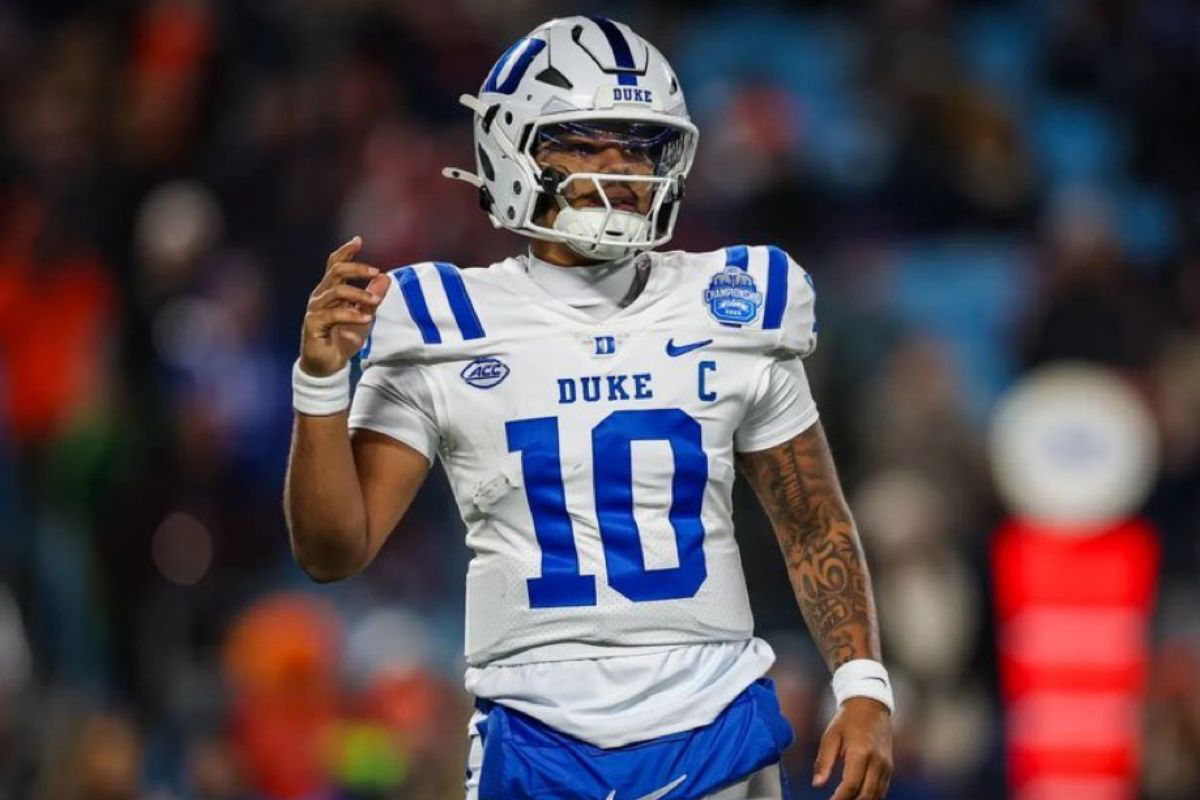
Darian Mensah’s dreams of joining Miami just hit a major legal roadblock. And according to one prominent attorney’s analysis, the news isn’t looking good for the star quarterback.

Duke University sued Darian Mensah on Tuesday after he announced his intention to transfer. They requested a temporary restraining order and injunction to prevent Mensah from entering the portal or signing with another school. North Carolina attorney David McKenzie, who has analyzed the contract in detail, believes Duke has clearly gained the upper hand in this legal battle.
Watch What’s Trending Now!
McKenzie posted a legal breakdown on X, starting with a straightforward conclusion about the case. “I think Duke wins this dispute on the merits, and it probably won’t be close,” McKenzie wrote. According to his analysis, Mensah agreed to give Duke exclusive rights to his name, image, and likeness for higher education and football through the end of 2026. He promised not to enroll at or compete for another institution, agreed not to initiate contact with other schools, and committed to notifying Duke within 48 hours of any contact from other institutions.
“He then, by all appearances, did exactly what he promised not to do, reportedly negotiating with Miami, announcing his departure on social media, and requesting entry into the transfer portal, all without the notice the contract required,” McKenzie explained. The attorney concluded that “contracts mean something. Or at least they should.”
Despite finishing the regular season with a 7–5 record, Duke finished first in a five-way tie for second place in the ACC with a 6–2 conference record. This got them a spot in the ACC championship game, where they upset Virginia in overtime and won their first ACC title since 1989. Mensah’s playmaking was a big part of this. He closed out the regular season completing 67.9 percent of his passes for 3,646 yards, 30 touchdown passes, and five interceptions. Letting him go would be a huge blow for the program.
Duke v. Mensah: A Hot Take on the NIL Contract Fight of the Year
Let me start with the bottom line: I think Duke wins this dispute on the merits, and it probably won’t be close. The contract is clear. Mensah agreed to an exclusive license of his NIL rights in higher education… pic.twitter.com/rUeI13YaPe
— David McKenzie (@mckenzielaw) January 20, 2026
What makes this contract particularly troubling for Darian Mensah is what McKenzie calls its “remarkable asymmetry.” It basically means that the rules are different depending on who breaks the deal. The contract includes a specific section where Mensah acknowledged that any breach on his part would cause Duke “irreparable harm for which there is no adequate remedy at law.” This is legal language that opens the door for a court to step in and stop him from playing elsewhere. But if Duke breaches the contract, Mensah’s only option is to seek money damages through arbitration. And he cannot in any way interfere with or stop Duke from using his name, image, and likeness.
This one-way enforcement mechanism raises an important question. Will a court actually enforce such an uneven agreement against a college athlete who signed what amounts to a take-it-or-leave-it contract? McKenzie suspects the answer is yes. But there’s a catch.
A brilliant twist in the case
Duke has issued an official statement on the Darian Mensah fiasco: “Mr. Mensah has an existing contract with Duke, which the university intends to honor, and we expect he will do the same. The court-ordered temporary restraining order (TRO) issued yesterday ensures he does not violate his contract. The university is committed to supporting all of our student-athletes, while expecting each of them to abide by their contractual obligations.” But there’s an ironic twist in Duke’s lawsuit that might actually work against the university’s request to stop Mensah from transferring.
Duke’s complaint emphasizes “irreparable harm” and argues that money alone can’t fix the damage if Mensah leaves. This is exactly what they need to prove to get a court order blocking his transfer.
But the contract itself tells a different story. According to McKenzie’s reading, the agreement caps either party’s total liability at “the total value of all consideration provided by Duke to Student-Athlete under this License,” which is approximately $4 million. The parties also waived any claims for consequential damages, lost profits, or other indirect harm. In simpler terms, the contract basically says that if Mensah breaks the deal, Duke’s maximum recovery is the $4 million they paid him.
McKenzie points out that this isn’t some arbitrary number. It’s what both sides agreed that Darian Mensah’s exclusive NIL rights were worth when they negotiated the contract. When Mensah walks away and licenses those same rights to Miami or another school, Duke loses exactly what they paid for. The problem for Duke is that if a court can easily calculate the damages at $4 million. And if Mensah could theoretically pay that amount back (especially if he’s about to sign a bigger deal with Miami), then where’s the “irreparable harm” that justifies freezing his career? Traditional legal principles say that if money can make you whole, you don’t get the extraordinary remedy of an injunction.
The February 2nd hearing will determine whether Mensah can move forward with his transfer plans or remain stuck at Duke for the remainder of his contract. This case represents the first known instance of a school suing its own player to prevent the athlete’s departure.
This situation follows another high profile QB controversy with Demond Williams and the Huskies. But that got ruled in favor of the Huskies without the matter reaching the court system. However, the outcome of Mensah’s case can set a precedent on the level of contractual liability enforced upon these college athletes in the NIL era.
Written by

Edited by

Aatreyi Sarkar