
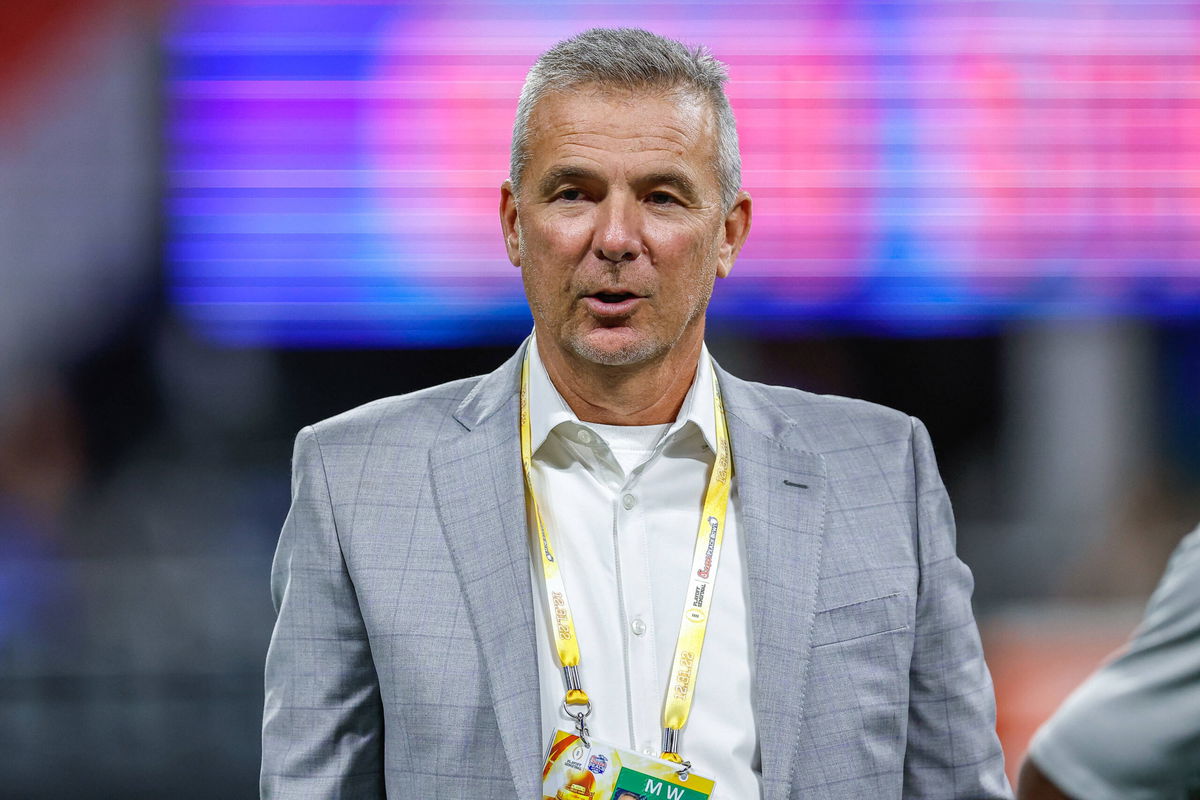
Urban Meyer represents so many great things in college football: a Hall of Famer with multiple national titles and a proven coaching philosophy and a mentor to other great coaches. But he was also a sore loser. Unfortunately, this part of him seemed to have a halo effect on his career, as his approach to losses ultimately led to his retirement.
Watch What’s Trending Now!
“I wasn’t great at that,” Meyer told Dan Lappin about how he handled losses on the Breaking Sales podcast. “I’ve had some strengths in my life, and then, I’ve had some weaknesses. And another reason why I just didn’t survive… Some of these guys coach till they’re 70 years old. I knew when I hit 55, I was done. Because a loss took my soul away, especially a loss where I knew that we shouldn’t have lost. I wasn’t good at blaming others. People lose games, and they fire the coaches. I never did that. I just would always stake it on myself; it was my fault.
“Resiliency to bounce back from a loss was something I really struggled with. Fortunately, we didn’t lose a lot or lose two in a row very often, but I admired people and tried to study them that were resilient in that way. And that was not a strength of mine.”
Meyer retired from college football with a winning percentage that was over 80%. At Ohio State, he never had a season with more than 2 losses. The worst record in his career was 8-5 at the Gators in his final year in Gainesville. However, it seemed like only a 100% winning record would have given him a prolonged career.
The former Ohio State head coach was unable to separate his coaching career from other aspects of his life. They were all wrapped into one, as every other thing suffered as a result—family, physical, and mental health. His 32 career losses had a greater impact on him than his 187 wins. It was after one such loss that Meyer was forced to retire from the game.
After a defeat in the SEC Championship Game against Alabama in 2009, Meyer experienced severe chest pain, collapsed at home, and was unresponsive for a while. His wife, Shelley, had to call emergency services to help save his life. He stubbornly returned to the sidelines afterward.
One of the signs of great coaches is their understanding of their strengths and weaknesses, with the aim of having others help cover these weaknesses. The self-aware Meyer often had assistant coaches in his programs who were better at handling defeat than he was. At Gainesville, he had Dan Mullen as his offensive coordinator and QB coach. Mullen was the kind of assistant who would do anything else with a loss but blame himself and let it affect him the same way it affected Meyer.
At Utah, Meyer had Whittingham as his defensive coordinator. While Whittingham would always acknowledge his mistakes, he handled losses with composure. Meyer retired from college football eight years ago, but his former Utah assistant is still going on at Ann Arbor.