Imago
Via Imagn
Imago
Via Imagn
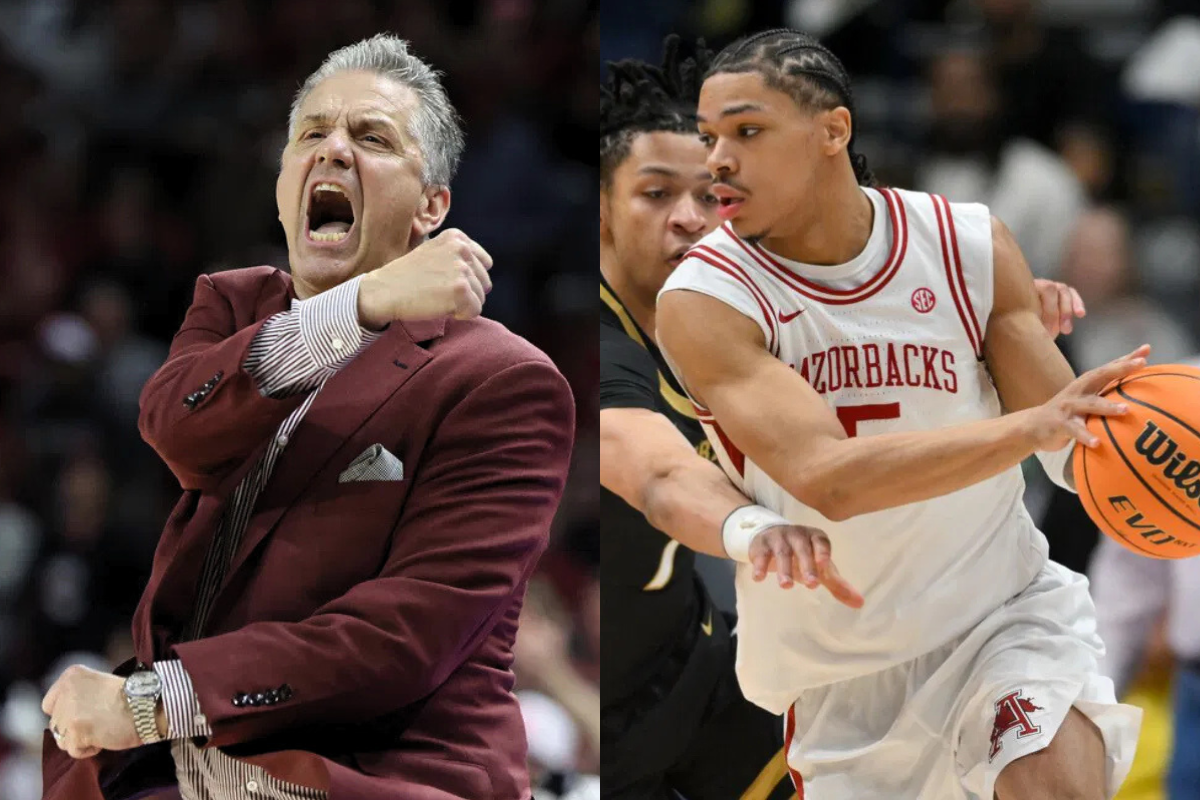
This wasn’t the kind of March moment John Calipari had in mind. The stakes were clear, the stage was set, and yet the margin for error disappeared almost instantly inside SAP Center.


Arizona Wildcats overwhelmed Arkansas Razorbacks 109–88 on March 26 in San Jose, ending Arkansas’ tournament run in a game that slipped away far earlier than the final score suggests.
Watch What’s Trending Now!
Still, even as the loss unfolded, Calipari’s focus turned somewhere else. He singled out one name postgame: Darius Acuff Jr. And while the scoreboard told one story, his message about the freshman guard told another.
“He was the ultimate competitor, had a will to win, would make baskets because he wasn’t afraid to miss late in games.” That praise didn’t come out of nowhere. Acuff led Arkansas with 28 points in what could be his final college appearance, continuing a season where he consistently carried the Razorbacks on his shoulders.
John Calipari reflects on Darius Acuff Jr. and his group after Arkansas’ Sweet 16 run comes to an end. pic.twitter.com/pmDIJrecZA
— FOX College Hoops (@CBBonFOX) March 27, 2026
However, his impact extends far beyond a single Sweet 16 night. Throughout the season, Acuff didn’t just play like a top freshman; he became the engine of Arkansas’ entire offense.
He averaged 23.3 points and 6.5 assists per game, becoming the first SEC player since Pete Maravich to lead the conference in both categories in a single season. At the same time, his tournament run only strengthened that case. Acuff poured in 88 points across three NCAA Tournament games, including a 36-point outing in the second round, proving he could scale up when the stakes rose.
Even as Arkansas struggled to keep pace against Arizona, his production never dipped. That consistency is exactly why ESPN projects him as the No. 8 overall prospect and the top guard in the upcoming NBA Draft.
Still, Calipari’s message went deeper than numbers. “He was the ultimate competitor, he had a will to win. He would make baskets because he wasn’t afraid to miss late in games.”
That framing matters because it aligns with a pattern. Calipari has built his reputation on developing elite freshmen who transition quickly to the next level, and Acuff now fits that mold as another potential one-and-done cornerstone. At the same time, the coach made it clear this wasn’t just about individual output. It was about setting a standard for what comes next in the program.
Arizona’s Dominance Exposes the Gap
Meanwhile, the game itself told a far harsher story for Arkansas. Arizona set the tone early and never gave it back, leading 54–43 at halftime before pulling away even further in the second half.
Arizona shot over 60% from the field and had six players score in double figures, showcasing a level of balance and efficiency Arkansas simply couldn’t disrupt. Because of that, every defensive adjustment came a step too late. Brayden Burries led the charge with 23 points, while Koa Peat added a 14-point, 10-rebound performance to keep the pressure constant.
At the same time, the Razorbacks began to unravel. Billy Richmond III was ejected after a flagrant-2 foul midway through the second half, and technical fouls followed as frustration mounted. “I’m sick that we lost this game, that I couldn’t do more to try to make it closer.”
Calipari didn’t stop there. “But let me just say this, Arizona was way better than us today. I didn’t think they’d be way better… but they’re good. They’re a very well-coached team.” That admission underscores the gap exposed on this stage. Arizona didn’t just win; they controlled every phase of the game with precision and depth.
Imago
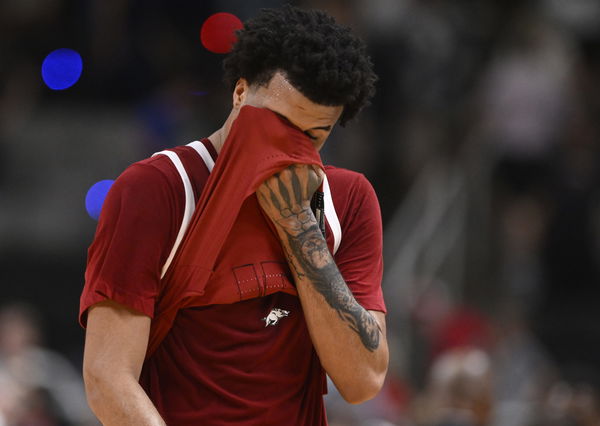
Mar 26, 2026; San Jose, CA, USA; Arkansas Razorbacks forward Malique Ewin (12) reacts after losing to the Arizona Wildcats in a Sweet Sixteen game of the West Regional of the men’s 2026 NCAA Tournament at SAP Center. Mandatory Credit: Eakin Howard-Imagn Images
Still, even in defeat, Calipari’s closing message centered on growth and foundation rather than frustration. “I hugged each of them after, told them I loved them.”
“What you did for us and how much I appreciate what you did for this program, our state, and the university.” That tone matters because it shifts the story forward. Arkansas finishes its season at 28–9, while Arizona advances to face Purdue Boilermakers in the Elite Eight.
For Arkansas, the bigger question now surrounds Acuff. He still has three years of eligibility, yet his draft projection places him firmly in lottery territory, making this performance potentially his final one in a Razorbacks uniform.
If that’s the case, he didn’t go quietly. He delivered 28 points in a blowout, capped a historically productive freshman season, and earned the kind of praise Calipari has reserved for players ready for the next level. Arizona moves on. Arkansas resets. But the standard, as Calipari made clear, has already been set.
Written by

Edited by

Ved Vaze