
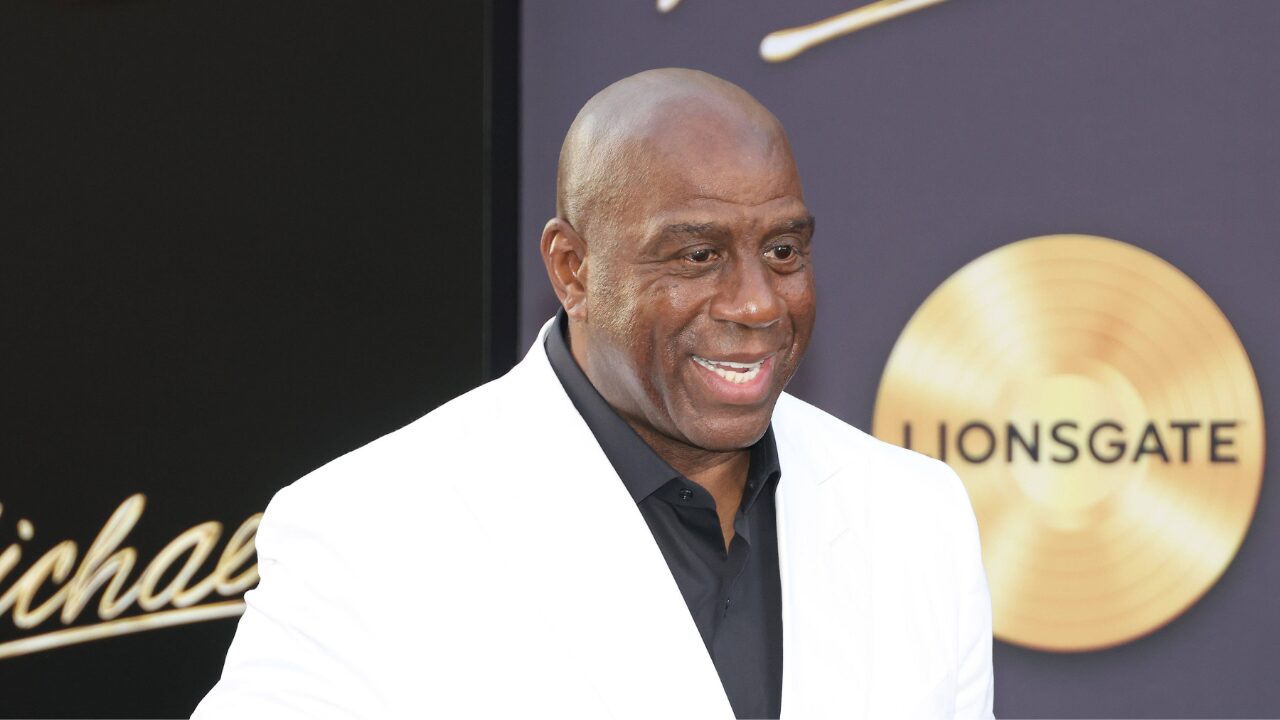
On November 7, 1991, Cookie Johnson stood beside her husband at a press conference that would change their lives forever. While the Los Angeles Lakers legend prepared to tell the world about his HIV diagnosis, Cookie had made a choice about what she would wear that day. She picked a white suit, hoping to represent something that neither of them knew they would have in the years ahead: a future.
Watch What’s Trending Now!
“I wore that white suit for a reason. I didn’t want to wear anything dark or black because to me, it’s what it symbolized,” Cookie later explained. “And the white suit, to me, symbolized brightness, like a future basically [and] positivity.”
At the time, Magic Johnson was just 32 years old, had already won five NBA championships, and was one of the biggest names in basketball. Now, 35 years after announcing his HIV diagnosis, the Lakers legend has shared an emotional life update, crediting his faith for the journey and expressing gratitude for everything he has experienced since that day. “Look at how far God has brought me since my HIV announcement 35 years ago! It is truly because of His grace and mercy that I am still here and thriving,” Johnson wrote on X.
The post continued with Johnson reflecting on the opportunities he had received and the people who had supported him. He spoke about God’s guidance, the prayers of his family, friends and fans, and how he had continued to believe in the future even when life presented him with an unexpected challenge.
But the day that changed everything had arrived much sooner than anyone could have imagined. Johnson had reportedly discovered his HIV status just one day before the announcement, after undergoing a test required for a life insurance policy. He had married Cookie in September 1991, and the couple had recently learned that they were expecting a child.
The diagnosis left them facing a future they had never prepared for. Magic later revealed that telling his wife was harder than anything he had experienced throughout his basketball career. Despite playing in nine NBA Finals, nothing compared to the pressure of having to share that news with her.
“There was no greater pressure than driving home to tell her,” Johnson recalled.
Cookie initially feared that the diagnosis meant she could lose her husband. She also worried about the stigma surrounding HIV, particularly at a time when many people did not understand how the virus was transmitted. The couple had to wait for her test results, with their unborn child’s health also weighing heavily on their minds.
Magic later described the moment they received the results as a turning point. Cookie and their baby were fine, allowing him to focus on his own health and the difficult road ahead. Yet, even with that reassurance, the couple still had to decide how much of their private struggle they were willing to share with the world.
Cookie initially opposed the idea of holding a press conference. She feared that people would treat them differently because of his diagnosis, explaining that many were still unaware that HIV could not be transmitted through ordinary physical contact.
“I didn’t want people to treat us like we were lepers,” she said.
Nevertheless, she stood beside Magic as he made his announcement. Johnson immediately made it clear that he was HIV-positive, not suffering from AIDS, and that his wife had tested negative. He also refused to let the diagnosis define what remained of his life.
“This is not like my life is over, because it’s not. I’ll live on. I’ll work out, I’ll be like one of the old-timers in a sense,” he told reporters.
He also delivered a message that would become closely associated with his announcement. “I’m going to go on, I’m going to beat it, and I’m going to have fun.” However, his determination to continue living did not mean his basketball career was over in his mind. Just months later, Johnson would return to the court in a way few expected.
In February 1992, Magic was voted into the NBA All-Star Game despite having announced his retirement. His participation was met with debate, but he delivered a performance that reminded everyone why he had been one of the league’s greatest players. Johnson finished with 25 points and nine assists, earning All-Star MVP honors.
He then joined the United States men’s basketball team at the Barcelona Olympics, winning gold alongside some of the biggest names in the sport. For a player who had stepped away from basketball following his diagnosis, the return was remarkable. But the celebrations did not last without controversy.
Johnson’s planned return to the NBA ahead of the 1992-93 season faced resistance from several players. Karl Malone, who had played alongside him on the Dream Team, publicly questioned whether competing against an HIV-positive player could put others at risk.
“I’m no fan, no cheerleader. It may be good for basketball, but you have to look far beyond that,” Malone said.
The debate exposed how much fear and misunderstanding still surrounded HIV. Johnson eventually announced his retirement again in November 1992. His decision was influenced by an incident during a preseason game, when he suffered a cut and noticed fear on the faces of other players around him.
He later explained that he had realised continuing to play could make it harder for him to remain effective in the fight against HIV. The experience was another difficult reminder that his challenges extended far beyond the basketball court.
However, Johnson’s relationship with the Lakers was not finished. In January 1996, at 36, he returned to the NBA after five years away. He played 32 games, averaging 14.6 points, 6.9 assists and 5.7 rebounds per contest. His return was not simply ceremonial; he was still capable of competing at a high level.
Yet basketball was only one part of the life Johnson was building. His decision to speak publicly about his diagnosis had also given him a responsibility that extended beyond his own career. HIV activist Elizabeth Glaser played an important role in helping him understand the influence he could have on others.
Glaser, who had contracted HIV through a blood transfusion and lost her daughter to AIDS, encouraged Johnson to use his public profile to educate people. Before her death in 1994, she made him promise to become a leading voice in the fight against the disease.
“She made me promise before she died that I would become the face of the disease,” Johnson recalled during a 2011 PBS FRONTLINE interview.
That promise became an important part of his work outside basketball. Johnson established the Magic Johnson Foundation in 1991, with a focus on HIV/AIDS awareness, education and support for underserved communities. Its work soon began producing measurable results.
By 1998, the foundation had raised more than $8.6 million and distributed over $6 million in grants. It also partnered with organisations and businesses to support AIDS education, fundraising initiatives and scholarships. What began as a personal experience had developed into a wider effort to help communities that often lacked access to resources and information.
Meanwhile, the medical landscape surrounding HIV was changing. When Johnson received his diagnosis in 1991, treatment options were far more limited than they are today. Combination antiretroviral therapy became widely available later in the decade, transforming the outlook for people living with HIV.
Johnson has continued to speak openly about the role medication and medical care have played in his life. In a 2024 interview with PEOPLE, he discussed his daily routine, which includes stretching and two hours of exercise before heading to work. He also made it clear that his health requires consistent effort and support from those closest to him.
“I’ve done my part, the medicine’s done its part, and then my wife stays on me to make sure I’m doing my part,” Johnson said.
Cookie has remained a constant presence throughout that journey. The woman who stood beside him during the 1991 announcement continues to encourage him to take care of himself more than three decades later. Their relationship has also been part of his life beyond basketball, as Johnson went on to build a successful business career.
His ventures through Magic Johnson Enterprises included bringing major brands such as Starbucks into underserved communities, along with investments in entertainment and sports. He also became involved in ownership and executive roles across professional sports. The opportunities he described in his anniversary message were not limited to basketball; they became part of an entirely different chapter of his life.
Now, 35 years after that press conference, Johnson is looking back at a journey that included personal fears, difficult decisions, basketball comebacks and a commitment to helping others. His latest message also brings the focus back to the people who stood beside him when the future was uncertain.
“I am thankful for all of the prayers from my family, friends, and fans throughout the years, and I am a living witness that there’s nothing too hard for God,” Johnson wrote.
The white suit Cookie chose in 1991 represented a future neither of them could fully see at the time. Thirty-five years later, Magic’s latest reflection offers his own perspective on just how much of that future they managed to build.