
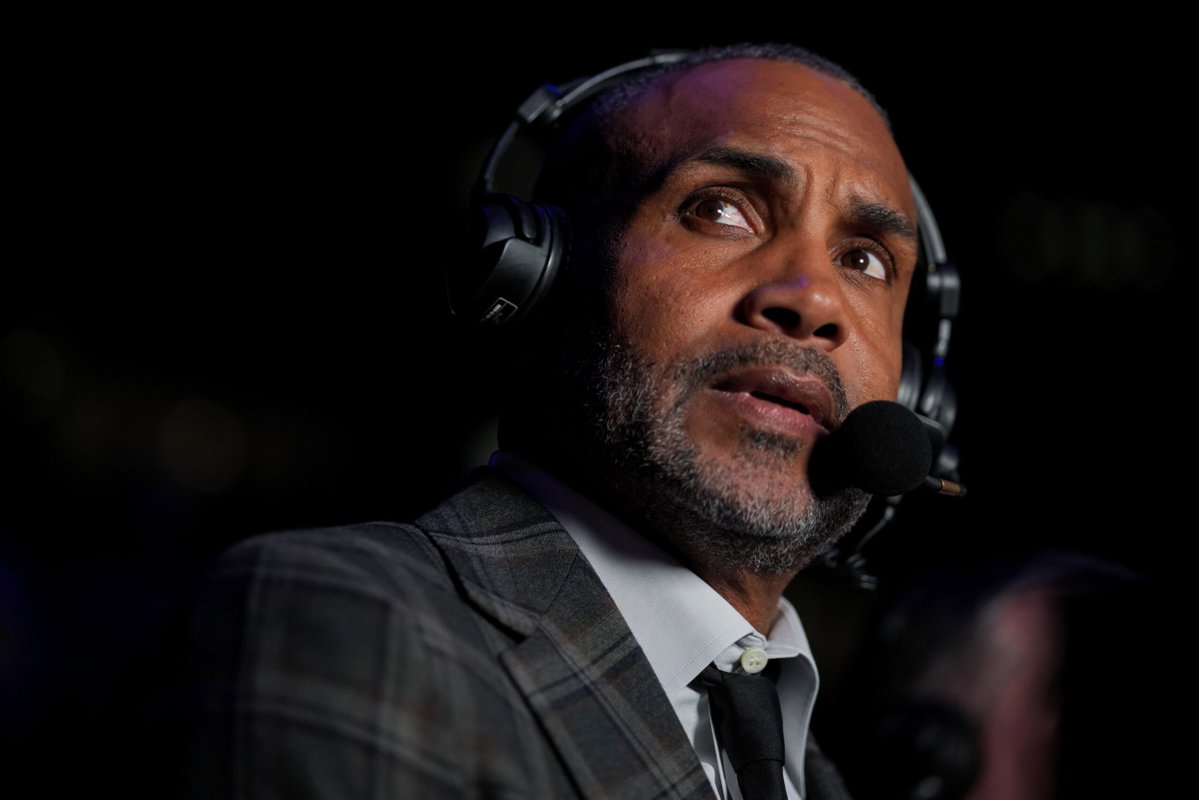
A 1999 ankle injury and a failed rehabilitation process cost Grant Hill four prime NBA seasons, and, according to him, much of it could have been avoided. Long before the LeBron James era, Hill was widely viewed as the player capable of becoming the face of the league. By 2000, he appeared ready to make the leap from superstar to defining player of his generation until a left ankle injury at the end of the 1999–00 season changed everything.
Watch What’s Trending Now!
Speaking to Vince Carter on the Cousins podcast, Hill reflected on the medical mismanagement that derailed what many believed could have been a transcendent career. Selected third overall by the Detroit Pistons in 1994, he quickly captivated the NBA with his versatile, all-around game. What initially seemed like a manageable injury ultimately stole four years of his prime.
“I feel like a lot of it could have been avoided,” he reflected. “I’m feeling like I was let down. The medical community didn’t do me right in that way.”

"There were mistakes made in terms of managing my injury. ... Feeling like the medical community didn't do me right." @realgranthill33 speaks out on his complicated injury history that began with a left ankle injury in 2000.
The timing of the injury played a major role in this disarray. After suffering the injury, the 7x All-Star forced himself to participate in the Pistons’ postseason. The injury eventually sidelined him after aggravation, and he had his first surgery in May 2000.
Soon after, Grant Hill signed the most anticipated deal with the Orlando Magic to pair up with Tracy McGrady. However, Hill revealed that the team immediately put him on the court in September, despite his still recovering from surgery.
Hill had spoken about this pressure dynamic before, acknowledging in earlier interviews that the combination of his own eagerness to prove himself and the franchise’s urgency to get their new star on the floor created a dangerous situation with no one clearly pump the brakes.
The 53-year-old added, “Never really being hurt before, not understanding rehab and loading and building up to that moment, I was just put right out there,” recalled Hill.
This dangerous experiment continued until the doctor who performed the surgery picked up the newspaper and found that Hill had played for 30 minutes. The doctor immediately reached out, as the team shouldn’t have let him play until mid-December. Speaking of the mishap, Hill said, “Nobody put a gun to my head and forced me to play. But also, nobody told me not to play.”
That absence of clear communication between the team, its medical staff, and the player is precisely where the system failed. After finding that out, the team placed him on a two-month rehab. However, it was already too late, as he underwent a second surgery in January 2001 due to a lack of improvement.
A third surgery followed as the ankle continued to resist recovery, and in 2003, during a procedure to realign the joint, Hill contracted a dangerous bacterial infection, MRSA staph – marking his fourth surgery.
Looking at the grave mistake, Grant regretted it, saying, “I might have missed the first couple of months, but I probably would have been back. By December, they’re going forward. Well, maybe not. Who knows? We don’t know. But we never knew that.”
Grant Hill’s grueling recovery phase
Grant Hill had also spoken openly about his injury in the past. He once addressed how the injury break affected him psychologically and how he approached the game.
“When I stepped on the court, even against Jordan, I always felt like I was the better player,” Hill said. “I had 4 years of injuries, your body betraying you. You lose confidence in your body.”
The MRSA infection alone nearly proved fatal to his career. His wife Tamia said, “It was bad, and I don’t think we realized even then how bad it was.”
At that time, Grant had nearly missed 200 games in his $93 million contract that he had signed three years ago. A fifth surgical procedure was ultimately required before Hill could begin rebuilding toward a return. However, despite all the hassle, he came back for the 2004–05 season, playing 67 games and averaging 19.7 ppg, a testament to his resilience.
Conversely, things have changed drastically in the modern NBA. Teams now take rehabilitation seriously and give their players structured workloads, irrespective of the situation.
Recently, Luka Doncic suffered a hamstring strain, and with the playoffs on the line, the Lakers didn’t take the risk. The calculus was straightforward: short-term sacrifice over long-term damage – exactly the framework that was absent around Hill in 2000. Something that the medical staff around Grant Hill at that time should have considered.