
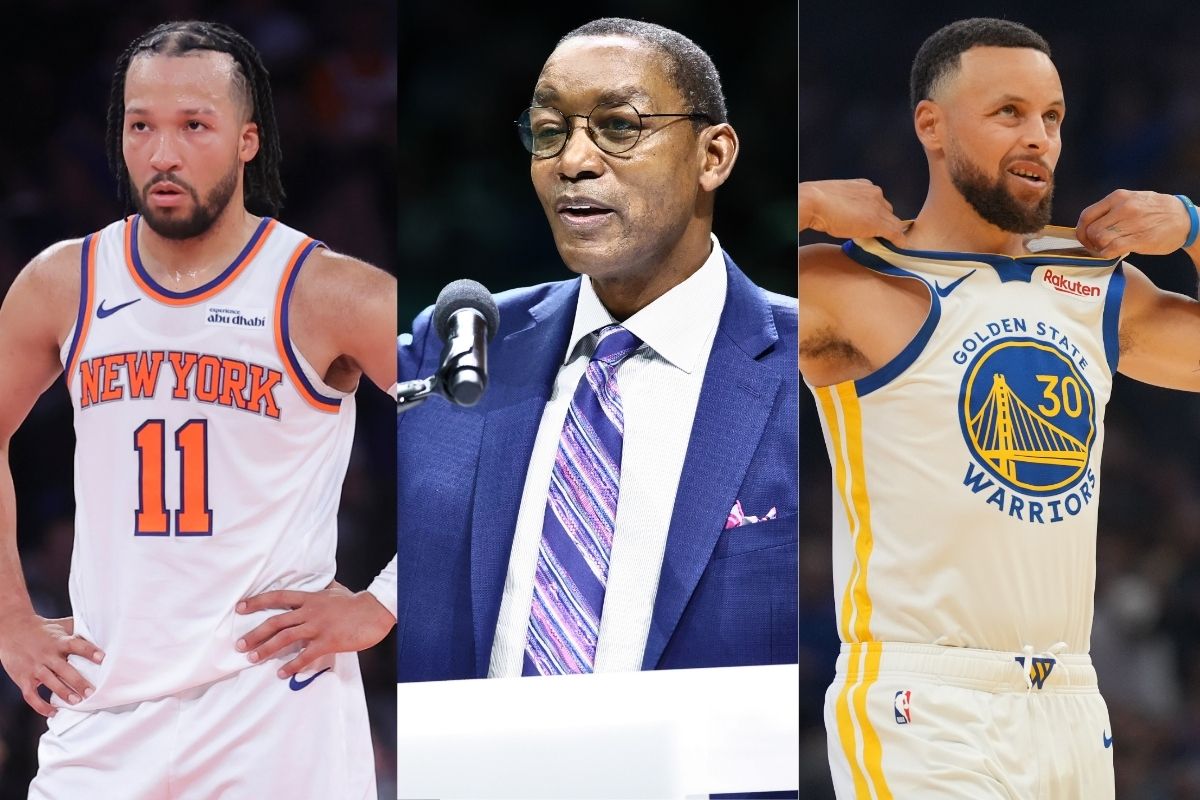
Isiah Thomas just ranked himself and Jalen Brunson above Stephen Curry in NBA Finals lore and his reasoning has nothing to do with rings. NBA history has seen only four point guards under 6’3″ become Finals MVPs: Isiah Thomas, Tony Parker, Stephen Curry, and now, Jalen Brunson. Sharing that height bracket, Thomas argued, doesn’t mean sharing the same game, and he drew a line separating Brunson and himself from Curry that has nothing to do with inches.
Watch What’s Trending Now!
The debate resurfaced within hours of Brunson closing out the 2026 Finals, and it taps into something the league has argued over for years: whether the box score even knows what to do with a small guard. Appearing on FanDuel TV’s Run It Back alongside DeMarcus Cousins, Chandler Parsons, and Lou Williams, the Pistons legend argued that Brunson’s game resembled his more than Curry’s, ranking both of them above the Warriors star ahead of Brunson’s championship-clinching Game 5.
“Curry did it at 6’3”, more or less shooting, scoring,” Isiah Thomas said. “Brunson and I, if Brunson becomes a champion, right, we did scoring and assisting. That is something totally different, and that’s why it’s so unique in terms of what you watch, because he can assist and then he can score. Curry was more just a scorer. So there are two different ways of doing it.”

Isiah Thomas 🤝 Jalen Brunson Unlike Steph Curry, some small guards can’t win an NBA Championship off shooting alone… Like the Pistons, the Knicks won because their captain became bigger than analytics 🏆

While Isiah Thomas drew a sharp distinction between himself, Brunson, and Curry, the numbers tell a different story.
The league has long viewed Jalen Brunson and Isiah Thomas as traditional guards whose primary responsibility was to orchestrate the offense and scoring when necessary. Stephen Curry, on the other hand, is a score-heavy guard with a lot of off-ball movements. And the Warriors’ playmaking burden often fell on Draymond Green and other initiators.
This really strengthens Thomas’ argument. However, statistically, the argument doesn’t stand.
Looking at the Finals MVP run of these three guards, the Pistons legend averaged 7.0 assists per game in the 1990 Finals. Curry dished out 5.0 assists in his 2022 run, while Brunson averaged 4.6 assists in the latest campaign.
That gap is real, but it leaves out context that cuts against Thomas’s framing: Curry hit 30 points, 5 rebounds, and 5 assists in two separate Finals – 2019 and 2022 joining Michael Jordan, LeBron James, and Jerry West as the only players to do that more than once. Calling that “just a scorer” undersells exactly the two-way offensive force Curry built his Finals résumé on.
So, reducing Curry to “just a scorer” overlooks the impact he creates. His gravity alone bends defenses before he ever puts the ball on the floor, opening driving lanes and kick-out passes for everyone around him. Whether through those reads or attacking the double teams himself, Curry has always been a playmaker on his own terms; he just releases the ball a beat earlier than a traditional point guard would.
He isn’t the traditional point guard, but he still is an offense-generating PG.
Worth separating out here is what Thomas is actually arguing, since the “Championship Debate” framing can blur it: he isn’t claiming Brunson or Curry could win a title the other one couldn’t, all three already have rings. The real disagreement is narrower: should a guard who scores and creates be graded on a different curve than one who mostly scores, regardless of how each one got there?
With Victor Wembanyama limiting his paint presence, the guard’s strongest area, Brunson faced a ton of defense on other avenues. Yet he managed to generate offense and ultimately became the highest-averaging guard in NBA Finals history with 32.6 ppg, a mark that had belonged to Curry since 2022 (31.2 ppg) until Brunson’s 45-point Game 5 closeout reset it.
However, Isiah Thomas’ argument didn’t just end there. It went way beyond scoring and assisting. He focused on the challenges faced by the undersized guards.
Isaiah Thomas explains why Jalen Brunson should be judged differently
The Hall of Famer didn’t stop at comparing Brunson’s game with Curry’s. He also argued that the many parameters used to evaluate basketball analytics fail to capture the impact that undersized players bring to the table.
“With Brunson and I being smaller, we cannot measure ourselves by these analytical category criteria that has been established in the basketball world that only fit and suits the 6’6″ and above players,” Thomas said.
He added, “But if you are trying to win as a small player, we cannot play to that criteria of statistical analyzation. So we need to figure out how we can win without being measured by the 6’6 and above guy. And Brunson has settled into that. So I’ve done it. He’s trying to do it. Curry did it at 6’3.”
He made those comments while the Run It Back discussed the Final MVP race ahead of Game 5. Ironically. Thomas initially named OG Anunoby as his pick, as he praised the star forward’s consistency on both ends of the floor. However, he quickly pointed out that players with Anunoby’s size often benefit from the standards that necessarily don’t apply to the guards.
While OG’s FG hovered around 52.5% throughout the series, Brunson struggled, shooting under 40%. According to Thomas, Brunson’s impact extends beyond the shooting percentage and efficiency.
The guard faced a dominant defense and Victor Wembanyama’s attention. Even if his efficiency took a hit, Brunson shouldered the team’s offense.
It was ultimately evident in Game 5 when he produced a masterclass 45 points to seal the deal and emerge as the champions. Almost scoring as much as the entire team’s offensive contribution in a physically tough battle.
That argument has stakes beyond a TV debate set, too. Brunson’s title run has already shifted how teams are framing the 2026 draft, with scouts pointing to him and to the Knicks’ 6-foot reserve Jose Alvarado as proof an undersized guard can still carry winning basketball deep into the postseason, with several analysts flagging shorter prospects for a longer look this cycle as a result.
It’s the same instinct behind Thomas’s argument, just applied to roster-building rather than MVP debates: if the conventional yardstick has consistently undervalued short guards, both broadcasters and front offices are starting to ask whether it’s the players or the yardstick that needs adjustment.