
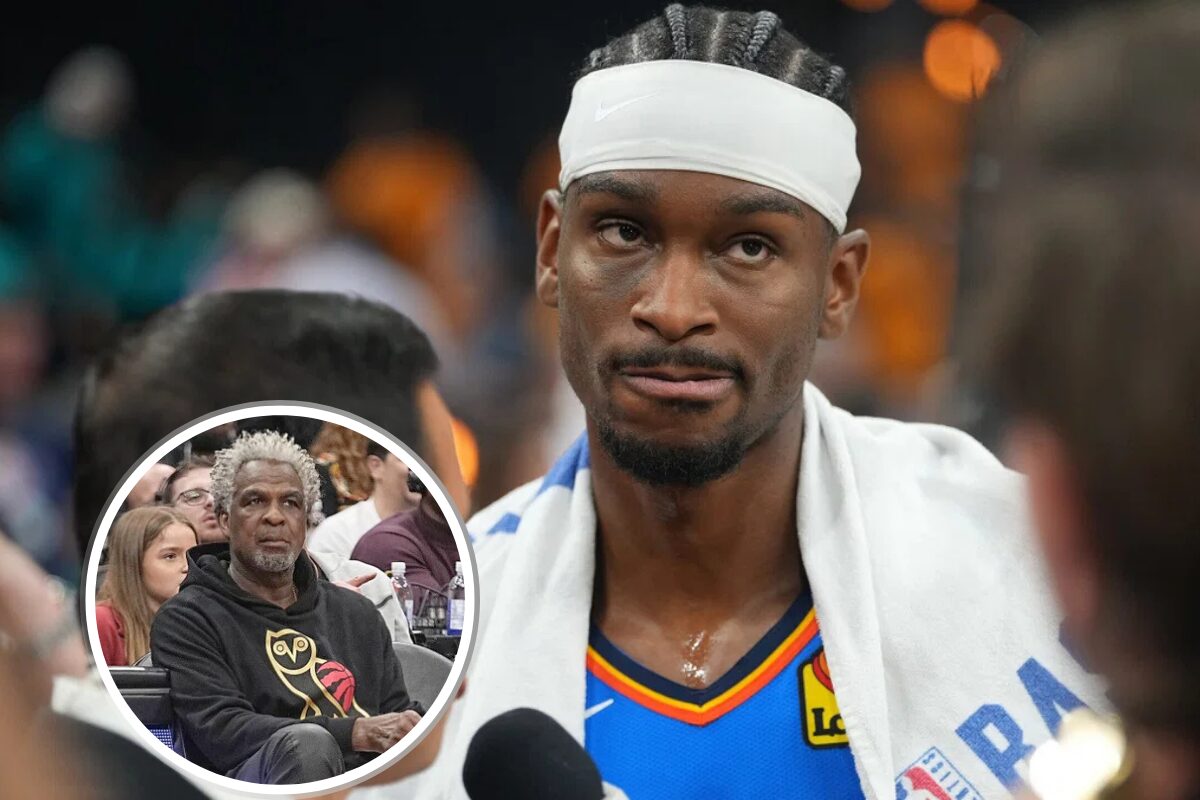
Back-to-back MVP titles are not enough to save Shai Gilgeous-Alexander from criticism after the WCF exit. He ended the series with a 35-point, 9-assist performance in Game 7. But his efficiency across the entire series painted the picture of a historic struggle. Charles Oakley, who built his reputation as one of the NBA’s premier defensive specialists, rebounders, and enforcers, cracked down on the reason why SGA struggled.
Watch What’s Trending Now!
“I don’t look at it like that, but when you win, you get hate. And I think SGA is a great player, great scorer, but he is not a great athlete,” Oakley argued in his recent interview on 95.7 The Game show. “And now that you see, there are a lot of wings that can check him and get into him, and he got to score, so he got to do whatever he can to score. Push off. If they let James Harden take two steps backwards, he’s taking two steps forward; that’s his game, let him go.”
Oakley’s critique was not a blanket dismissal. It was a precise mechanical diagnosis: SGA’s scoring model is built on footwork, angles, and timing. Not elite physical tools. Oakley acknowledged that SGA compensates for a lack of elite athleticism with an advanced understanding of how to manipulate defenders and get to the free-throw line.
But Oakley’s point and the core of his “scoring problem” is that this system has a vulnerability: when longer, more physical defenders can stay attached and take away the foul, the entire offensive structure breaks down.
Both Shai Gilgeous-Alexander and James Harden are masters at using their off-arm (and body) to create space and draw fouls, though their techniques differ. Aside from Games 2 and 7, where he shot 50% or higher, SGA struggled against the Spurs.
The vulnerability Oakley identified was quantifiable in the 2026 playoffs. According to Yahoo Sports’ Tom Haberstroh, SGA hit the court 46 times during the postseason and drew a foul on 23 of those occasions, a 50% conversion rate. By comparison, Jalen Brunson converted just 20.8% of similar situations, and Donovan Mitchell 21.2%. Even James Harden, the acknowledged master of this craft, was at 40.6%. SGA was an outlier, and the Spurs knew it.
In the series opener, he converted just 7-of-23. Again in Game 3, SGA was 6-of-17 FG (35.3%). Then Game 4: 6-of-15 FG (40.0%).Game 5: 7-of-19 FG (36.8%), though salvaged by a massive 16-of-17 night at the free-throw line. Game 6: 6-of-18 FG (33.3%) while finishing a brutal -28 plus-minus on the court.
Thus, it became the fourth straight game below 40 percent from the field, his longest such stretch since the 2021-22 season, per ESPN. In fact, there was another damning stat for Shai Gilgeous-Alexander.
Imago
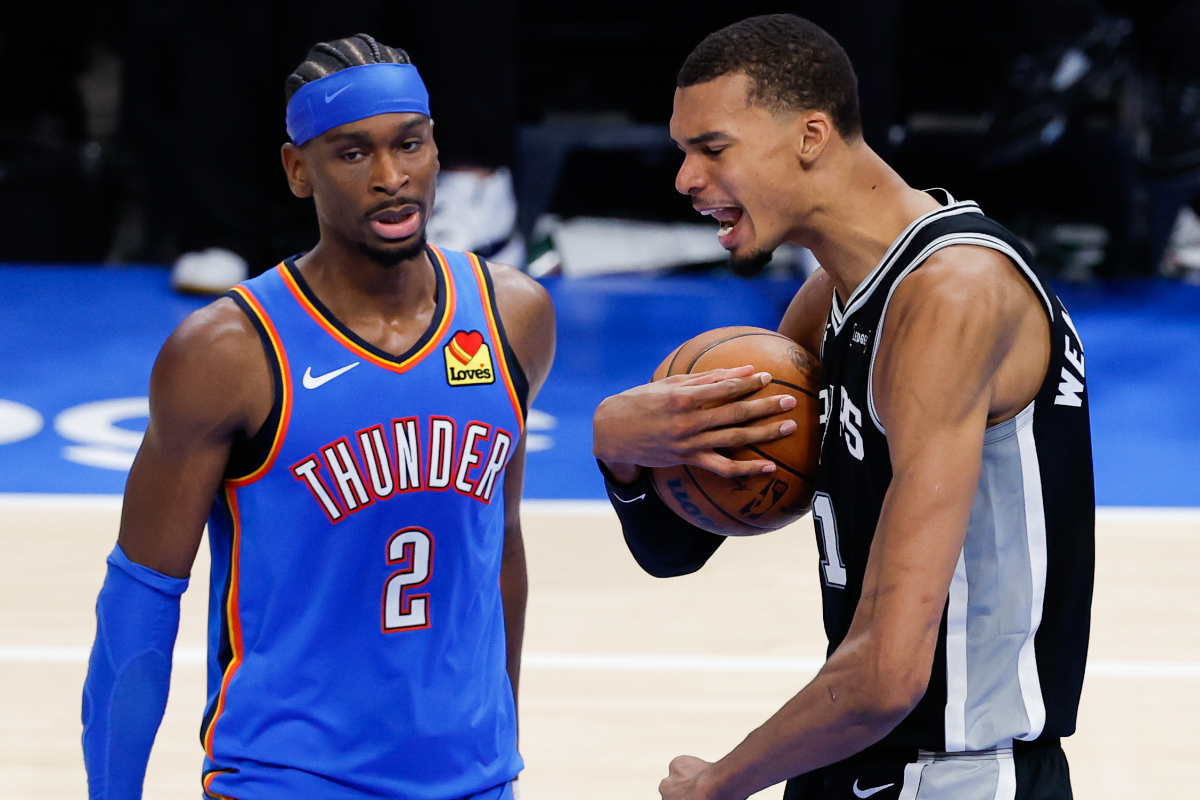
May 18, 2026; Oklahoma City, Oklahoma, USA; San Antonio Spurs center Victor Wembanyama (1) reacts in double overtime against the Oklahoma City Thunder during game one of the western conference finals for the 2026 NBA playoffs at Paycom Center. Mandatory Credit: Alonzo Adams-Imagn Images
His -28 point differential was the worst impact for an MVP in a closeout game since Joel Embiid in 2023 against the Boston Celtics. Before Game 7, his three primary defenders, Stephon Castle, Dylan Harper, and Devin Vassell, have all held him to shooting below 50% in this series. That’s why there was an efficiency drop in the West Finals.
Across seven games, Gilgeous-Alexander posted 25.9 points on 40.9% shooting from the field. But it was a clear drop from his regular-season performance, when he averaged 31.1 points per game on 55.3% shooting. While Oakley’s criticism remains true, Shai openly embraces it as his greatest strength.
“You run fast, I go slow,” he said previously.
Even in his exit interview, he was open to speaking about his disappointments.
“It was a failure,” SGA said. “I failed at my goal. I didn’t achieve what I wanted to achieve.” Shai also vowed to work on his game to resolve those problems. “I didn’t get where I wanted to go this season. There’s a reason for that. Now I have to look at that reason and try to make sure it never happens again.”
The Conference Finals exposed exactly what Oakley described: a scorer whose system depends on the foul-drawing holding up. When three young, physical wings took that away, game after game, the two-time MVP had no reliable fallback.
Whether SGA’s off-season response involves developing a more diverse shot-creation toolkit, or simply betting on the officials not holding the line again, will define whether 2026 was a one-year correction or a permanent ceiling. But SGA is ready to tackle them head-on.