
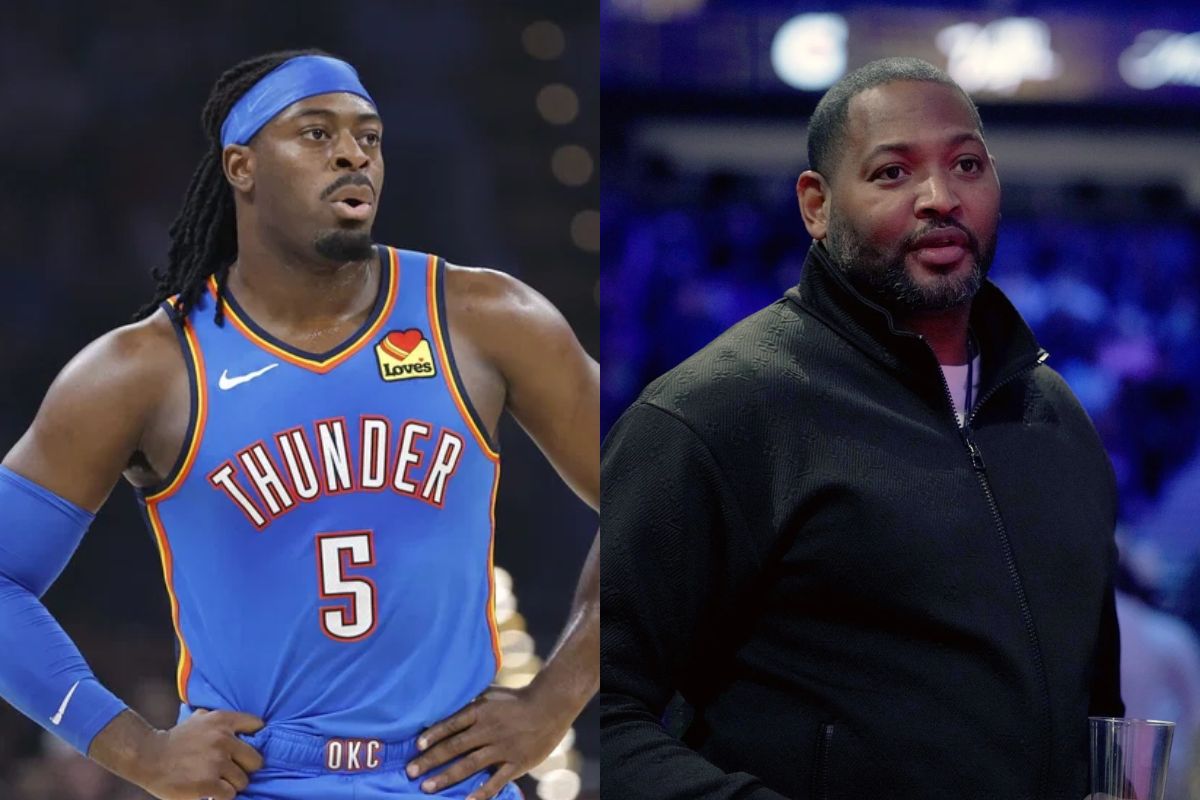
The last two times the Los Angeles Lakers faced the defending champions, they suffered multiple injuries to two core players, back-to-back blowout losses, and a grueling physical matchup. Almost everyone is expecting this series to go similarly, mostly because of the borderline-dangerous defensive tactics of Oklahoma City Thunder guard Luguentz Dort. Leave it to the Lakers veterans to come up with some solutions to help LeBron James & Co. The table on Spectrum SportsNet, featuring Robert Horry and James Worthy, had its own input on tackling the formidable aggression of Lu Dort.
Watch What’s Trending Now!
The 7x NBA champion Robert Horry warned the Lakers about the well-known challenge posed by Thunder players like Dort and Alex Caruso. “You got to understand, like, this team right here: you got Lu Dort, that is how they go. Then you got Caruso, who comes off the—those are the top dogs defensively,” Horry explained.
But he also had to emphasize Dort’s critical role in OKC’s defensive identity by outrightly labeling the guard as a player who consistently flirts with the line of acceptable physicality. “But the thing about them is you got to go to the ref and say, ‘Yo, watch his hand check.’ We all know Lu Dort is a little close to the dirty side. Yes. So you got to go out and just go out and just play and not worry about that and go to the refs and say, ‘Yo, watch it, man. You know, this is a playoff. All eyes are watching you guys. So what you call on that end, you better make sure you call it for us, too, because that’s the right thing to do.'”
Horry’s comments aren’t just a warning about physical defenders- they point to a deeper playoff dynamic: the negotiation between players, officials, and game flow. By highlighting Lu Dort’s “edge” and Alex Caruso’s disruptive presence, Horry is really emphasizing how Oklahoma City weaponizes defensive pressure not just through skill, but through ambiguity.
In the postseason, where officiating often tightens situationally but loosens physically, players like Dort thrive in that gray area, forcing opponents to make a choice between adjusting mentally or getting baited into frustration.
What’s particularly insightful in Horry’s quote is the strategic layer he hints at: engaging referees early. This isn’t about complaining- it’s about planting a narrative.
Veteran teams understand that officiating crews subconsciously calibrate over the course of a game. If the Lakers can establish early that Dort’s hand-checking is something to monitor, they’re effectively influencing how marginal contact is interpreted later in crucial moments. That’s a subtle but critical playoff tactic.
At the same time, Horry acknowledges the trap: over-focusing on perceived “dirty” play can derail offensive rhythm. The best teams absorb that physicality without losing composure. So the real challenge isn’t just dealing with Dort or Caruso, it’s maintaining discipline while quietly shaping the whistle.
What made it a little entertaining was James Worthy’s funny demonstration of how the Lakers should react to a hand check.
Robert Horry wants the Lakers to divert attention from Lu Dort to the referees
Robert Horry, who played in the Shaq & Kobe era in LA, is bluntly touching on a major debate surrounding the top-seeded Oklahoma City Thunder and their premier enforcer. Luguentz Dort has established himself as one of the most feared lockdown defenders in the NBA, but his reputation has repeatedly been called into question due to questionable incidents.
The “dirty” label has followed him closely in recent weeks, notably after an incident against the Phoenix Suns, where Dort was accused of tripping superstar Devin Booker, sending him briefly to the locker room. Earlier in the year, Dort was also ejected for a flagrant foul after tripping Nikola Jokic, sparking a fiery on-court altercation and drawing criticisms from players and fans alike who claim he utilizes reckless tactics to gain an edge.
For the Lakers, navigating Dort’s physical style of defense is the primary challenge in this Western Conference clash. The solution, according to Horry, is not to retaliate by matching his energy, but to engage in psychological warfare with the officiating crew.
By constantly reminding the referees of Dort’s tendency to “hand check” and push the limits of permissible defense, the Lakers can pressure the whistleblowers to maintain a tight game. As the series intensifies, whether the referees heed Horry’s advice and keep a close eye on the Thunder’s enforcer could very well dictate which team controls the tempo of these high-stakes playoff games.