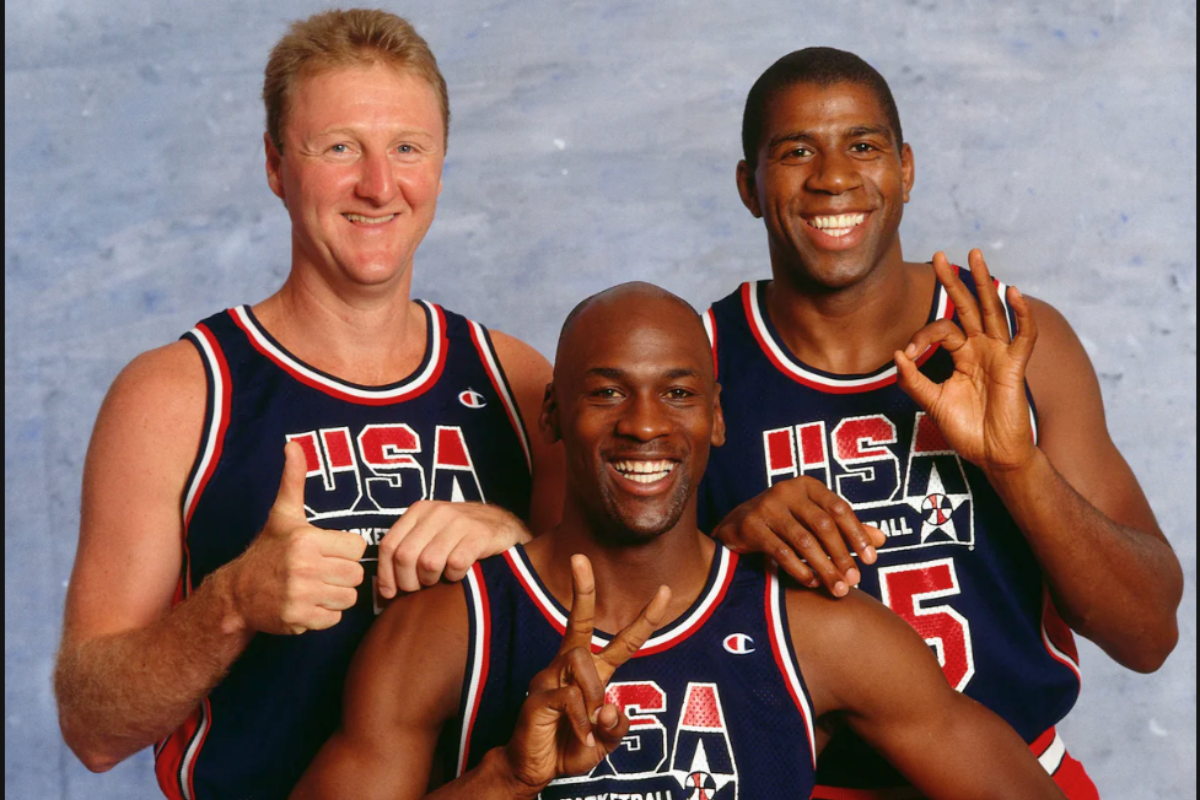
For years, one opinion from Stephen A. Smith never changed. Whenever the greatest player debate surfaced, his answer stayed the same. Michael Jordan sat alone at the top.


However, a recent explanation shifted the conversation from greatness to responsibility. Smith argued the league Jordan dominated only existed because of two players who came before him.
Watch What’s Trending Now!
Smith pointed to the moment the NBA’s image began changing. According to him, the transformation started when Magic Johnson and Larry Bird entered the league. “A source text sent me this, reminding me of the championship with Larry Bird and Magic Johnson. When they first came into the league, the championship was on tape delay. When Magic Johnson dropped 42 and 15 playing center because Kareem Abdul-Jabbar couldn’t go into game six,” stated Smith.
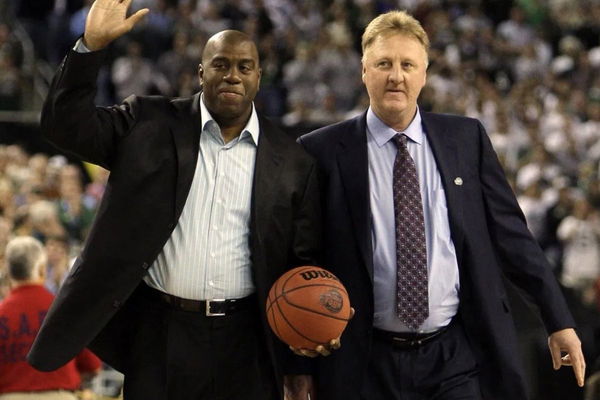
Imago
Larry Bird (re.) und Earvin Magic Johnson (beide USA) im Vorfeld des 30j
The numbers mattered because of what surrounded them. During that period, NBA franchise values had declined, television exposure struggled, and public perception hurt the league’s credibility. “Franchise values had declined, and they were struggling. There was a perceived imagery involving dr–s, c—-e, etc. And the objective was: how to unify?”
Smith’s reference described the widely discussed dr-g reputation attached to the late-1970s and early-1980s NBA, which damaged the league’s popularity at the time. Because of that climate, the rivalry became more than competition. It became marketing, identity, and stability.
Smith did not minimize Jordan’s impact. Instead, he separated foundation from expansion. “Magic Johnson and Larry Bird led the transformation. That’s why one could easily argue they’re more responsible for the success of the NBA than Michael Jordan, because even though Michael Jordan certainly did an immense amount of things in promoting the game and provoking international and global appeal, it had to start somewhere.”
He continued by framing Jordan as the accelerator, not the ignition. “Michael Jordan could not have done what he did if it were not for Magic Johnson and Larry Bird. He was able to take the NBA to another level. Certainly assisted Magic and Bird, who dominated the 80s.”
The argument centers on sequence. Bird and Johnson rebuilt credibility. Jordan globalized it.
Michael Jordan also gave credit to Bird-Magic
The roots go back to 1979, when Johnson’s Michigan State defeated Bird’s Indiana State in the NCAA championship game, drawing 35.1 million viewers. That audience carried into the NBA when the pair joined the Los Angeles Lakers and Boston Celtics.
For ten straight years, the Finals featured one of them. Three of those series came head-to-head in 1984, 1985, and 1987. Meanwhile, Jordan entered a league already stabilized by their success. He did not win his first championship until his seventh season, while Johnson won as a rookie in 1980 and Bird won in his second year in 1981.
That gap shaped his motivation. “At last I fit somewhere in the category of Larry Bird and Magic Johnson,” Jordan said in The Last Dance. “(It) ate at me, it did. It did. My energy started to gear towards my teammates and pushing them to excel.”
Because of that pursuit came the championships, the three-peat, and eventually the 1992 Dream Team.
Smith’s argument is not a GOAT ranking. Jordan remains his number one player. The distinction instead separates impact type. Bird and Johnson repaired the NBA’s image, television value, and cultural acceptance. Jordan then exported the product worldwide. One created the stage. The other filled the arena. Without the first act, the second never becomes global.
Written by

Edited by

Ved Vaze