
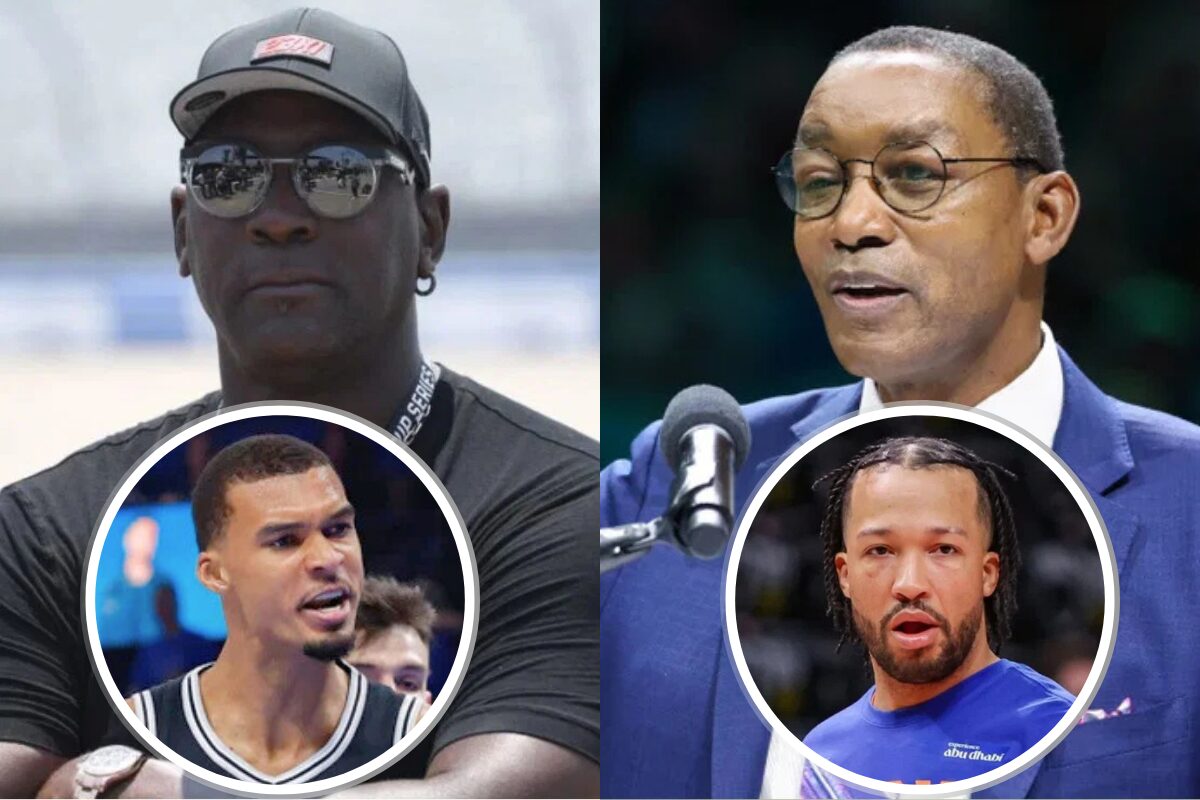
Isiah Thomas has been a vocal supporter of Jalen Brunson’s historic playoff run, pushing back on the “too small” criticism that’s trailed Brunson his whole career. Brunson answered that criticism the only way that actually settles it: he won everything there was to win. The Knicks guard closed out the 2026 Finals as a unanimous Finals MVP- every one of the 11 media voters who decide the Bill Russell Trophy put his name down, capping a run that also included unanimous NBA Cup and Eastern Conference Finals MVP honors. And yet the “face of the league” conversation hasn’t moved an inch.
Watch What’s Trending Now!
Victor Wembanyama is still the answer everyone reaches for. That’s the actual disrespect Thomas is pointing at not that Wemby belongs in the conversation, but that Brunson, despite winning literally everything, isn’t. This has opened an old wound for Zeke, who lived a version of the same thing decades ago when the league elevated Michael Jordan as its face while Thomas’s Pistons were busy beating him.
“What Jalen Brunson just proved again is that when your game is tight and right, no matter what size you are, you become the best at what you do,” said Thomas on The Crossover Podcast.
Before he ever got to Jordan, though, Thomas went somewhere more personal- the way the question itself gets asked of guys his size.
“This is what all of us face as small people, right? We get the question when we beat the bigger guys. Now you just watch me win. Dude, you just watched me win,” Thomas said.
“Now you come to me in my locker room after I beat all your big guys, and you ask the small guy, ‘Hey, what do you think about that big guy over there?’ Didn’t you see that?” He paused, half-laughing at himself.
“But we don’t get to — I’m older now, so when I was playing, you couldn’t really get on the mic and be that brash with it. But I’m sure in Jalen Brunson’s mind, he’s like, ‘They’re talking about the face of the league, dude. Didn’t you just see me walk the face of the league?'”
Then he drew the parallel to his own career.
“So, see that was the question we was asking in Detroit when we beat Bird, Magic, and Jordan. But they made Jordan the face of the league. And here in Detroit, they were saying, ‘Why can’t all be the face of the league? Why is this one elevated when you see him three, four years in a row beating your face of the league, right?’ Well, to to me and and so when you when you ask that question, right, it’s a much deeper question in terms of who they want to be the face of the league, not who’s the best, right?
“So, who do they want to be the face of the league? So they say this guy is, but the small guys we always have to take a step back because what we realize as small people is that it’s a 6’6″ and above category, you know, for whatever reason our game, our wins are not counted the same as the big people’s part.”
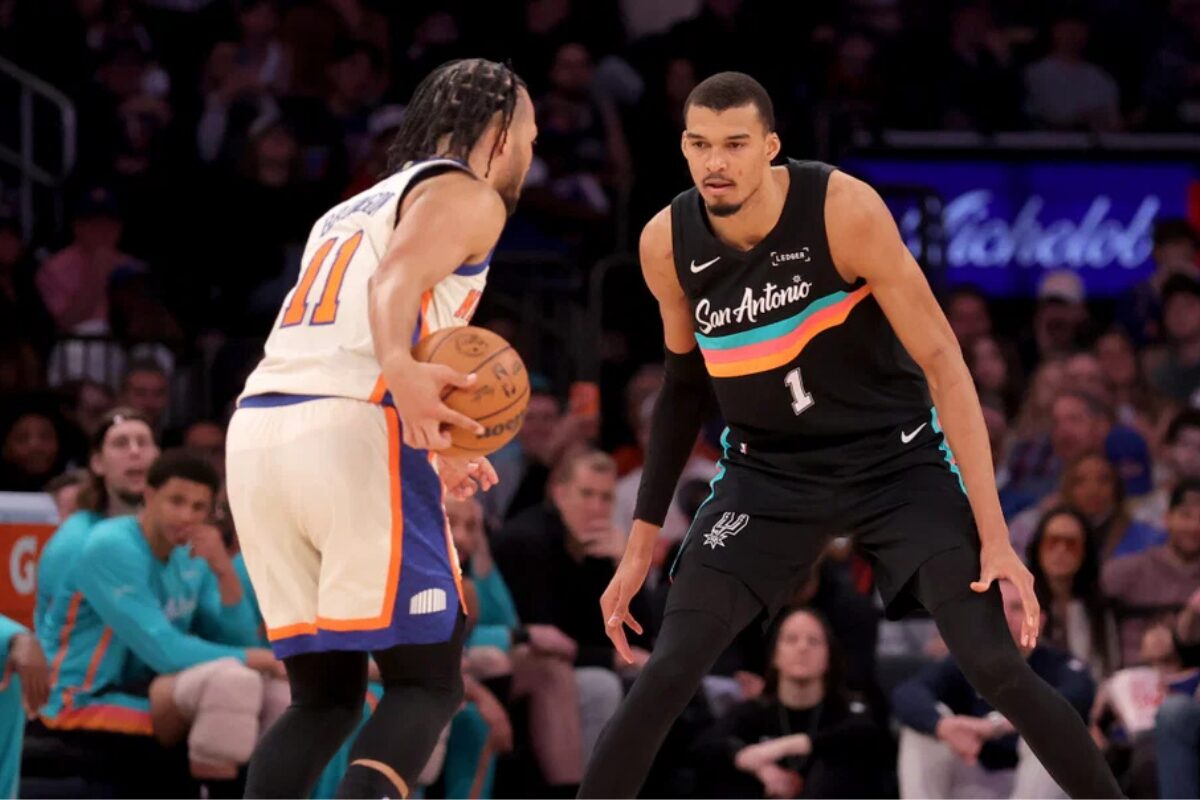
The Pistons would regularly beat the Bulls, including in their back-to-back championship seasons. Isiah Thomas even won the Finals MVP in 89-90. Similarly, Jalen Brunson averaged 32.5 points in the Finals and even closed out Game 5 with 45. He became the first player in Knicks history to score more than 40 points in an NBA Finals game.
He’s also just the fourth guard 6-foot-2 or under to ever win Finals MVP, joining Thomas himself, Tony Parker, and Stephen Curry.
Imago
Credit: IMAGN
That’s why Zeke calls for Brunson’s inclusion in the top-tier debate. But to Victor Wembanyama’s credit, with his 7-foot-4 height and 8-foot wingspan, he possesses the rim protection of a traditional center but handles the ball and shoots like a wing. In the 2025–26 regular season, he averaged 25.0 points, 11.5 rebounds, and 3.08 blocks per game.
The Spurs star reached the NBA Finals in just his third season en route to being the first-ever unanimous DPOY. Historically, even legends like Michael Jordan and LeBron James took much longer to elevate their rosters to a championship round. While Wemby lost the NBA Finals to the Knicks, he deserves to be part of the face of the league debate.
Why the league keeps reaching for the giant
Thomas’s question deserves an actual answer, not just a grievance. Part of it is simple scarcity: a player who’s 7-foot-4 and can switch onto a guard, shoot threes, and protect the rim is something the league has genuinely never had, and rarity is what gets built into a marketing campaign.
A guard playing brilliant, disciplined basketball is replaceable in a way Wembanyama isn’t- there’s a reason the league has marketed its giants this way, going back to Wilt Chamberlain and Kareem Abdul-Jabbar.
Even Wembanyama has acknowledged the machinery behind it himself, telling NBA insider Chris Haynes that being crowned face of the league “is something that can be manufactured, but only to some extent,” before adding that it ultimately comes down to who the best players are.
Brunson doesn’t have a physical anomaly to sell. He has results, and results have historically counted for less than spectacle when the NBA decides who gets the billboard.
The snub doesn’t seem to be sitting well with Brunson, either. The two teams’ rivalry didn’t end when the confetti fell- Brunson aimed a pointed, profanity-laced shot at Wembanyama during the Knicks’ championship toast, the release valve on a series that had turned openly hostile.
Wemby walked off the floor without shaking hands after the Knicks closed it out in Game 5, the second time this season Brunson had beaten him for a trophy after also outdueling him in the NBA Cup Final.
The series itself got chippy too, with a shove on Brunson that narrowly avoided a flagrant and a contested foot landing under him on a late closeout.
But the animosity, and the question of who actually gets to be the league’s face, isn’t going anywhere.
Led by head coach Chuck Daly, the Pistons developed a physical, defensive-minded, and mentally draining style of play.
They physically intimidated opponents, rotated perfectly on defense, and relied on execution.
They dominated in the later part of the 80s as a team. It’s true that Michael Jordan hadn’t won team awards at the time, but he set records unlike others.
- 1987–88: He became the only player to win Most Valuable Player (MVP) and Defensive Player of the Year (DPOY) in the same season,
- 1988–89: averaged a mind-boggling 32.5 PPG, 8.0 RPG, and 8.0 APG during the regular season.
- Jordan still led the league in scoring (33.6 PPG), but the team grew stronger around him. They pushed the Pistons to a Game 7 in the Eastern Conference Finals.
The Pistons even used the Jordan Rules to limit MJ. Every time Jordan drove into the paint, Pistons enforcers like Bill Laimbeer, Rick Mahorn, and Dennis Rodman physically knocked him to the ground. In the off-season, Michael Jordan worked out in the gym and gained muscle to counter the Pistons en route to his first of many championships.
Thus, Isiah Thomas defeated Bird, Jordan, and others. But MJ was on the rise like no other. That’s why he was part of the ‘Face of the league’ long before winning any team accolades.
Brunson’s case is, in some ways, harder to wave off than Jordan’s ever was. Jordan was already stacking individual hardware before he won a single playoff series. Brunson has now won every trophy the league hands out in a single season and still isn’t the face of it. That’s the gap Thomas is naming, and right now, nothing in the NBA’s marketing machine suggests it’s about to close.