“Has to Watch His Mouth”: Kevin Garnett Called Out for Victor Wembanyama Criticism by Stephen A. Smith

Add us on Google
“Has to Watch His Mouth”: Kevin Garnett Called Out for Victor Wembanyama Criticism by Stephen A. Smith
Add us on Google
Imago
Credit: IMAGN
Imago
Credit: IMAGN
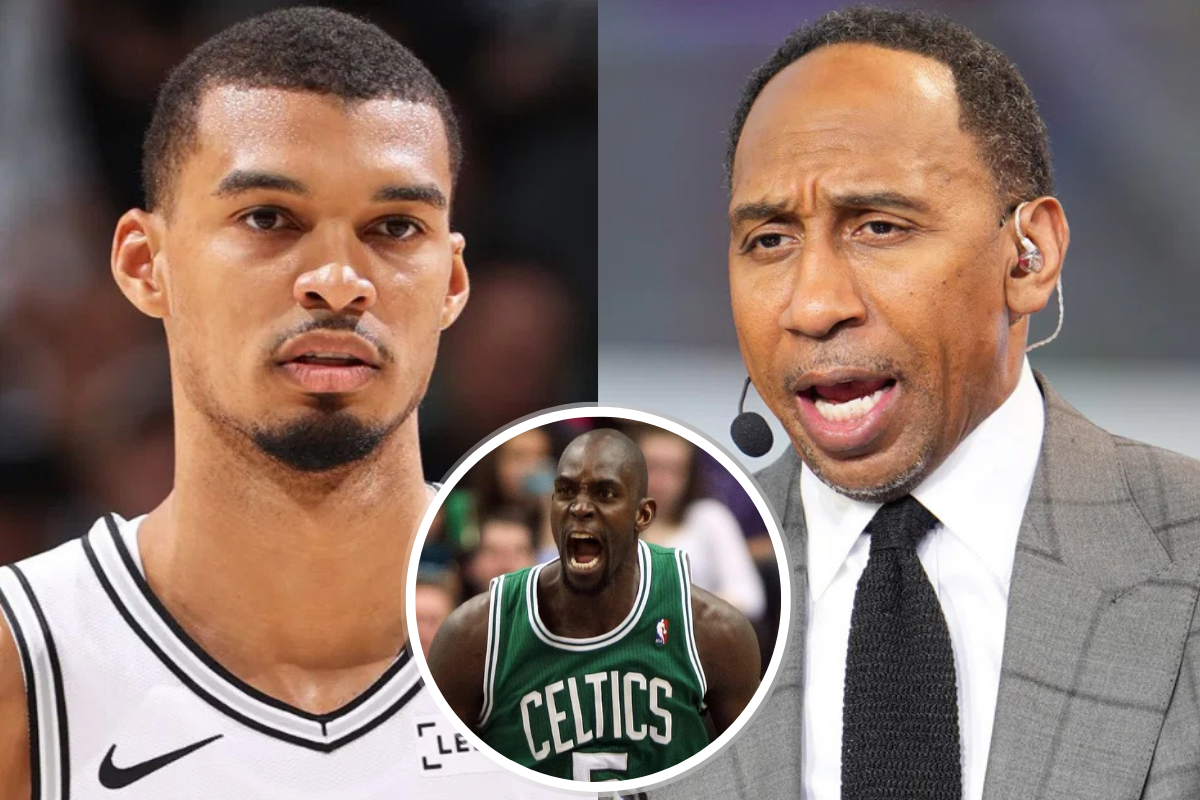
The Western Conference Finals saw a young San Antonio Spurs team defeat the OKC Thunder in seven games. The final buzzer that saw the Spurs clinch a place in the Finals, witnessed Finals MVP Victor Wembanyama in an emotional state, hugging teammates and almost in tears. It reminded fans of an image of Kevin Garnett screaming “Anything is possible!” through tears, on the floor of TD Garden, after 12 years of playoff heartbreak.
Watch What’s Trending Now!
It remains one of the most emotionally raw moments in NBA Finals history. It was 2008, and nobody questioned whether the Big Ticket had cried too soon. Now, 18 years later, the Hall of Famer finds himself on the other end of a very familiar conversation, and Stephen A. Smith is not letting it slide. On ESPN’s First Take on Thursday, Smith pumped the brakes on the criticism Garnett leveled at a young superstar who dared to show how much the moment meant to him.
“Kevin Garnett has to watch his mouth,” Smith said. “And let me tell you why he has to watch his mouth, his language. Because we need to listen to this man talk basketball. Kevin Garnett is special. I can’t get enough of watching Kevin Garnett basketball. … cos when this brother breaks it down and gives you real talk on the game of basketball, which he always does, Kevin Garnett is must-watch. I love him to death, but he needs to watch that mouth.”
Stephen A Smith says Kevin Garnett needs to watch his mouth/language when he talks basketball:
“Kevin Garnett has to watch his mouth. We need to listen to this man talk basketball. Kevin Garnett is special. I wish he was here with us right now… but the language, that’s the… https://t.co/NVI3BD4sAi pic.twitter.com/HBQaca8wXc
— NBA Courtside (@NBA__Courtside) June 4, 2026
Speaking on the KG Certified podcast, Kevin Garnett didn’t hold back:
“Guess what? The alien got to go through some heartache to be able to tell the fairy tale Hallmark card story. He’s crying in the motherf*****g Western Conference finals? That was too emotional for me. Yeah, man. He’s got four more games to try to get. You’ve got to go through the finals now. Nah, you still got to be even keeled right here.”
Garnett went further, predicting the Knicks would win the series in six, arguing Wembanyama needed to feel genuine pain before he could truly appreciate what a championship means.
The criticism carried unusual weight given that, as recently as the summer of 2025, Wembanyama had turned to Garnett personally for mentorship, making this a public rebuke from someone in his corner. Wembanyama, for his part, had addressed this tension earlier in the season.
“Personally, I refuse to carry the burden of having to hide my emotions,” he said.
Just hours after the podcast clip spread, the New York Knicks delivered exactly the kind of outcome KG had foreseen. They erased a 14-point third-quarter deficit behind 30 points from Jalen Brunson to steal Game 1 on the road, 105-95, extending their playoff winning streak to 12 games.
Wembanyama posted a double-double, 26 points and 12 rebounds, but shot 6-of-21 from the field and turned the ball over six times, both postseason career highs in the wrong column.
“I Was Bad Tonight,” Wembanyama’s Post-Game 1 Accountability Reframes the Emotional Debate
Victor Wembanyama was not searching for excuses.
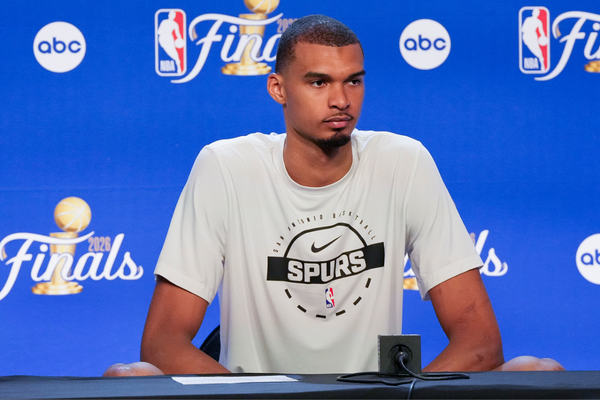
“I was bad tonight. It’s not more complicated than that,” he told reporters after the loss.
He didn’t point to defensive schemes, first-game nerves, or the hostile environment of a Finals opener. When asked whether the emotions of playing in his first NBA Finals contributed to his performance, Wembanyama dismissed the notion entirely, telling reporters it “was not a factor.”
He instead immediately aligned himself with his coach, saying he needed to establish more of a presence inside, while saying he wasn’t “worried in the slightest” about how the series would unfold.
Imago
Credit: IMAGN
Mitch Johnson identified issues beyond Wembanyama’s shooting line.
“We gotta get him moving and spacing towards the rim, whether that’s on rolls or running in transition,” Johnson told reporters. “We need to do a better job of establishing that earlier on, for sure.”
Johnson also pointed to a deeper identity problem from the Spurs as a unit:
“16 assists for us is not our brand of basketball… There’s a lot of things that we’ve discussed in this press conference that we can get better at and clean up, but that’s something that is not up to the standard, even anywhere close to what we’re used to.”
The Knicks outscored San Antonio 50-42 in the paint and 23-14 on second-chance points, areas Johnson and Wembanyama both acknowledged must improve.
The player Garnett accused of being too emotional, too caught up in the moment, too undone by feeling, responded to his worst postseason shooting night by standing at a podium and calling it plainly for what it was. Tears at a conference trophy and cold accountability after a Finals loss are not contradictions. They are the same person.
Game 2 tips off Friday in San Antonio, and the question KG’s podcast raised has already shifted: it’s no longer whether Wembanyama is too emotional, it’s whether he can use that same intensity to recalibrate and take the series back home.
Written by

Edited by

Tanay Sahai