
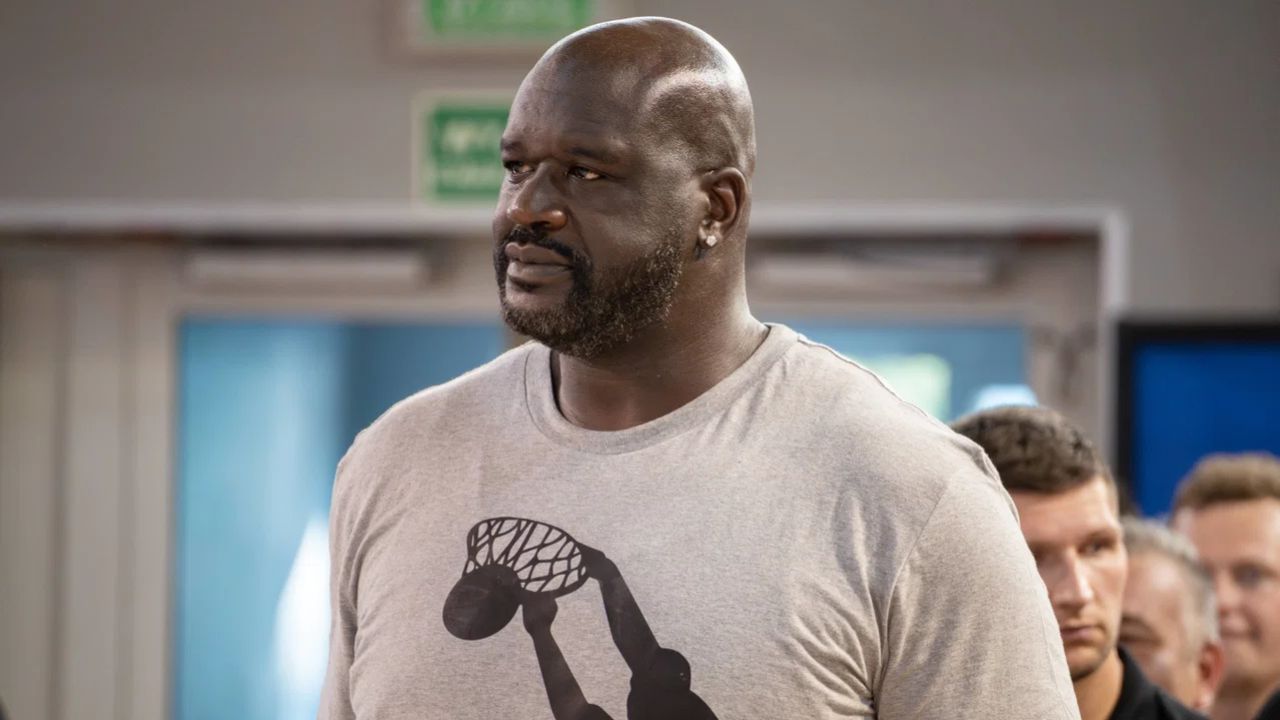
In 1984, a basketball coach walked into an army base in West Germany and came across a teenager who stood nearly 6-foot-9. Mistaking the towering boy for a soldier, Dale Brown asked how long he had been serving. The answer caught him completely off guard. The boy was only 13, and his name was Shaquille O’Neal.
Watch What’s Trending Now!
More than four decades later, that unexpected meeting had become one of the most important relationships in Shaq’s life. But as family, friends and former players gathered at LSU’s Pete Maravich Assembly Center on November 11 to celebrate Brown’s life, O’Neal had something much more painful to share than memories of their time together.
“My sister passed away, and I forgot to tell her I love her. Kobe Bryant passed away, I forgot to tell him I love him. And now my daddy Dale is gone, and I forgot to tell him I love him.”
Speaking through his emotions, the four-time NBA champion urged everyone to reach out to the people they love before they lose the opportunity. “If you have a person you haven’t talked to, that you haven’t seen. Make sure you reach out. Because for me, this is the third time this has happened to me,” O’Neal said. His words carried the weight of three losses, but understanding why Brown’s passing affected him so deeply requires going back to the teenager they first met in Germany.
At 13, Shaq was already unusually tall, but basketball was hardly a guaranteed future for him. In an interview with Esquire, O’Neal described himself at that age as someone with little confidence who didn’t believe he could become a player. With his stepfather serving in the Army, joining the military seemed like a more realistic path than chasing a basketball career.
When Brown visited the base to conduct a basketball clinic, Shaq approached him with a simple request. He wanted exercises that could help strengthen his legs and improve his jumping ability. Brown gave him advice and promised to send him a training program. For the young teenager, it was the beginning of a connection he would carry for the rest of his life.
However, the road ahead wasn’t nearly as straightforward as Brown might have hoped. Shaq struggled to establish himself as a basketball player, and his high school coach even cut him for being too clumsy. Brown later recalled that the teenager wrote to him about the setback. Rather than allowing him to give up, the LSU coach continued encouraging him to work hard and stay committed.
That encouragement mattered because Shaq was seriously considering walking away from basketball. He had already started imagining a future in the Army, but Brown kept reminding him that his education and future mattered just as much as his ability on the court. He also continued sending letters and basketball advice, making sure the teenager knew someone believed in him.
The relationship eventually brought Shaq back to the United States, where Brown offered him a scholarship to play at LSU. It was an opportunity that changed the direction of his life. Looking back at their first meeting, O’Neal once recalled, “He put his arms around me like he found gold.” For someone who had struggled to believe in his own potential, Brown’s faith meant everything.
Shaq eventually became the player Brown had hoped he could be. During his three seasons at LSU, O’Neal developed into one of the most dominant players in college basketball. His freshman season produced averages of 13.9 points, 12 rebounds and 3.6 blocks per game. By his sophomore year, those numbers had climbed to 27.6 points, 14.7 rebounds and five blocks per game.
Although his scoring average dipped to 24.1 points as a junior, he continued to dominate the paint, adding 14 rebounds and 5.2 blocks per game. His performances made him the clear choice at the top of the 1992 NBA Draft, where the Orlando Magic selected him with the No. 1 pick. The teenager who once thought basketball wasn’t for him was now on his way to becoming one of the greatest centers the game had ever seen.
Yet, even as Shaq’s career took off, his connection with Brown never became a thing of the past. The coach continued to guide him, and their relationship remained close long after O’Neal left Baton Rouge. Brown’s letters were a regular part of Shaq’s life, with LSU revealing that he sent him at least one letter or email every week.
Their correspondence also offers a glimpse into just how much they meant to each other. In 1993, Brown wrote to Shaq after his rookie season in the NBA, congratulating him on winning Rookie of the Year. But his message went beyond basketball. He reminded the young star to handle fame with dignity, respect others and use his platform to help people who needed it.
Brown wanted Shaq to build a legacy that extended beyond trophies and statistics. He encouraged him to become a role model and use his success to make a difference in other people’s lives. It was the same kind of guidance he had offered a teenager in Germany, only now his former student was one of the biggest names in professional basketball.
Six years later, Shaq returned the affection in a letter congratulating Brown on his induction into the Louisiana Sports Hall of Fame. He made it clear that choosing LSU had always been about more than basketball. “You are one of my heroes, one of my idol, one of my good friends,” O’Neal wrote. He also credited Brown with teaching him how to care for people and give back to the community.
Their bond was not built around Shaq’s achievements alone. Brown had remained part of his life through the highs and lows, offering the kind of guidance that went far beyond what a player could expect from a coach. That was why O’Neal continued to call him “Daddy Dale” even decades after their time together at LSU.
And while Brown’s legacy extended well beyond his famous relationship with Shaq, his achievements at LSU showed just how much he meant to the university. He led the Tigers for 25 seasons, from 1972 to 1997, finishing with 448 victories. His teams reached the Final Four in 1981 and 1986, appeared in 13 NCAA Tournaments and won four SEC regular-season championships.
Brown also helped develop several notable players, including Mahmoud Abdul-Rauf and Shaq. At his Celebration of Life, former players remembered a coach whose influence went beyond the basketball court. Collis Temple Jr. described him as a change agent, while Abdul-Rauf remembered his commitment to helping others. The tributes reflected the same qualities that had made Brown so important to O’Neal.
For Shaq, however, there was another regret he carried from his college years. Despite becoming the No. 1 pick, winning four NBA championships and building a Hall of Fame career, he never managed to bring a national championship back to LSU. Addressing those gathered at the memorial, O’Neal admitted, “I’ve won on every level except college. My only regret is that I wasn’t good enough to win a national championship here.”
It was a reminder that some things stay with an athlete long after the trophies have been put away. Shaq had accomplished almost everything the game could offer, but he still wished he could have given Brown one more reason to celebrate. And now, with his former coach gone, the basketball regret was joined by something far more personal.
The man who had spotted something special in a teenager nobody else seemed to believe in was no longer there to hear how much he meant to him. Brown had spent decades reminding Shaq of his potential, even when the young player couldn’t see it himself. At the memorial, O’Neal made sure everyone understood just how much that belief had shaped his life.
“He was the first person in my life who believed in me.”
For the four-time NBA champion, Brown would always be more than the coach who helped him reach the NBA. He was the man who gave him confidence when he had none, kept guiding him when he was ready to quit and remained close long after basketball brought them together. To Shaq, he was always Daddy Dale. And his final message to those listening was simple: never wait until someone is gone to tell them how much they mean to you.