
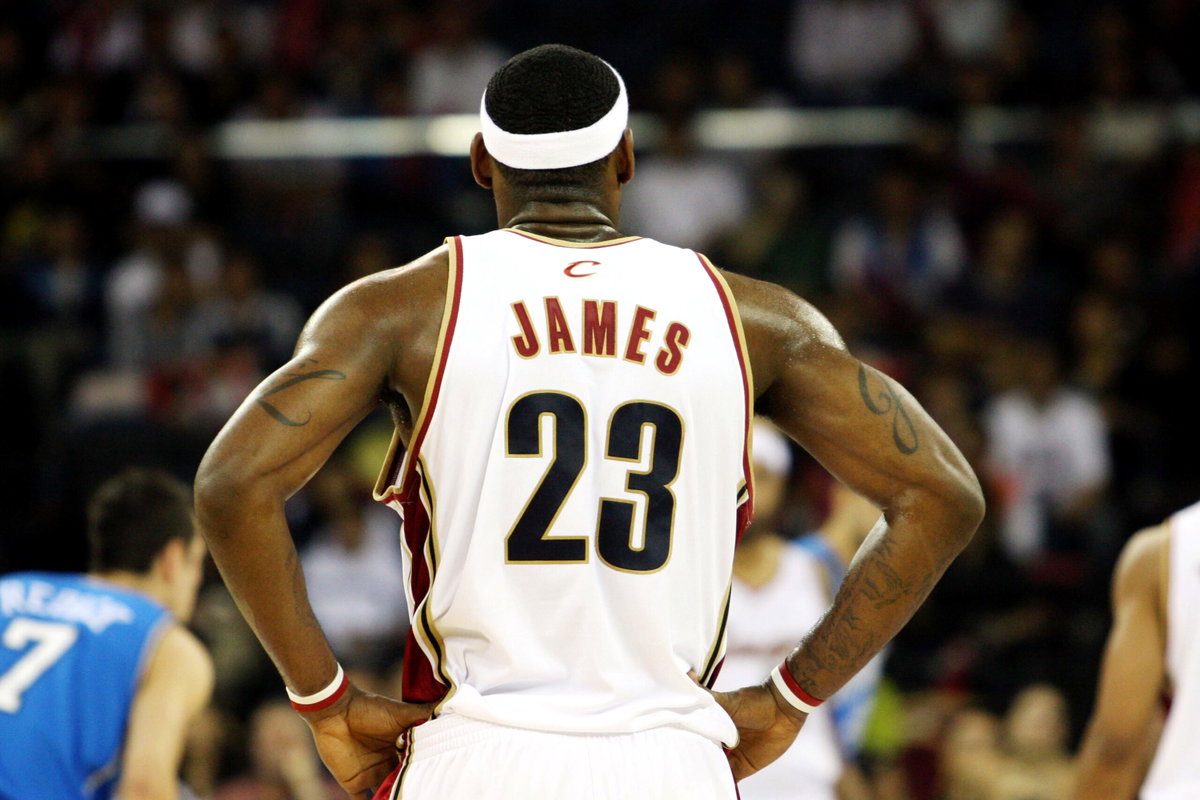
In the cut-throat world of basketball, few wounds leave a deeper scar than getting traded in your prime. What makes things harder at times is when it’s done in a manner that paints you as the bad guy and the incoming number one overall pick as a savior. But when that ‘someone’ is a 16-year-old LeBron James, it could completely change the narrative.
Watch What’s Trending Now!
The former Cavaliers main man, now charting his post-hoops path, dropped a bombshell earlier this week. He admitted that Cleveland shipped him out not for salary cap relief or fit, but because executives saw him as a roadblock stunting rookie LeBron James’ skyward trajectory.
“It was a business, and I knew what it was,” Davis admitted on FanDuel TV’s Run it Back. I was in my prime then, and I was on fire, and I knew the game well. I knew I didn’t need players for me to score points. So when LeBron came in as a rookie, I was already ready. I was already seasoned. So he was basically feeding me the ball. The first three games, I think I was averaging like 25 points. So they was like, ‘God, it’s not going to work. It’s not an opportunity for him to grow just because, you know, Rickys just whatever we do, he’s just on fire.’ He wont he wont stop,’ You know, so they got me out of there.”

Ricky Davis says the Cavs traded him because he limited the growth of LeBron 😱 "He was feeding me the ball... I saw it coming. I'm scoring 20 points and the #1 pick is scoring 6-8 points. It's not gonna work for a business." @MichelleDBeadle | @ChandlerParsons | @TeamLou23
This kind of move- pushing out a proven veteran to clear the developmental runway for a prized rookie- is not without precedent in NBA history. In 1996, the Lakers famously traded their reliable starting center, Vlade Divac, to the Charlotte Hornets simply to acquire the draft rights to 17-year-old Kobe Bryant, a franchise-altering gamble that Jerry West later admitted was a nervous, high-risk bet on an unknown. The Cavaliers, it now appears, may have run the same play.
Davis’s recollection of his scoring output, however, does not quite square with the record books. At the time of the December 15 trade, he was averaging 15.3 points per game, third on the Cavaliers behind rookie LeBron James (17.7) and Zydrunas Ilgauskas (15.7).
LeBron, far from being a passive distributor lost in Davis’s shadow, had announced himself in sensational fashion: in his very first NBA game against the Sacramento Kings, the 18-year-old dropped 25 points, 9 assists, 6 rebounds and 4 steals while shooting 60% from the field.
Davis’s claim that LeBron was merely “feeding him the ball” while scoring only six to eight points is difficult to reconcile with those numbers. What the stats do support is the broader dynamic Davis describes- he was a prolific, shot-hungry scorer sharing the floor with an equally ball-dominant rookie- which is arguably the real source of the friction.
The Cavaliers’ front office, for their part, offered a notably different explanation at the time. General manager Jim Paxson framed the move as a character and culture decision, not a developmental one.
“Davis is a scoring machine but has bumped heads with Silas,” ESPN reported at the time of the trade, referring to head coach Paul Silas, who had previously coached Davis in Charlotte and found him difficult.
“The atmosphere will change, and it had to. We needed some veteran men who have been in a winning situation,” Silas said in the team’s official statement. Paxson added that the goal was to “add some veterans around [LeBron] so he doesn’t have to shoulder it alone” – the exact opposite framing from Davis’s account.
Whether Davis was moved to protect LeBron’s development or simply because his attitude was poisoning the locker room, or both, may never be fully settled.
As for the trade itself: Cleveland sent Davis, center Chris Mihm, Michael Stewart and a second-round draft pick to Boston in exchange for Eric Williams, Tony Battie and Kedrick Brown. The Cavaliers prioritized defense and character in the return package- Williams was one of the Celtics’ top defenders, and Paxson said the new arrivals would give LeBron “three solid defenders” around him.
Davis arrived in Cleveland after a short stint with the Miami Heat (another future Bron team), marred by injury. The Cavs offered him a lifeline with a six-year contract. But the acquisition of the hometown prodigy changed everything.
“Well, I thought it would just be to help us, help the team, you know, and and going there and and try to get some playoff wins. But, you know, I kind of seen it coming. You know, we were in the same position. I’m scoring 20 points, and the rookie, they number one pick, is scoring six to eight points. It’s not going to work for a business. So I mean, I knew it was coming sooner or later,” Davis added.
Davis left Cleveland before he could even see Bron lift the ROTY trophy later that season. He was traded to the Boston Celtics in December 2003. He became a fan favorite before moving to Minnesota in 2006, then returned to Miami a year later. His last NBA stint was with the LA Clippers from 2008 to 2010.
Following that, his career trajectory saw him play in Turkey and France, including short stints in China and Puerto Rico. He returned to the US in 2011, ultimately closing out his basketball career with a one-season stint in the NBA D-League, still looking for a call-up to the big leagues.
From bottom dwellers to playoffs, LeBron James’ rookie years with the Cavs
When LeBron James arrived in Cleveland as the number one pick 23 years ago, the Cavs were a league punchline. They managed just 17 wins the year before, mired in mediocrity.
Over his first three seasons, the 18-year-old phenom shouldered an impossible load, dragging a raw roster from lottery laughingstock to a 50-win playoff contender by 2006. He exceeded expectations and ignited the franchise’s first real hopes for a championship in nearly a decade.

Imago
Bildnummer: 01005431 Datum: 19.12.2003 Copyright: imago/Matthias B. Krause
LeBron James (Cleveland Cavaliers) verträumt; Le Bron, Vdig, quer, Stirnband, Blick, träumen, NBA-Saison 2003/2004, Cleveland Cavaliers Philadelphia Basketball Herren Mannschaft USA Porträt Randmotiv Personen – caption imago
This is exactly why, despite his rushed exit, Davis recalled his short tenure playing alongside James with distinct fondness.
“It wasn’t, and that was a good thing. You know, right now I still talk to LeBron and his mom and his people and his family. It was a great relationship between me and LeBron. You know, that was my rookie. And you know, I was just teaching him the right ways and the right things to do, and what not to do, and what to do. So we had a great relationship. We didn’t fall out, you know, over some stuff we can’t control,” the now 46-year-old concluded.
As fate would have it, after a successful tenure with Miami, LeBron came back to finish what he started in Cleveland, ultimately leading them to their maiden Championship win in 2016.
The Ricky Davis episode- whatever its true cause- was merely the first of many calculated sacrifices Cleveland made on the road to that title.
It is, at the very least, a reminder that in the NBA, no contract, no reputation and no track record can insulate a player from the cold mathematics of franchise-building.