
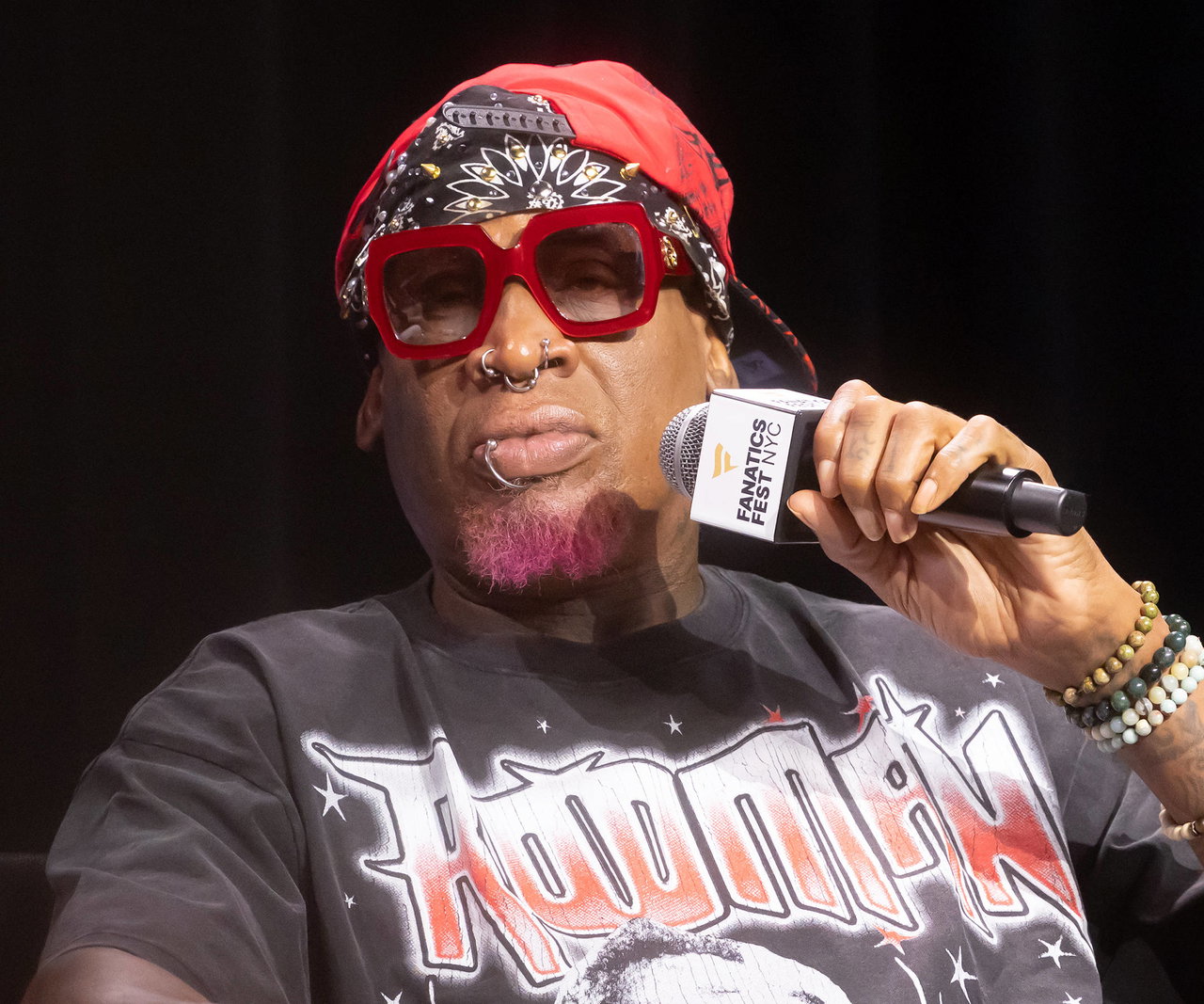
Dennis Rodman, at his peak, was a performer. He changed hair colors like clothes, experimented with makeup, and partied like there was no tomorrow. All that flashiness effectively hid the pain he burrowed within, but the closest to him would always see the truth. The man who seemed like an open book was barely ever one, but at the Fanatics Fest in New York, he flipped the pages of history and went back to his childhood.
Watch What’s Trending Now!
His fashion and experimentation began quite early and had roots in his family situation. So, on a live show of Dwight Howard’s Above The Rim podcast at the Fanatics Fest, the Hall of Famer personally told fans about his childhood and all the struggles he faced.
“Well, I’m totally different today, just like you are,” he said on the Above The Rim podcast. “Just hard work, man. It was a lot of luck, man. A lot of luck when you’re living in the projects and stuff like that. Could have been dead, could have been in prison. I should have been, but I wasn’t. But it’s fortunate that I made it out of the projects and I’m here.”
When Howard asked about the origins of his famous style that was far ahead of his time, Rodman revealed his family’s role in it.
“When I was growing up in the projects, stuff like that, I had no brothers and stuff like that, no male figures. So, my sister had this brain idea to dress me as a girl every day. I mean, every day dress me as a girl every day.”
So, back in 1996, when Rodman showed up to promote his memoir ‘Bad As I Wanna Be’ in a white wedding dress, it was just another side of who he was. But it was also effective in garnering attention. In fact, his memoir was on the New York Times bestseller list for over four months.
And over the years, his style has been almost impossible to box. He experimented with it all: Vegas showgirl, class clown, street style, and sometimes, a bit of all.
The former NBA player revealed some parts of this story before, including in his own memoir. His biography traced how his biological father abandoned him when he was three, and he was raised by his mother and two sisters.
Beyond his fashion influences, The Worm cleared up misconceptions about his motivations, stressing that basketball was purely his ticket out of poverty rather than a pursuit of fame.
“I didn’t play this game to be famous. Hell no! That wasn’t my goal. My goal is to come out here, play basketball, play hard, just try to get out the ghetto, try to make something with my life. I’ve been homeless for four years in the streets. I know what that feels like. You probably see a lot of people in New York homeless and stuff like that. That don’t feel too good, especially when it’s hot. But I got out of that.”
Even as a 20-year-old, his situation had barely improved. He hopped from place to place, having no idea what the next day would look like. He’d stay at a friend’s place, at a park, behind a 7/11, whatever he could find. But the NBA changed his life.
“I lived in the country for a while, and then I went to Detroit, then I went to San Antonio, then I went to Chicago, I went to the Lakers, then I went to the Mavericks.”
From surviving four years on the streets before his collegiate breakout at Southeastern Oklahoma State to becoming a 2x Defensive Player of the Year, Rodman’s journey remains one of the most unpredictable stories in NBA history.