Imago
Credits: Imagn
Imago
Credits: Imagn
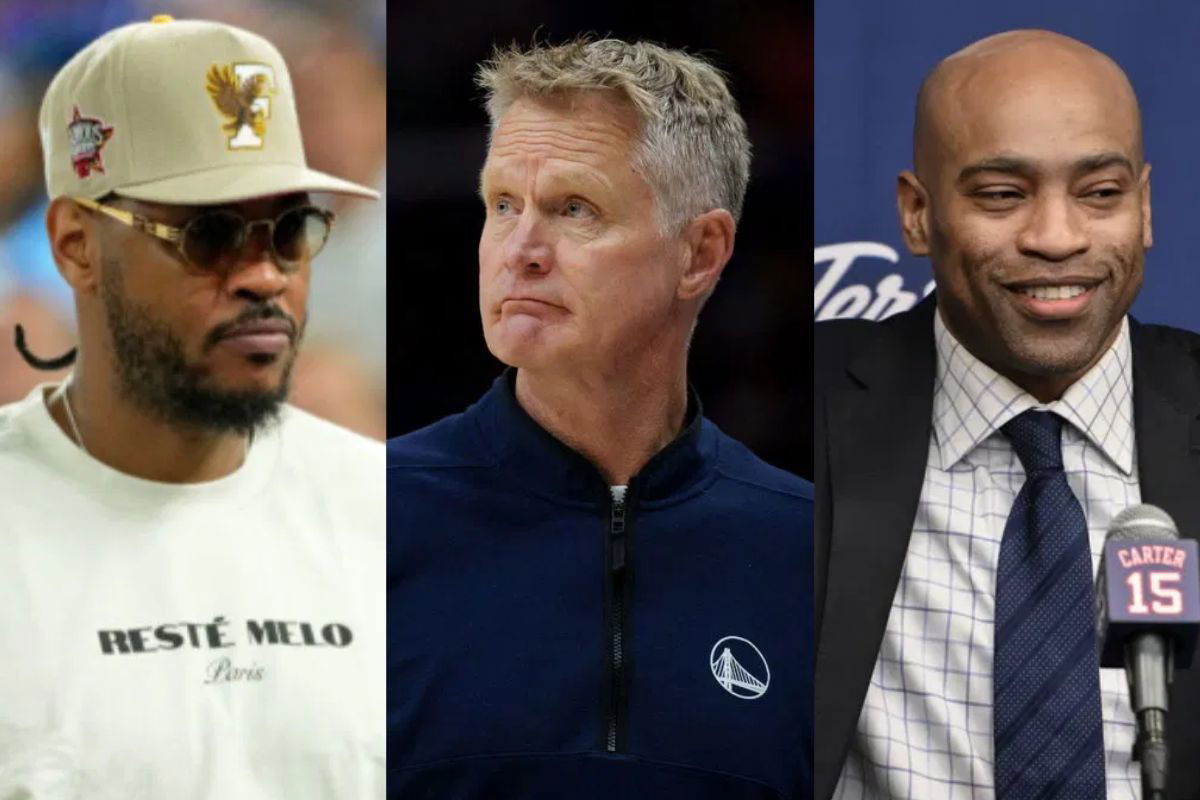
Now that Steve Kerr has taken a conceptual debate to a call to action, the subject of the NBA’s grueling 82-game schedule has reached a fever pitch. However, it’s not just the league office that’s pushing back. Not everyone is on board with Golden State Warriors coach’s recent “emergency” plea to shorten the season. In a powerhouse roundtable discussion at Madison Square Garden, the NBA on NBC crew of Carmelo Anthony, Vince Carter, and Tracy McGrady weighed the pros and cons of Kerr’s proposal, questioning the financial and cultural implications of abandoning a format that has defined the league since 1967.
Watch What’s Trending Now!
The contention behind the retired NBA players’ dissent centers on a mix of economic reality and the grind that defines an NBA superstar. “I don’t think I agree with the decision,” Carmelo Anthony stated bluntly. “Economically, I just don’t see the players… with the BRI [Basketball Related Income, total revenue generated by the NBA and its teams to calculate salary cap and revenue distribution] split the way that it is, I don’t see the players agreeing to that because that’s so much money to be losing, year to year, year in and year out if you take it down 10 games.”
The financial stakes are substantial under the current ~50/50 revenue split. For a star on a max contract, such as Stephen Curry’s $59.6 million salary in 2025-26, a 10-game reduction (roughly 12% of the schedule) could mean forfeiting about $7–8 million in base pay annually, assuming prorated games.
ADVERTISEMENT
Even for a league-minimum or mid-tier player, the hit might range from hundreds of thousands to millions over a career, requiring a full CBA renegotiation to offset through higher per-game rates or other mechanisms.
Vince Carter, who played a record-shattering 22 seasons before LeBron James surpassed that, echoed the sentiment that the 82-game slate is a rite of passage. “Playing an 80-plus game season is just—that’s what comes with being in the NBA,” Carter argued. “When you work your butt off to get here, that’s what comes with it. So why are we changing the format of what’s been great for so many years?”
Through mid-March 2026, the Warriors rank among the league’s most impacted teams by injuries, with approximately $47.4 million in total cash lost due to player absences (per Spotrac’s injury tracker), placing them fifth in the NBA behind teams like the Pacers, Mavericks, Grizzlies, and Trail Blazers.
ADVERTISEMENT
Stephen Curry alone has missed 28 games this season due to a lingering right knee issue (patellofemoral pain syndrome and bone bruising), contributing heavily to the team’s 9–19 record in games without him.
This elevated injury toll, far above the league’s typical distribution, shows Kerr’s urgency in calling for change.
ADVERTISEMENT
Their opinion has been the consensus among the old guard regarding the 82-game schedule. But they also acknowledge that the player injuries are a big problem, especially with Steve Kerr’s team.
Vince Carter, Carmelo Anthony have a radical solution to Steve Kerr’s woes
Steve Kerr’s recent comments calling for a 72-game season to combat a league-wide spike in injuries have been polarizing. Kerr has argued that the modern “pace-and-space” game, which requires more high-speed sprinting and distance covered, makes the traditional 82-game schedule physically dangerous for today’s athletes. He called for an official meeting with Adam Silver and his officials to discuss the possibility of shortening the season.
ADVERTISEMENT
The “pace-and-space” style emphasizes faster tempo and perimeter shooting, a stark evolution from earlier eras. League-wide pace has risen to around 99.3 possessions per game in 2025-26 (per Basketball-Reference), up from the low-to-mid 90s common in the early 2000s.
Three-point attempts tell an even clearer story: teams now average roughly 35–37 attempts per game, compared to just 15–16 in the 2000s and under 12 in the 1990s. This shift demands more sprinting, directional changes, and overall distance covered, amplifying physical wear over an 82-game slate.
Top Stories
“Karma Is a B*tch”: Fans Respond to Caitlin Clark’s Reese-Like Awkward Moment

Shaquille O’Neal Takes a Stand for Bam Adebayo Hours After Charles Barkley’s Choice Words for Heat Star

“USA Basketball Is Ridiculous”: Calls Mount Against HC Kara Lawson as Decision Involving Caitlin Clark Reveals Surprise Team USA Stat

Chelsea Gray’s “Peanut Butter & Jelly” Take Fuels Angel Reese –Paige Bueckers Possible Future in Dallas

Celtics Player Diagnosed With Incurable Condition in 2nd Grade Reflects on “Rough” Childhood

Vince Carter on Steve Kerr suggesting the NBA lowers the 82 game season:
“This game has been good to us. 80 plus games just comes with being in the NBA. When you work your butt off to get here, that’s what comes with it. Why change the format that’s been great for so many… pic.twitter.com/fz3fLN8K8g
— NBA Courtside (@NBA__Courtside) March 15, 2026
ADVERTISEMENT
While Tracy McGrady admitted there were “pros and cons,” noting that fewer games could eliminate the “back-to-backs” that lead to stars sitting out, Carter and Anthony remained focused on the evolution of player preparation.
Melo suggested that the rise in injuries might be linked to how younger players approach their training rather than the schedule itself. “We adapt to the grind… which helps us evolve and get better as a player and understand our body a lot more,” the Knicks legend noted.
T-Mac concluded with a challenge to the current generation. Rather than cutting the season, McGrady proposed a different solution: “Why don’t we come back and teach these guys how we train then and how we prepare for a season? If we want them to stick to 82 games, let’s come back and show them how we train.”
ADVERTISEMENT
Air Canada, who cut back on his insane dunks to minimize injuries, was ready to suit up and demonstrate. But it’s unlikely anything Vince, Melo, or T-Mac could do to help the Warriors get Stephen Curry back from runner’s knee sooner rather than later. Their offer is a token solution at best
Kerr’s Warriors have been among the hardest hit by injuries regardless. With the revenue split between owners and players currently at roughly 50/50, any reduction in games would require a massive renegotiation of the Collective Bargaining Agreement (CBA), a hurdle that analysts say most owners are currently unwilling to clear.
ADVERTISEMENT
ADVERTISEMENT
ADVERTISEMENT