
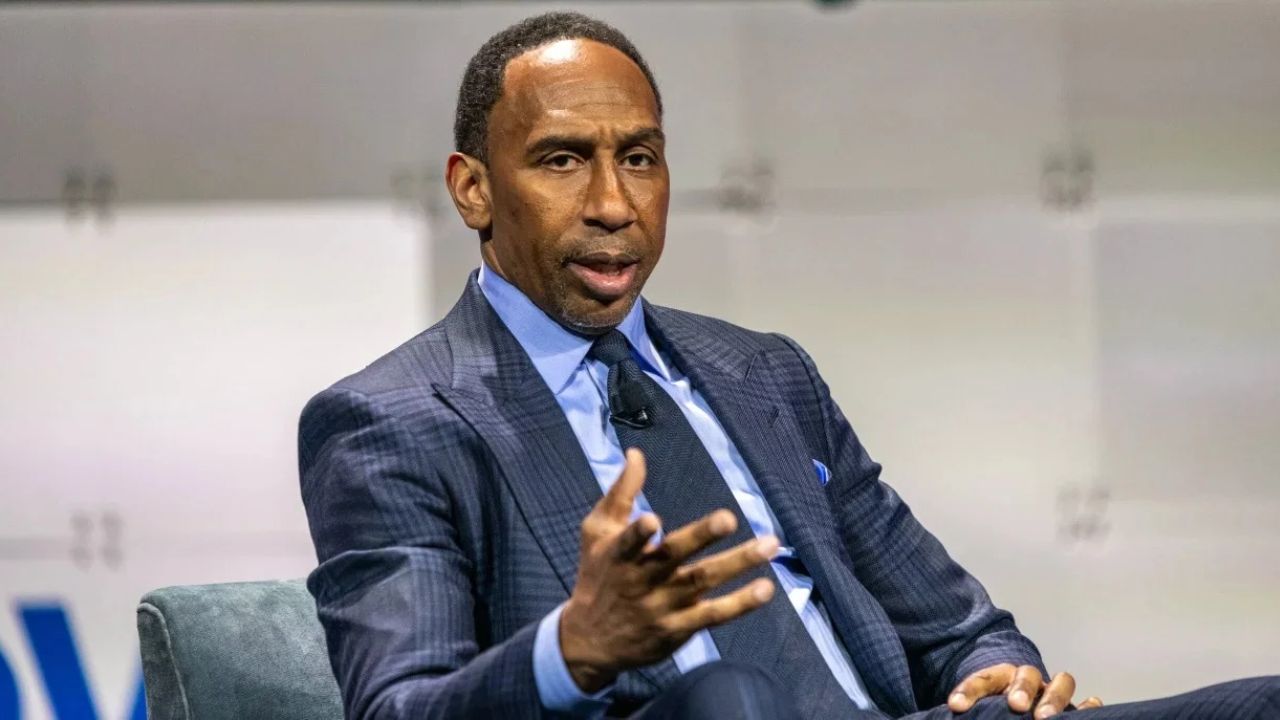
Stephen A. Smith is not backing away from his controversial racial comments about the Lakers’ predominantly white core. In his defense, he has now rolled the clock back two decades. He brought Larry Bird into an increasingly heated debate with sports commentator Clay Travis. Smith believes his critics have misunderstood his point.
Watch What’s Trending Now!
However, the latest defense raises another question: does Bird’s own experience justify the way Smith framed the Lakers discussion?
“It’s interesting that you forget a few things, Clay, Clay Travis,” Smith said on the latest episode of The Stephen A. Smith Show: Straight Shooter. He directly addressed Travis’ criticism by recalling a star-studded roundtable interview.
“I got a quote here. And this is a quote. It was, it aired on June 10th, 2004. It was before Game 3 of the NBA Finals; it was a roundtable that included Magic Johnson, LeBron James, Carmelo Anthony, and Larry Bird; it was hosted by the great Jim Gray. And on that panel, Bird, as in Larry Bird, that dude, recalled asking white players assigned to guard him whether they’d had a problem with their coach. Larry Bird went on to say, quote, I just didn’t want a white guy guarding me because it’s disrespect to my game. Larry Bird said that. That is a quote from Larry Bird. I don’t know what Clay Travis’s comments were. I don’t know what Clay Travis’s comments were in the aftermath of that Larry Bird comment.”
He then challenged his critics:
“Larry Bird, who is considered universally one of the greatest players to have ever lived, and even with Jerry West, the great Jerry West, being a silhouette, the great Maravich being something special to behold. Along with various other great players who happen to be white. Larry Bird said that. How y’all feel about that? Was there an uproar over that? Did you get a Larry Bird for saying that?”
Stephen A. Smith argued that discussing race in basketball from a historical perspective should not automatically be interpreted as hostility toward white players.
“I’m not going to say the word inferior or anything like that, because Larry Bird was inferior to no one. Jerry West was inferior to no one, along with a host of other players. I’m simply making the point, as we sit here and we discuss this, did you bring up, were you in an uproar over that? Is the league 65 to 70 percent black by accident? Considering America and the country that we live in, who has dwindled, once upon a time was 85 to 90 percent white. And it has dwindled down to 57 percent white, but it is still the majority of this country.”
Smith aimed the reference particularly at Clay Travis. He had accused Smith of promoting racial division after his comments on First Take.
Travis argued that questioning whether Black players would allow white stars to win a championship was a double standard, adding that a white commentator making the reverse argument would face severe consequences. Smith had already called Travis out on First Take, insisting that he meant what he said and had no intention of apologizing.
Stephen A. Smith’s defense went beyond Bird.
He framed his argument around the historical prominence of Black athletes in the NBA and the significance of a team led by three white players challenging for a championship.
He also made it clear that he was not rooting against Los Angeles. In fact, Smith argued that the Lakers’ success could benefit the league, particularly with the 2028 Olympics approaching in the same city.
“Do you have any idea what’s in store for the future of Luka Doncic? Because of how bad that brother is?” Smith said, describing Doncic as a “global iconic basketball figure.” He also pointed to Austin Reaves’ production, arguing that a successful Lakers team featuring both players would have enormous appeal.
The controversy began building earlier in the season.
After the Lakers acquired Walker Kessler in July, Smith questioned whether a team relying on three white players as its leading options could win a championship. His comments escalated a few days ago when he challenged Black players across the league to prevent the Lakers from winning the title.
Amid the chatter, the Lakers have opened the season 14–3, establishing themselves among the Western Conference’s leading contenders.
Kessler, meanwhile, has offered a much simpler response to the racial framing. Speaking on The Young Man and the Three, he said, “I don’t really care. I mean, I’m just gonna be completely honest. You know, I think regardless of if we were white, black, or whatever, like we’re just playing basketball, man. At the end of the day, like it really doesn’t matter. Like if you can play this game, like you can play this game. It doesn’t matter what you look like.”
He also appeared comfortable with the playful “Snowtime Lakers” nickname circulating around the team.
Smith’s argument now rests on two separate claims. t
Race has historically shaped basketball’s public identity, and that the Lakers’ current success challenges assumptions about who can lead a championship contender.
For now, the Lakers’ postseason results remain the biggest unanswered part of the debate.