
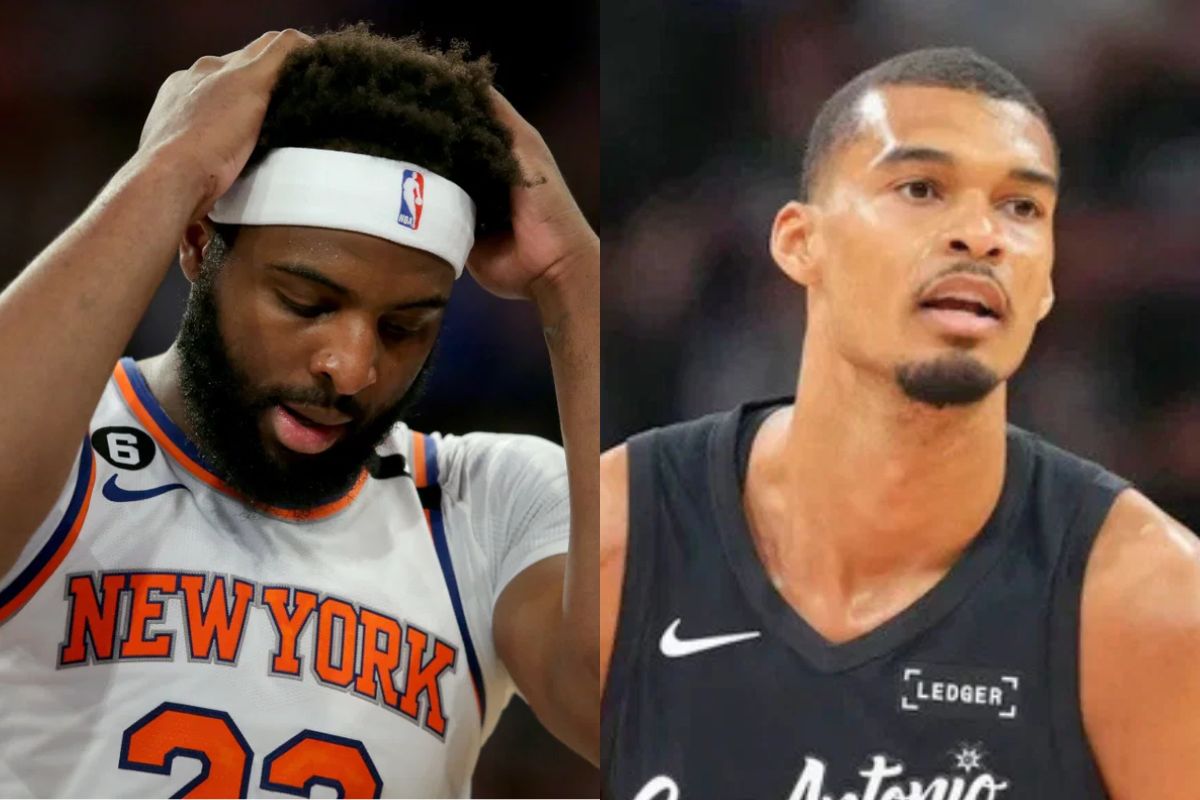
The NBA Finals finally got the flashpoint everyone expected. After a relatively controlled and technical Game 1, the tension that had been simmering beneath the surface erupted early in Game 2 on Friday night. With emotions running high, Victor Wembanyama looking determined to make a statement, and Mitchell Robinson embracing the physical battle inside, it didn’t take long for the series to produce its first major confrontation. Midway through the second quarter, what began as another bruising exchange between the two big men quickly escalated into a heated scuffle, bringing players together and forcing officials to step in.
Watch What’s Trending Now!
The altercation was broken up before it could spiral further, but the referees’ decision in the aftermath immediately became the bigger story. With the Spurs clinging to a 46-42 lead and less than five minutes remaining before halftime, only Robinson was assessed a technical foul, a ruling that left many questioning whether justice had been served equally. The call sparked an instant debate, and some of the strongest reactions came not from the benches but from the broadcast booth. Former NBA champion Richard Jefferson had the most damning analysis of the entire incident.
“It is physical, I don’t disagree with this,” said Jefferson. “Watch this. Wemby turns and pushes him, Wemby pushes him, and then they push each other back. And that’s when the technical occurs on Mitchell Robinson.”
Mike Breen agreed with him, claiming, “that should be a double technical,” to both Robinson and Wemby. But Tim Legler doubled down with the lack of necessity on this play by adding, “Or nothing.”
RJ added, “Jostling here, this is normal basketball. Now Wemby, he pushes him back. That could’ve been a technical on Wemby and then he pushes him back, and now you’re like, ‘Oh, that’s a technical on Robinson.’ You got to call this thing even right down the middle for both players.”
The replay only added fuel to the controversy.
It was Wembanyama who appeared to initiate the confrontation, raising questions about why the Spurs star escaped punishment altogether.
Wemby initiated the contact by pushing Robinson. The Knicks center retaliated with a forceful shove of his own, sending the Spurs big man backward. Wembanyama responded in kind before quickly putting his hands up in an apparent attempt to de-escalate the situation and walk away.
However, Robinson seemed intent on continuing the exchange, pursuing the French phenom and appearing to make a second attempt at shoving him before teammates and officials stepped in.


Mitchell Robinson was given a technical foul for this interaction with Victor Wembanyama.
The controversy surrounding the technical foul only grew louder as the game became increasingly physical. Moments later, New York found itself in even more trouble when Josh Hart was assessed a Flagrant 1 foul after grabbing Devin Vassell’s ankle and sending him tumbling to the floor.
Unlike the Wembanyama-Robinson incident, however, there was little room for debate on this call. The play immediately drew comparisons to Hart’s infamous ankle-grab on Jimmy Butler during the Knicks’ 2023 playoff matchup against Miami.
Beyond those flashpoints, the officiating had been relatively balanced. Much like Game 1, both teams were being whistled at a similar rate, and neither side could reasonably argue that fouls were being called disproportionately.
Spurs guard Stephon Castle, for example, picked up three personal fouls before halftime as officials attempted to keep the escalating physicality under control.
That is why the second-quarter confrontation remained such a talking point. The issue wasn’t the game’s overall whistle; it was the handling of that specific sequence.
Physicality peaks in Game 2
The baseline for this heated matchup was set in Game 1, a grueling contest that established just how physical this series would become. Heading into Game 2, both frontcourts were the dominant storyline.
While the Spurs have the generational talent in Victor Wembanyama, Mitchell Robinson has been dealing with lingering injury concerns that put his availability for the Finals in question.
However, his presence in the lineup for Game 2 after he reportedly had surgery for a broken bone in his shooting hand signaled the Knicks’ intent.
Robinson played just 10 minutes in Game 1 and finished with only two points, but his impact extended far beyond the box score. The Knicks inserted him specifically to bring a level of physicality that could disrupt Wembanyama’s rhythm, and the strategy worked.
The Spurs star struggled to find consistent answers against the rugged defensive approach, and San Antonio eventually squandered a 14-point lead before falling 105-95.
Wembanyama made it clear afterward that adjustments were coming, and he backed up that promise from the opening tip of Game 2.
Playing with noticeably more aggression and edge, the French phenom appeared determined to attack Robinson at every opportunity. It didn’t take long for their individual battle to become one of the game’s biggest storylines.
In one sequence, Wembanyama crossed up Robinson so badly that the Knicks center stumbled and dropped to one knee.
The crowd erupted, Wembanyama fed off the energy, and the intensity between the two big men only grew.
Not long afterward, that simmering rivalry boiled over into the confrontation that resulted in the game’s first technical foul.
The technical foul may have been handed out in a matter of seconds, but the aftermath lingered well beyond the whistle.
As players returned to their positions and the game resumed, cameras continued searching for reactions, and they found one that quickly caught viewers’ attention. While Robinson was still visibly frustrated with the ruling, an entirely different response emerged from the Knicks bench.
Head coach Mike Brown was caught on camera laughing after the technical foul was assessed. Whether he was reacting to the sequence itself, the officials’ decision, or simply the chaos of the moment was unclear, but the timing was impossible to ignore.
This was no longer just a battle of schemes, adjustments, and shot-making. The series had evolved into a test of composure, mind games, and emotional control.