
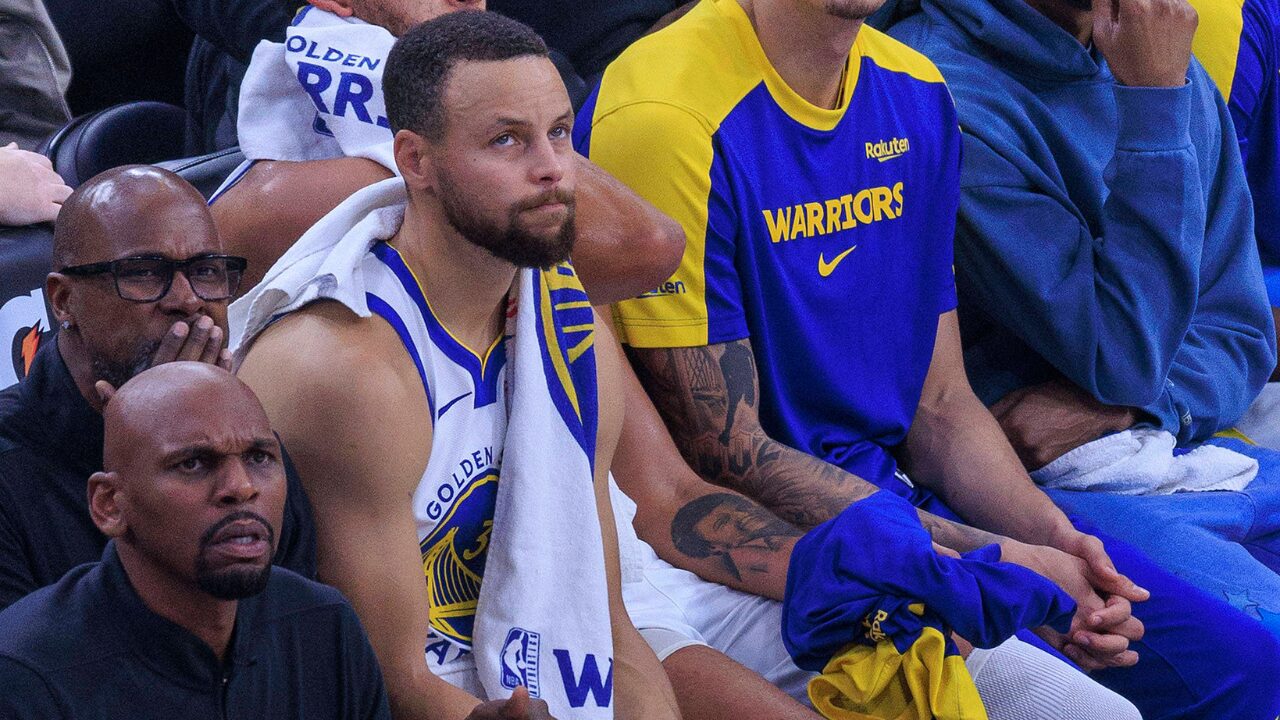
In the spring of 2012, Stephen Curry faced a problem that threatened to change the course of his career before he had a chance to reach his full potential. After repeated right-ankle injuries and a setback following his first surgery, Curry underwent another procedure on April 25. The worst-case scenario discussed with surgeon Richard Ferkel involved rebuilding the ankle with tendons from a cadaver.
Watch What’s Trending Now!
The uncertainty followed Curry into rehabilitation. Looking back on that period in a 2018 interview with Australia’s Nine Network, he recalled how difficult it was to keep going without knowing when things would improve. “I’d just had my second surgery on my ankle. … in that moment it really tested my mental strength to get through the dog days of a second summer of rehab, and not really know where the end was going to be.”
Fourteen years later, Curry is a four-time NBA champion, but an injury scare has brought those memories back into focus. He limped off during the Golden State Warriors’ open practice on Sunday, October 18, ahead of their season opener against the Los Angeles Lakers. Coach Steve Kerr offered reassurance, while ESPN reporter Anthony Slater reported that Curry’s right ankle was the problem, not his knee, and that his availability for Wednesday remained uncertain.
“He’s fine. I went and talked to him after he went downstairs and I went in the training room, he’s doing fine,” Kerr said after practice.
Slater provided the more specific update on X: “Steph Curry tweaked his right ankle at the open scrimmage tonight. TBD on his status for the Warriors opener at Lakers on Wednesday, but team source reiterated it’s ‘not serious.’”
The update offered some relief, but it did not settle the question Golden State needed answered. Curry had left the court, and the Warriors still did not know whether he would be available for their opening game.
The initial fear was that Curry had hurt his right knee again. That concern was understandable after the 2025-26 season, when a knee problem kept him out for 27 consecutive games and limited him to just 43 appearances.
The knee problem changed the conversation
Curry missed more than two months with patellofemoral pain syndrome, commonly called runner’s knee, along with bone bruising. The condition forced him to rebuild his workload carefully over the summer rather than simply return to his usual routine.
In September, Curry explained the plan behind that approach. “Feeling fantastic. There was a very particular and kind of prescriptive plan over the course of the summer of what I could do on court (and) off court to build the foundation back but give my knee some rest.”
The plan was designed to help him return to his normal level without overdoing it before training camp. Curry also acknowledged that last season’s absence would remain in his mind as he tried to stay available throughout the new campaign.
“I think because I missed so many games last year that that’s going to be like top of mind, and obviously should be. But anybody at this age and with the number of miles, you’re managing something. So, it’s kind of part of the longevity aspect of this, and I’m not afraid of it,” Curry said.
That distinction matters. The Warriors’ concern is not that his early-career ankle problems have suddenly returned in the same form. It is that Curry is coming off a season in which his knee required extended management, and another setback could complicate a plan built around keeping him available.
The ankle diagnosis was encouraging compared with the possibility of another knee problem. Still, the team had not disclosed the severity of the sprain or confirmed that Curry would play against the Lakers.
Golden State cannot afford many more absences
Curry’s injury would be a difficult problem for any team, but the Warriors are entering the season with several other important players unavailable. Jimmy Butler is recovering from ACL surgery, Moses Moody is recovering from a ruptured left patellar tendon, and Kristaps Porziņģis remains out indefinitely with an undisclosed health issue.
Charles Bassey is also dealing with knee tendinitis. Kerr described him as a potential candidate to miss Wednesday’s game, while Brandin Podziemski’s status remained unclear after he missed the open scrimmage.
The absences leave Golden State with fewer options at both ends of the floor. Butler’s injury removes a major secondary shot creator, Moody’s absence thins the wing rotation, and Porziņģis’ situation limits the team’s frontcourt choices.
Podziemski’s availability is particularly relevant if Curry cannot play. Kerr had been leaning toward a starting group featuring Curry, Podziemski, Gui Santos, rookie Yaxel Lendeborg and Draymond Green, with Green at center.
Without Curry, Brandon Williams and De’Anthony Melton would be among the possible options to handle more of the ball-handling duties. If Podziemski is also unavailable, the Warriors’ backcourt would become even thinner.
Curry’s absence would not simply mean losing a leading scorer. His movement without the ball forces defenders to follow him far beyond the three-point line, creating space for teammates to attack the basket or find open shots.
Green can help organize the offense through handoffs and passing from the top of the key, but he cannot reproduce Curry’s shooting threat. The Lakers would have more freedom to crowd the paint and put pressure on Golden State’s other creators.
The numbers show how much Curry changes the offense
Golden State’s numbers from last season underline the size of that challenge. According to StatMuse, the Warriors recorded an offensive rating of 119.3 in games Curry played, compared with 110.7 in games he missed.
That difference of 8.6 points per 100 possessions is substantial. The figures cover different groups of games and do not prove that Curry alone explains the entire gap, but they show how much the team’s offensive production changed with him available.
Curry averaged 26.6 points and 4.7 assists in 43 appearances last season. Podziemski averaged 11.7 points and 3.4 assists, making him a useful secondary option rather than a direct replacement for Curry’s scoring and playmaking.
Melton offers defensive value and can handle the ball, while Williams could be asked to take on more responsibility if Curry sits. Neither has established himself as a primary creator capable of replacing Curry’s role over an extended stretch.
That leaves Kerr with a difficult balance. The Warriors can spread the responsibility across several players, but they cannot expect one of them to replace Curry’s production, movement and effect on opposing defenses.
Curry’s ankle history tells a more complicated story
The sight of Curry limping away also brought back memories of the injuries that once led to doubts about his durability. He underwent right-ankle surgery in May 2011 after repeated sprains, then needed another procedure in April 2012.
Former Warriors general manager Bob Myers later described how unusual those injuries had been. Reflecting on Curry’s early struggles in an ESPN TrueHoop feature, Myers said: “He was turning his ankle in completely nontraditional, crazy ways. … It was scary. I’d never seen someone sprain his ankle like that prior to Steph. And I haven’t seen it since.”
Curry eventually moved beyond that period. He played 78, 80, 79 and 82 games in four consecutive seasons from 2012-13 through 2015-16, showing that the early ankle problems did not define the rest of his career.
That history is important, but it should not be confused with the current injury. The 2012 surgery involved a serious ligament problem, while the Warriors have described the latest incident as a right ankle sprain without disclosing its grade.
The more immediate concern is how the ankle affects Curry’s carefully managed return to full basketball activity. The Warriors had already reduced his preseason workload as they looked to preserve him for the long season ahead.
Kerr acknowledged before the injury that managing Curry and the team’s other veterans would be necessary. “But to be really frank, every year we run into this (situation) where, if we have a bunch of games stacked together… So, I would just come out and tell the fans out there to be mindful when you’re buying the tickets, of the schedule. Take a look. Because we’ve got not just Steph but multiple vets we are going to try and manage, because it’s the only way we can do this.”
Curry has also made clear that staying available matters more than chasing a heavy workload early in the season. “But I’d rather (play) 65, whatever, games, 70 games, with the big picture in mind,” he said in October.
The Lakers opener now carries another question
The Warriors are scheduled to face the Lakers at Crypto.com Arena on Wednesday, October 21. The matchup will feature Luka Dončić leading a reworked Los Angeles team, while Golden State is still working through its own availability concerns.
Curry’s presence would give the Warriors their most reliable source of shot creation and force the Lakers to account for his range and off-ball movement. Without him, Golden State would have to find offense through a less proven group while dealing with the Lakers’ size and Dončić’s ability to control possessions.
The next update on Curry’s ankle will matter more than any speculation drawn from the practice footage. As of the latest confirmed reports on Monday morning, the Warriors had not issued a definitive game-status designation, and Slater’s report still listed Curry as questionable in the practical sense of an unresolved decision: his status was “TBD.”
For now, the initial assessment is encouraging, but it is not clearance to play. After a season in which Curry missed 27 straight games, Golden State has every reason to be careful with its most important player.
The Warriors built their offseason plan around giving Curry the best chance to stay on the floor. Whether this ankle scare becomes a brief interruption or affects the opening-night lineup will depend on the next update, not the relief of the first one.