
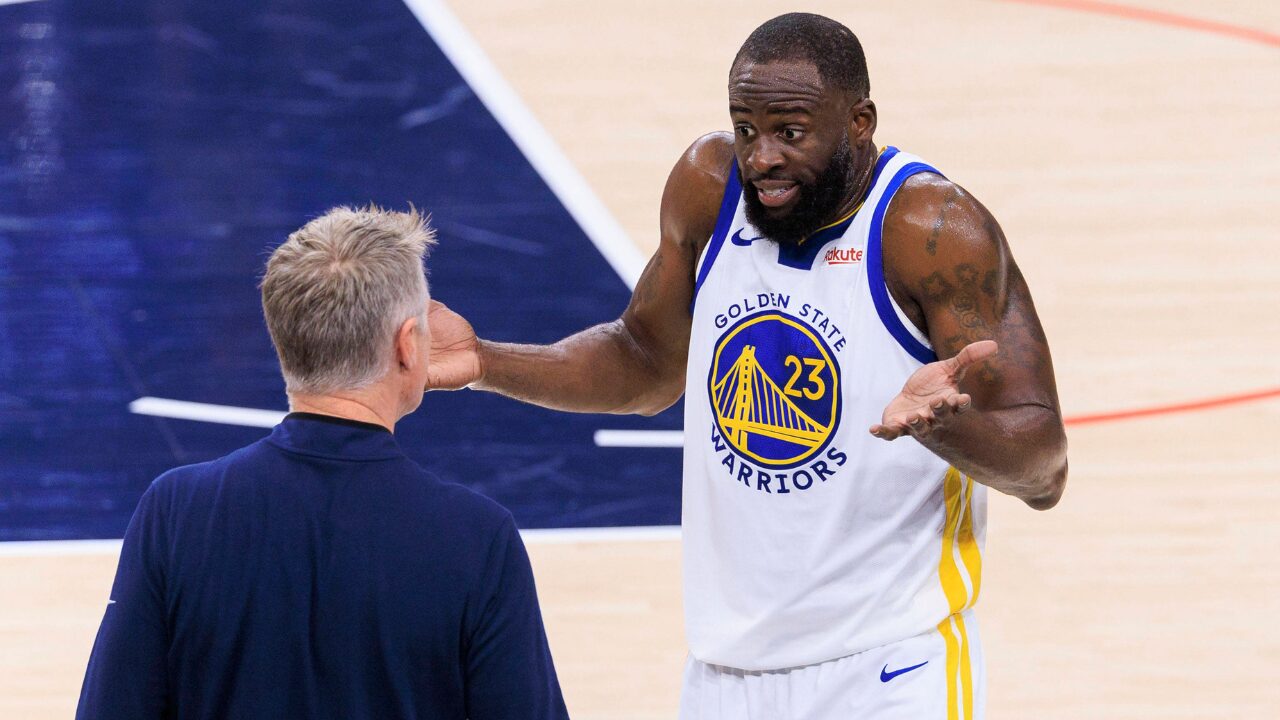
In December 2023, Steve Kerr drove to Draymond Green’s Los Angeles home after the Warriors forward had been suspended indefinitely for striking Jusuf Nurkić. They sat in Green’s backyard for nearly two hours. Both men cried. Green later recalled Kerr telling him, “I want you to end this the right way. I want us to end this the right way. And you’re not doing that right now.”
Watch What’s Trending Now!
For a while, that seemed to capture the strange place Kerr and Green had reached after nearly a decade together. They had gone from “three knockdown, dragouts a year” in Kerr’s first five seasons to a long truce, four championships and a relationship Kerr described as deeper than basketball. But in December 2025, another major blowup forced the two back into uncomfortable territory. Kerr later admitted that there were things Green had done he could never forgive, even while saying he would “do anything for him.” That complicated relationship has now spilled into another private exchange.
“Since he shared what I shared with him in private. I feel it’s only right that I share what he shared with me in private,” Kerr said on the Tom Tolbert Show. “At the end of the year we had our exit meeting, and he said, ‘Hey, I want to thank you for your patience, because you’ve been really patient with me.’ And I think it’s been well worth it. I mean, he’s a guy I will say forever. We don’t have a single championship without him. The guy’s that impactful on winning. This year I need the same patience from him. Because this is going to be an interesting year, a transition year of sorts. And we’re going to do some things differently, and he and Steph obviously have this great rapport.”
The latest chapter did not begin with Kerr asking Green for patience. It began months earlier, when the two again found themselves on opposite sides of a timeout.
On December 22, 2025, the Warriors were trailing Orlando 71-66 when Green committed a turnover and continued engaging with an official. Kerr called timeout, believing the team had lost its focus, and tried to get Green into the huddle. The two began arguing. Moses Moody and assistant coach Jerry Stackhouse tried to calm Green before he eventually walked to the locker room.
Green returned to the bench before the fourth quarter but never checked back into the game. Kerr said he would not have put him back in. Golden State still won 120-97, with Stephen Curry scoring 26 points, but the victory became secondary to the scene between the coach and his veteran forward.
Green later explained that he left because he could tell the confrontation was not going to improve. “I don’t think it was a situation where it was going to get better,” he said. “It was best to remove myself.” Kerr, meanwhile, initially kept the details private. “Everything is private,” he said after the game. That privacy did not last forever.
According to the Warriors’ floor general, Kerr had candidly told him it had become “incredibly hard” to support him publicly. In return, however, Green just said, “Don’t.”
Green later recalled that Kerr’s admission seemed to lift a weight from the coach. “I could see the weight lifted off his shoulders,” Green said. “Like, what? Yeah. Don’t.” The exchange offered a glimpse of how different their relationship had become: Kerr was no longer simply defending Green because he was one of his stars, while Green was telling his coach he could live with the consequences of his own actions.
That honesty had already surfaced in another conversation. After Kerr’s comments to The New Yorker about the things Green had done that he could “never forgive,” Green addressed the December confrontation on his own podcast. He said he had eventually told Kerr, “I don’t think you like me. I don’t think you’ve ever liked me, if I’m honest.” Green said Kerr cried after hearing it.
Yet Green did not leave the story there. “I’m not who I am today without Steve Kerr,” he said, crediting his coach with teaching him how to win and shaping the person he became. For Green, the two truths could exist at once: Kerr had done things he could not forgive, and Kerr had still changed his life.
With the Warriors entering what he called a transition year, the coach warned that Green will have to adjust. “We’re not going to take away from that, but he’s going to have to adapt a little bit, and it’s probably going to be a little frustrating at times, so I’m going to need his patience, too,” Kerr said.
The transition Kerr is describing is not simply about asking Green to behave differently. Golden State is trying to reshape an aging core without discarding the players who built the dynasty. Kerr has said that means the veterans themselves have to be open to new ideas, including changes to how they practice, prepare and approach their days.
He emphasized that the Dubs wouldn’t have won any of their four championships without him. Green’s defense, playmaking and chemistry with Curry have made him central to the dynasty, even as managing him has occasionally tested Kerr.
That importance has never really been in question. Kerr has called Green one of the most impactful players in Warriors history, while Green’s value has never depended solely on his scoring. His ability to defend across positions, quarterback the defense, screen for Curry and keep Golden State’s offense moving has made him one of the team’s foundational pieces.
There have been basketball disagreements too. Green previously claimed that Kerr limited his offensive growth, particularly after Kevin Durant arrived in 2016, and said Golden State never ran a play exclusively for him. Green raised that criticism publicly in April 2026, arguing that his role changed once Durant joined the Warriors and that Kerr may have hindered what he could have become offensively. His scoring did drop from a career-high 14.0 points per game in 2015-16 to 10.2 in Durant’s first season, although the decline alone does not establish that Kerr “hindered” his career.
That history makes Kerr’s latest request more complicated. Green is not simply being asked to accept a smaller role or swallow another criticism from his coach. He is being asked to trust that the next version of the Warriors can still make room for what he does best—even if it looks different from the team that won four titles.
Kerr has supported Green through arguably the worst phase of his career, when he kept getting ejected. In 2023, after he was tossed for striking Jusuf Nurkic in the face, Kerr publicly stepped in to say that this problem was bigger than basketball and that, for him, it was about “helping” the person, not the player.
“It’s an opportunity for Draymond to step away and to make a change in his approach, in his life, and that’s not an easy thing to do,” Kerr said. “It’s not just about an outburst on the court. This is about his life. Look at the past year and what’s happened, it’s clear he needs the opportunity to change. And that’s what an indefinite suspension gives him the opportunity for.”
The comments carried more weight because Kerr had already taken that concern beyond the podium. When Green was suspended indefinitely in December 2023 after striking Nurkić, Kerr went to his home in Los Angeles. Green later described the backyard conversation as an emotional one, with both men crying as Kerr urged him to “end this the right way.” Green ultimately missed 12 games during the suspension.
It was also part of a larger stretch of trouble for Green. Just a month earlier, he had been suspended for five games after putting Minnesota’s Rudy Gobert in a headlock. The Nurkić incident was therefore not an isolated flashpoint, which helps explain why Kerr framed the indefinite suspension as an opportunity for Green to change his approach rather than simply serve a punishment.
Even the courtside image from the end of last season, when the Warriors crashed out of the play-in game, of Kerr, Curry and Green in a huddle will be remembered for a long time. The coach and floor general were both out of contract, and Kerr was heard telling his two pillars: “I don’t know what’s gonna happen next, but I love you guys to death.”
The moment came after Golden State’s 111-96 loss to the Phoenix Suns on April 17, 2026. Kerr’s contract had expired, and he acknowledged that his future was uncertain. “I still love coaching, but I get it, these jobs all have an expiration date,” he said, while also making clear that any return to Golden State would need Curry to remain part of the equation.
Green, meanwhile, was facing his own uncertainty. He had a $27.7 million player option for the following season and told reporters, “I’m not retiring. Hopefully, I’ve done enough to still be here.”
Months later, both Kerr and Green signed new short-term deals and will somehow try to run it back again. Kerr ultimately returned on a two-year deal, while Green exercised his player option, keeping the coach and veteran forward together for another season. But the point here is that Kerr knows all jobs have an “expiration date,” and he was prepared to let go with nothing but gratitude.
That makes Kerr’s latest comments less like a warning that the relationship is breaking and more like an acknowledgment that it has entered another phase. He has spent 12 years learning when to push Green, when to defend him and when to let him walk away from a confrontation. Now he is asking Green to offer some of that same patience in return.
And perhaps that is the most telling part of Kerr’s response. After all the arguments, suspensions and private conversations, he still began his message by reminding everyone what Green means to the Warriors: “We don’t have a single championship without him.”
The challenge now is whether that bond can survive a Warriors team that can no longer simply recreate the version of itself that made Green indispensable in the first place.