
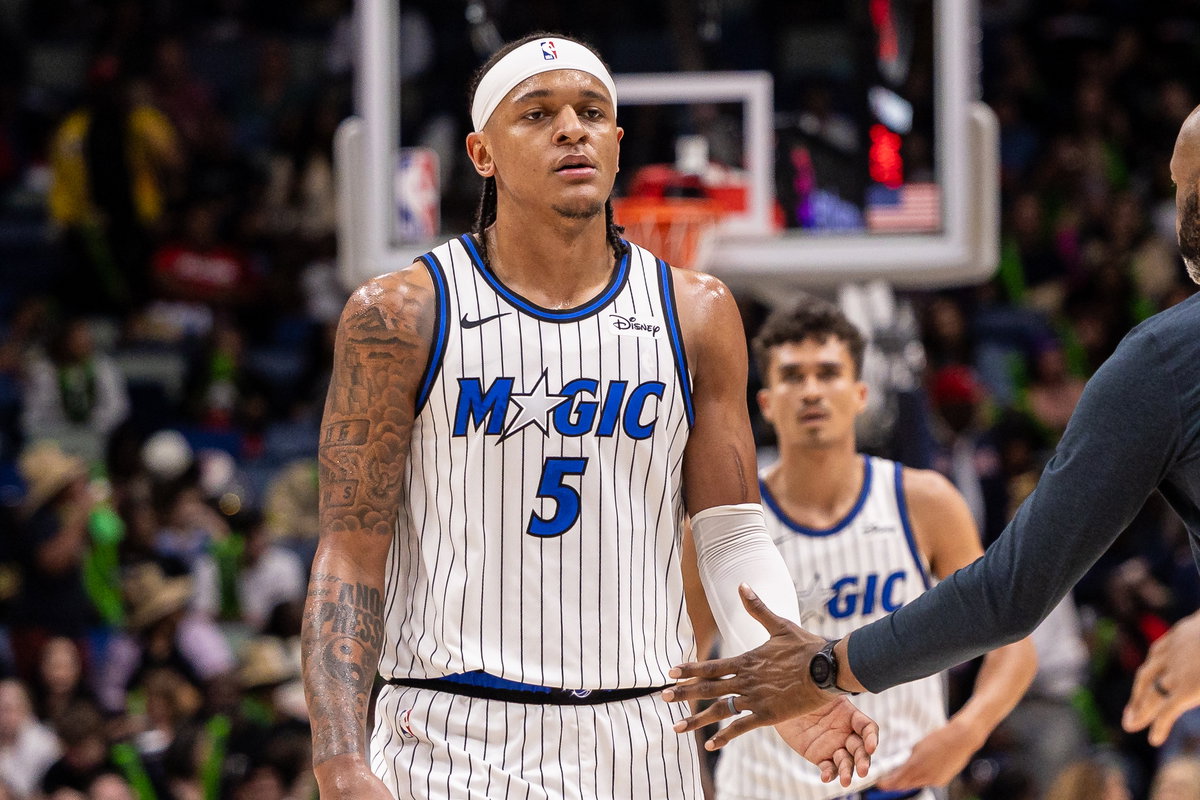
Game 5 offered the Orlando Magic nothing, not a lead, not momentum, not even a flicker of control. It was 48 minutes of chasing shadows. Game 6 was supposed to be the answer. Back home, with the crowd surging behind them and a chance to advance, Orlando didn’t just respond; they exploded. By halftime, they were up 22, dictating every possession, feeding off the energy in the building. It felt over. It felt inevitable. And then, it vanished.
Watch What’s Trending Now!
In a collapse so sudden it bordered on surreal, the Magic lost not just their lead, but their rhythm, their confidence, everything. For a staggering 45 minutes of game time, Orlando couldn’t buy a basket. What began as redemption night turned into something far more haunting: a game they controlled, a moment they owned… and a lead they somehow let slip into silence. The Detroit Pistons came back from a 24-point deficit to force Game 7. They held the Magic to just 19 points in the second half and only eight points in the fourth quarter. This was the largest comeback by any road team in the NBA playoffs since 1996-97.
“The Magic went 1-27 shooting over the final 16 minutes of tonight’s game, making 1-of-20 shots in the fourth quarter…. An absolutely stunning, inexcusable loss,” NBA insider Brett Siegel mentioned on X.
It is difficult to rationalize how a game can unravel so completely. Basketball is often described as a tale of two halves, but collapses of this magnitude, especially at home, are exceedingly rare. The Orlando Magic did not merely start well; they executed a near-perfect first half. The ball moved crisply, possessions were purposeful, and every player who saw the floor contributed on the scoreboard.
Everything aligned with their intended game plan. And yet, what followed bore no resemblance to what came before, a sharp, almost inexplicable departure from control to chaos.


Orlando went 45 minutes between made baskets, going scoreless from 8:46 PM ET to 9:31 PM ET 😳 The Magic's 23 straight misses were the most by any playoff team this century.

Desmond Bane and Paolo Banchero combined for 25 first-half points. In response, the Pistons’ highest scorer was Tobias Harris, with 10 points.
The message in the Pistons locker room was “staying in the moment”. JB Bickerstaff asked his team to focus on each possession at a time. “We weren’t going to get it all back at once,” said the Pistons head coach. Carrying that mindset, the Pistons came out searing. They went on a 51-15 run from the start of the third till nearly the end of the game. They held the Orlando Magic to just four made field goals. Banchero and Bane went 2/20 from the field in the second half.
The closest modern parallel comes from the 2018 Western Conference Finals Game 7- a game that has become synonymous with offensive collapse, but even that doesn’t quite mirror what unfolded here.
Houston’s failure that night was historic in its own right. The Houston Rockets missed an NBA-record 27 consecutive three-pointers, shooting just 7-of-44 from deep overall. It was a brutal, prolonged drought that flipped the game and ultimately handed the Golden State Warriors a 101–92 comeback win.
But even in that collapse, the context was different. The Rockets’ offense was heavily skewed toward high-volume three-point shooting- a system that, by design, lives and dies on variance. Their misses were catastrophic, but not entirely detached from how they played. They also did not control the game in the same commanding, wire-to-wire fashion being discussed here.
That’s what makes this situation more perplexing. The comparison exists only in scale- a prolonged inability to score, but not in structure. Houston’s drought was an extreme version of its identity unraveling. This, by contrast, feels like a complete abandonment of one.
JB Bickerstaff commends the Pistons for playing for each other
Bickerstaff was the happiest man in the room after Game 6. The Pistons’ head coach could only praise his players’ mindset and selflessness for their 24-point comeback in Game 6. Players made immense sacrifices. Think about an All-Star center in Jalen Duren taking just six shots in a series he has largely struggled in. They can put their egos aside for the team’s sake.
“They are so connected, and they just don’t want to let each other down,” the Pistons head coach said about the group.
Similar to Game 5, franchise cornerstone Cade Cunningham ran the second half. He followed up his 45-point performance with 24 second-half points that also included four steals and a block. But the box score was just one side of the story. Cunningham executed his plays on the offensive end.
However, the Pistons won because their defense showcased grit. Guys like Paul Reed and Amen Thompson hardly made a scoring dent during the Pistons’ historic stretch. But defensively, they created chaos. The tandem had seven blocked shots in between them. And it wasn’t as if the perimeter was left vulnerable. The Pistons held the Magic to just two made threes in the second half out of 11 attempts.
The team didn’t need an inspiring talk or a hammering from Bickerstaff to look alive in the second half. They share a connection in which everyone wants to perform for each other. That energy was on complete display tonight.
The one seed in the East didn’t want to go down without swinging. But they delivered a demoralizing knockout blow to the Orlando Magic. With that, Detroit has created an opening that didn’t exist after four games in this series. They’ll play a Game 7 at home on the back of showing incredible resilience.
With everything to play for, the Pistons might have just stolen the Magic’s mojo. All they have to do is avoid falling into a situation even remotely close to what happened in Game 6. Because the Pistons just proved no lead is safe against them.