
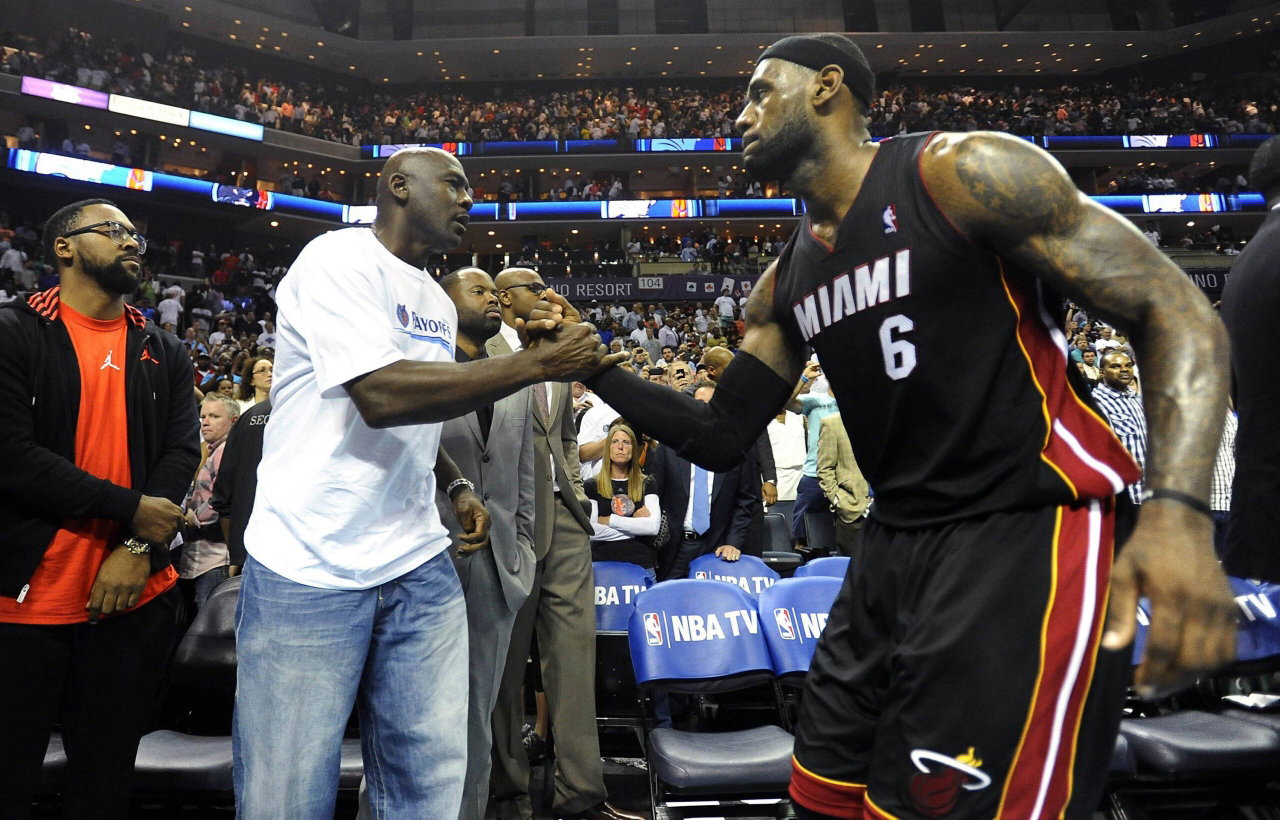
For a young LeBron James, watching the Chicago Bulls on WGN felt less like watching a basketball game and more like a night at the movies. When his family finally got cable television, he could watch Michael Jordan in action, and the experience stayed with him long after those broadcasts ended.
Watch What’s Trending Now!
“Obviously, when we finally got cable in our household, we watched WGN. I used to catch the Bulls games on WGN. Oh my goodness. It felt like it was a night out, like going to the movies. It was like watching Michael Jackson at the Grammys or doing the moonwalk. I remember vividly sitting on the floor and hearing that intro on WGN,” James recalled.
“It’s crazy you say that because I felt when I first started playing basketball, even though I loved Michael Jordan, I never thought I could be Michael Jordan. Yeah. So, I resonated with Penny more. Penny and Grant Hill helped shape my game,” James said. The distinction offers a closer look at how two stars from the 1990s helped influence the player he would eventually become.
The Bulls on WGN Were Only the Beginning of LeBron’s Story
Jordan was not the only player who caught James’ attention during those early years. Alongside the Bulls legend, he was following Penny Hardaway, whose game offered a different kind of example for the young fan.
“In the early, like, the mid-90s, when I first started really watching NBA basketball, obviously, it was MJ and Anthony ‘Penny’ Hardaway. Those were my two guys,” James said.
The two players represented different things to the young fan. Jordan was the superstar everyone could watch and admire, while Hardaway offered a different kind of game to study. James later explained that his connection to Hardaway and Grant Hill went beyond their popularity. Their styles matched what his Little League coaches were teaching him.
“Look, those two guys really helped shape my game because I would watch them, and the way I was being taught the game by my Little League coaches was almost exactly how Penny and Grant Hill were playing,” James explained.
That detail matters because it takes the story beyond childhood fandom. James was not simply naming the players he enjoyed watching. He was remembering how their approach to basketball connected with what he was learning himself.
Hardaway was making his name with the Orlando Magic, while Hill was emerging as a star with the Detroit Pistons. Their careers were taking shape at the same time James was learning the game, and their numbers show why both deserve a closer look.
Penny Hardaway Offered More Than a Scoring Example
Hardaway’s NBA career helps explain why he was such an interesting player for a young LeBron to watch. In the 1994–95 season, Hardaway averaged 20.9 points, 4.4 rebounds and 7.2 assists per game for Orlando. He earned All-NBA First Team honors and helped the Magic reach the NBA Finals.
Hardaway’s numbers the following season made that balance even clearer. In 1995–96, he averaged 21.7 points and 7.1 assists per game while shooting 51.3% from the field. He finished third in MVP voting, showing that his impact went well beyond being an exciting young guard. He could carry a major scoring load while also creating chances for his teammates.
Magic Johnson also recognized Hardaway’s unusual talent. In 1996, Johnson said, “Penny can do things I only dreamed of doing in terms of scoring. I don’t think you should compare him to me. He’s more of a scorer than I was. His game is more like Michael’s… instead of the next Magic, I think he’ll be the next Michael Jordan.”
Johnson’s comparison highlights the range of Hardaway’s game. He could create for teammates while also carrying a major scoring load, a combination that made him more than a traditional playmaking guard.
Still, Hardaway was only half of the picture. James named Grant Hill alongside him, and Hill brought a different set of strengths to the court.
Grant Hill Brought Another Dimension to the Picture
Hill’s place in James’ recollection becomes clearer when you look at his early years with Detroit. In 1994–95, his rookie season, Hill averaged 19.9 points, 6.4 rebounds and 5.0 assists per game. He shared Rookie of the Year honors and immediately became one of the Pistons’ most important players.
Hill continued to produce across the board. In 1995–96, he averaged 20.2 points, 9.8 rebounds and 6.9 assists. The following season, he posted 21.4 points, 9.0 rebounds and 7.3 assists per game, earned All-NBA First Team honors and finished third in MVP voting. He also recorded 13 triple-doubles, more than any other player in the league that season.
Hill’s numbers show how much he contributed across the floor. He could score, rebound and create opportunities for teammates while operating from the forward position. That all-around production helps explain why James singled him out alongside Hardaway.
Hardaway and Hill were not identical players, and their statistics should not be treated as proof that either one directly determined how James would play. But both had the kind of all-around games that made them interesting examples for a young player learning to do more than score.
The connection to James’ childhood coaching helps explain why Hardaway and Hill stood out to him. But it also raises an important question: if Jordan was the player who made him fall in love with basketball, why did James see a different path for himself?
Why Michael Jordan Still Mattered
None of this means Jordan was less important to James. His comments make the opposite point: Jordan was the player who inspired him to pick up the sport in the first place.
Jordan’s 1995–96 season shows the extraordinary standard James was watching. Jordan averaged 30.4 points per game, won regular-season MVP and Finals MVP, and led Chicago to a 72–10 record and the championship. But James’ recollection was about his own childhood perspective, not a claim that Jordan’s game was impossible to learn from. He admired Jordan while finding Hardaway and Hill’s approaches more relatable to the way he was being taught to play.
James was describing his own childhood perception when he said he never thought he could be Jordan. That should not be mistaken for an objective limit on what he believed he could achieve as a player. It was a distinction between the superstar he loved watching and the players whose styles felt closer to the way he was learning the game.
That difference is what makes his recollection more interesting than a simple list of childhood idols. Jordan remained central to the story, even though Hardaway and Hill offered the examples James felt he could relate to on the court.
The Influences Behind LeBron’s Own Game
James’ own career provides a useful point of comparison. In 2004–05, his second NBA season, he averaged 27.2 points, 7.4 rebounds and 7.2 assists per game for Cleveland. Those numbers show how much he could contribute as a scorer, rebounder and playmaker even early in his career.
There are clear similarities between that all-around production and the versatility James remembers watching in Hardaway and Hill. That does not prove either player directly shaped a specific part of his professional game. It does, however, help explain why their styles are relevant to his recollection.
That is a more revealing way to look at childhood sports heroes. A player can inspire someone to fall in love with a game without serving as the model for every skill that person develops. Sometimes the players who leave the deepest impression are the ones whose approach feels familiar enough to learn from.
James summed up the distinction himself: “MJ inspired me to play the sport, but Penny and Grant Hill were the ones who actually shaped my game.”
The distinction is what makes James’ memory worth revisiting. Jordan gave him a reason to fall in love with basketball, but Hardaway and Hill showed him different ways to approach it. His heroes did not have to be the players he tried to become.