

Home court advantage reigns supreme in the Cavaliers-Pistons second-round series once again. The Cavs did have to battle from a marginal first-half deficit. Donovan Mitchell did more, scoring 39 in the second half, and helping Cleveland tie the series. Spida has changed the series with his consistent scoring output. However, JB Bickerstaff did point out a more concerning disparity.
Watch What’s Trending Now!
The Pistons aren’t the typical shooting team. They are known for their physicality and playing with force. Bickerstaff believes the Cavaliers assumed that identity in the third. However, that was no excuse for Detroit getting just 12 free throws, almost the same as Mitchell had in just the fourth quarter.
“It’s unacceptable… Ever since we came to Cleveland, the whistle has changed. There’s no way that one guy on their team shoots more free throws than our team. We’re not a settled team. We’re not a jump shooting team. We drive the ball, attack the paint,” said Bickerstaff.
The Pistons’ head coach didn’t want to give excuses. But it’s impossible to look past a 12-34 free-throw disparity. Bickerstaff felt Kenny Atkinson’s comments were making an impact.
Atkinson emphasized that the Cavaliers needed to adapt to the physical style of play and how the games were being called, rather than expecting the same foul calls as in the regular season.
“I think Donovan’s at his best and we’re at our best when he’s getting in the paint, driving and getting in the lane. You know, the one thing with that is. Donovan complains less than any star in this league. I’ve had referees tell me that. So his free-throw attempt rate has been cut in half, from the regular season to the playoffs. Cut in half. Not three-fourths, half.”
Atkinson added, “It’s on us to adapt to how the game is being called… This isn’t on the referees. This is on us to adapt.”
Spida has gone to the charity stripe 23 times since those comments, and, as Bickerstaff rightfully pointed out, both those games did take place in Cleveland. In some ways, referees did take notice of Atkinson’s comments, especially with rewarding Mitchell’s drives.
That discussion around officiating surfaced again during Detroit’s 107-97 Game 2 win over Cleveland, when Atkinson showed visible frustration with referee Curtis Blair over a fourth-quarter loose-ball foul call. Rather than escalating the moment, though, Atkinson remained near the bench, staring toward Blair and shaking his head in disagreement.
The reaction stood out given the emotional tone of the game. James Harden spent stretches in conversation with the officiating crew, while JB Bickerstaff repeatedly voiced frustration during stoppages.
There was also an added layer to the Atkinson-Blair exchange because the two were teammates at the University of Richmond from 1988 to 1990, where they reportedly developed a “fire and ice” dynamic, with Atkinson viewed as the more intense competitor. Despite that history, both have consistently maintained a professional relationship throughout their NBA careers.
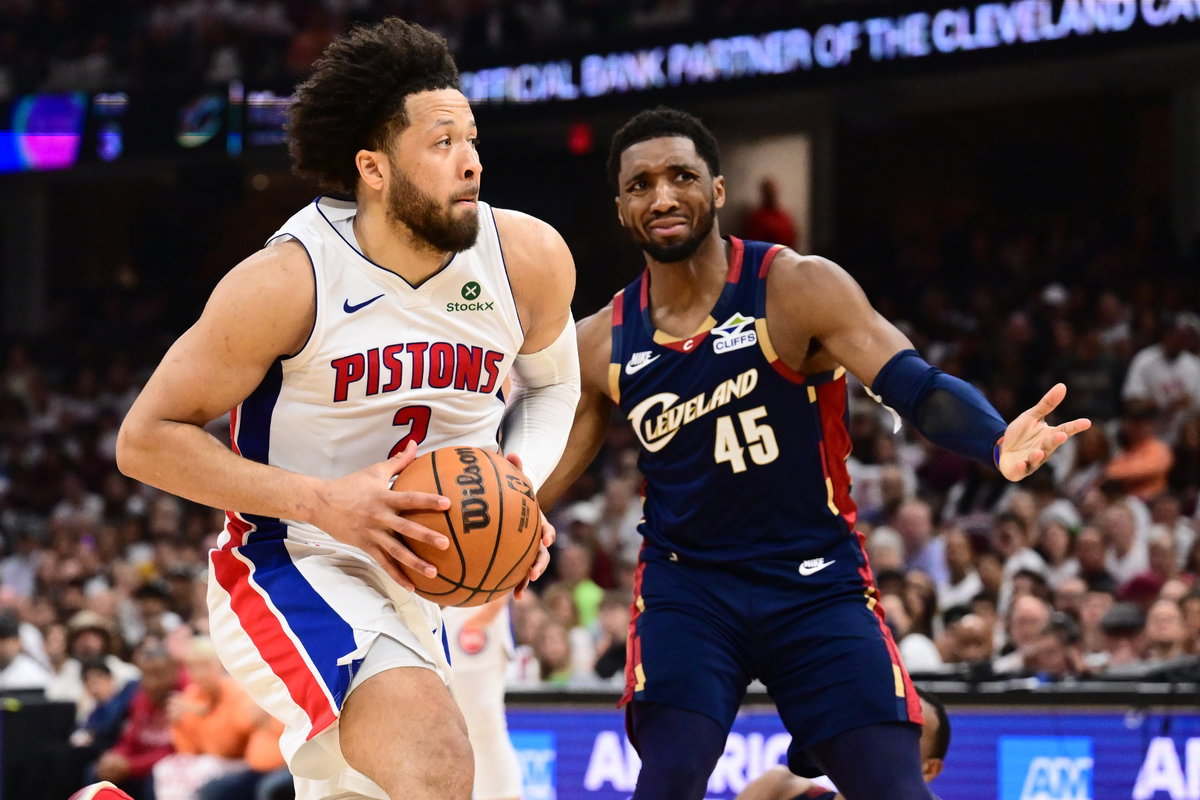
Imago
May 9, 2026; Cleveland, Ohio, USA; Detroit Pistons guard Cade Cunningham (2) drives to the basket against Cleveland Cavaliers guard Donovan Mitchell (45) during the first half of game three in the second round of the 2026 NBA Playoffs at Rocket Arena. Mandatory Credit: Ken Blaze-Imagn Images
Situations like this are part of a long-standing playoff dynamic across the NBA. Coaches frequently point out perceived officiating imbalances, whether involving free-throw disparities, physicality, or star treatment, in hopes of influencing how future games are called. The strategy is rarely direct criticism alone. Instead, it often combines subtle public comments, visible in-game frustration, and postgame messaging designed to increase awareness around certain trends.
While the league routinely fines coaches for excessive criticism of officiating, the tactic persists because of the belief that it can influence consistency and emphasis from game to game.
Few coaches mastered that balance better than Phil Jackson. Throughout his career, Jackson regularly used press conferences to spotlight officiating concerns, often drawing league fines in the process. During the 2010 NBA Finals, for example, he publicly questioned foul calls involving Kobe Bryant and argued that certain whistles had “changed the complexity” of the series.
Jackson’s approach typically blended measured diplomacy with pointed criticism, leveraging his stature to shape the conversation around officiating subtly. The current Cavaliers-Pistons series has shown shades of that same gamesmanship. Atkinson’s comments about playoff physicality and Donovan Mitchell’s whistle were followed by a Game 4 in which Cleveland enjoyed a significant free-throw advantage.
Bickerstaff later pointed directly to that shift, saying, “Again, you look at the foul count, you look at the disparity, and that’s hard to overcome. And you wonder, you know the reason why it’s interesting. You know, since Kenny made his comments publicly about, you know, us, the whistles changed in this series” – a classic example of playoff counter-messaging between opposing coaching staffs.
The Pistons had 20 free throws in the first three games of the series. There was, however, a sharp drop, as they had 35 attempts in Game 1. On the other hand, the Cavs have won the free-throw battle over the last three games. Game 4 recorded the largest free-throw disparity during the ongoing series.
JB Bickerstaff even complained about the clear lack of consistency in the calls.
“It’s interesting the difference on each side of the ball. You can go back and watch it yourself, but watch when Duncan Robinson tries to come off screens and the amount of hands that are on him,” the Pistons head coach added.
The major issue is also that numbers show the Pistons slash more than they shoot. The Cavs took 41 threes tonight, more than half of their overall attempts. The Pistons took 60 shots inside the arc. Yet, Cleveland managed to create a large free-throw gap. Likewise, Bickerstaff wasn’t pleased. He said the Pistons will send a few tapes to the league.
But they see the disparity only as a distraction, not as the cause of the loss.
JB Bickerstaff agrees; the Pistons need to be better
Detroit had some momentum after the first half of Game 4. They led by 4 points at the half. That’s the same number of points they held Donovan Mitchell to in the first half. Then came the Cavaliers’ explosion, a 22-0 run to start the third, with Spida displaying his entire repertoire of shot-making.
That is why Bickerstaff didn’t just blame the officials for losing the game.
“I mean, they came out and played with more force and tenacity than we did to start the quarter… They came out very aggressively on both ends of the floor. We just didn’t match it,” said the Pistons head coach.
Detroit was heavily outplayed in the third quarter. The Cavaliers didn’t just convrt 68.4% of their field goals. They also recorded three blocks and a steal. Defensively, holding the Pistons to 103 points was the primary reason behind Cleveland’s win. It’s the lowest Detroit has managed in the entire series. Evan Mobley’s five blocks and two steals in Game 4 set the benchmark for the activity Atkinson expects from the Cavs.
His comments that Bickerstaff referred to weren’t critical. Atkinson wanted to see the Cavaliers respond in kind. They provided that tonight, after which Bickerstaff admitted the Pistons have to be “better”. Free throws didn’t do the damage; Donovan Mitchell and the Cavaliers did.