If Willy Wonka ever traded chocolate for championship banners, he might have ended up in Bergen County, New Jersey.
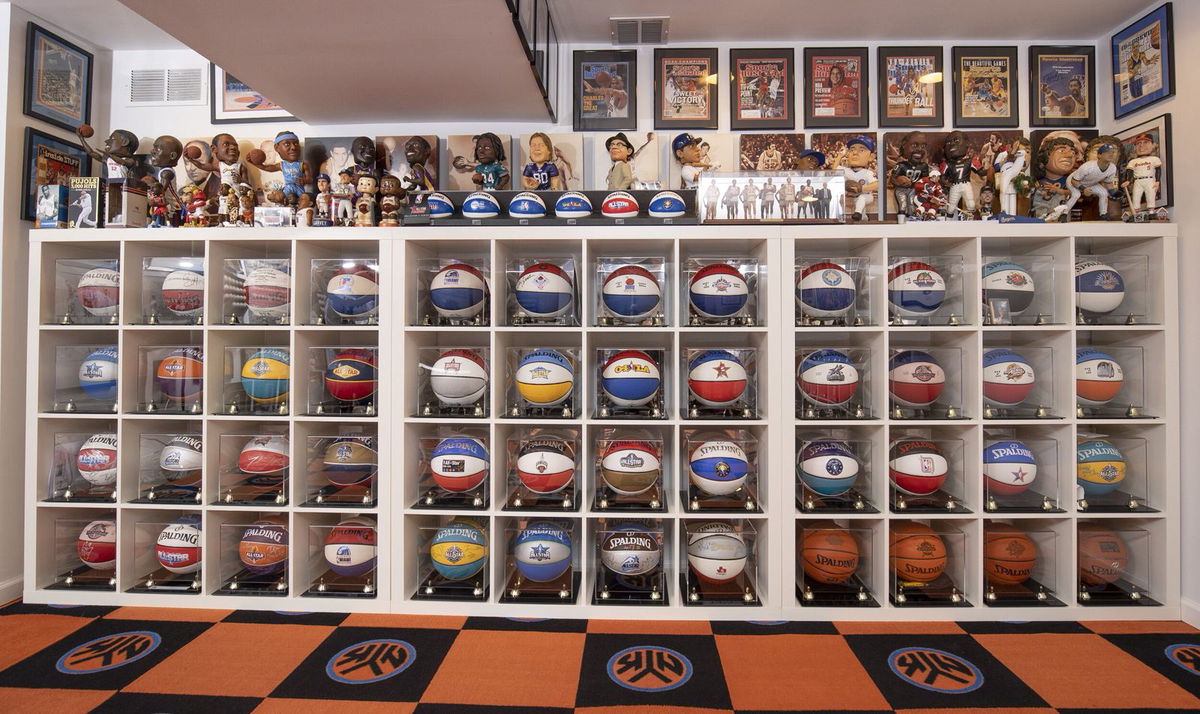
Down in the basement of Bergen County attorney Leo Klein’s home, the carpet is checkerboarded in New York Knicks colors. Framed photos line the walls. Signed memorabilia fills the shelves. And mounted carefully in chronological order are 40 multi-colored basketballs, one from every NBA Three-Point Shootout since 1986.
Klein isn’t just a fan of All-Star Weekend. He’s its unofficial archivist.
For more than 16 years, the 65-year-old collector chased down the rarest artifacts from the league’s most skill-driven event, the moneyballs. What began with a replica purchase in 2005 turned into a decades-long pursuit that included classified ads, auction calls, and even cornering longtime NBA executive Rick Welts at David Stern’s funeral in a last-ditch attempt to track down the elusive 1986 and 1987 originals.
Now, with the NBA celebrating the 40th anniversary of the contest Larry Bird made famous, Klein owns something no one else does: a complete timeline of the evolution of the three-point revolution.
Recently, Klein sat down with EssentiallySports’ Ryan Ward to walk through the collection, the stories behind the rarest balls, and why the shootout still matters more than ever in today’s perimeter-obsessed league.
Editor’s note: The following one-on-one conversation has been edited and condensed.
What are we looking at behind you?
Klein: “That wall has all the moneyballs from 1986 in Dallas the inaugural long-distance shootout all the way to the present. They’re in chronological order. It’s basically the entire history of the contest.”
Larry Bird won the first three, right?
Klein: “He did. The famous story is the second year when he walked into the locker room and said, ‘Which one of you guys is coming in second?’ He backed it up, too.”
When did you start collecting?
Klein: “The contest started in 1986, but I began attending All-Star Weekend in 1994 in Minnesota. It took me 16 years to find the 1986 and 1987 game-used moneyballs. I wasn’t even sure they still existed.”
Why were those so hard to track down?
Klein: “Only about 25 balls were made the first two years. They weren’t mass-produced. They were hand-painted leather Spalding balls red, white and blue with no official logos. They were given out to executives, kids, players. Kids used them in their driveway. Parents probably threw them out. They disappeared.”
How did you finally find them?
Klein: “The 1986 ball came from the Dallas Mavericks’ equipment manager. He kept one of the original 25 and in 1991, when the Celtics came back to Dallas, he had Larry Bird and several teammates sign it. It came with a letter of provenance and even the American Airlines banner from the original ball trolley.”
“The 1987 ball was unbelievable. It was from Seattle. A former Sheraton Hotels executive had it Sheraton was a sponsor that year and years later it was consigned to a jewelry shop and put on eBay. I found it after 16 years of searching.”
You won’t say what you paid?
Klein: “I’m not disclosing that.”
What makes the early balls unique beyond rarity?
Klein: “The imprints. In 1986, there was nothing just Spalding. In 1987, there’s a tiny imprint that says ‘All-Star Saturday Night Shootout.’ In 1988 in Chicago, there’s a four-line imprint with the city and date. Around 1989, they began adding official All-Star logos to the white panels. That evolution shows how the league grew.”
Did the league realize the significance of the contest back then?
Klein: “No. Rick Welts was tasked by David Stern with creating the three-point shootout. Stern had already started the Slam Dunk Contest in 1984 to energize All-Star Weekend. The three-point contest followed in ’86. Nobody thought to preserve the balls.”
“I even asked Rick Welts at David Stern’s funeral in New York if he had any of the early balls. He said no. Spalding didn’t keep them either.”
At what point did the balls become more widely available?
Klein: “In 1992, they started mass producing limited runs you could buy in the team store. Before that, they were strictly tournament-used. The real value is in those first few years.”
Is there a particularly interesting modern one?
Klein: “The 2021 Atlanta bubble ball. There were no fans. It wasn’t sold in stores. It was strictly tournament-used. That makes it rare in a different way.”
You’ve attended 27 All-Star Games. Is the shootout still the highlight?
Klein: “Absolutely. The game itself has become a little anti-climactic. The Slam Dunk and the Three-Point Shootout are the energy of the weekend. Some fans don’t even stay for the game anymore.”
Has the three-point contest changed the league?
Klein: “You can’t win today without shooting threes. Steph Curry accelerated it, but look at Karl-Anthony Towns, Dirk Nowitzki, Victor Wembanyama. Seven-footers shoot threes now. The contest mirrors the evolution of the league.”
Do you prefer the shootout over the dunk contest?
Klein: “For the purist, yes. The dunk contest has become gimmicky props, ladders, jumping off other players. When Spud Webb won, he didn’t use props. The three-point shootout is pure skill against the clock.”
What’s your most prized possession?
Klein: “Those first three balls. And the bubble ball. The early ones represent the birth of something nobody realized would reshape the league.”
What happens next with the collection?
Klein: “I’d love to find a serious collector or museum that will preserve it and keep it together. It’s a timeline. It tells the story of how the NBA evolved.”
Klein’s basement isn’t just a collector’s paradise. It’s a visual record of how the NBA transformed from a league experimenting with All-Star entertainment into one built around spacing, pace, and perimeter precision.
From the hand-painted leather balls of 1986 to the Wilson-manufactured modern versions introduced after the NBA’s supplier switch in 2021, each moneyball marks a different chapter in basketball’s stylistic evolution.
And while stars like Larry Bird, Stephen Curry, and the league’s current generation have elevated the three-point shot into a strategic necessity, Klein preserved the physical proof of that transformation. “They’re timepieces,” Klein said during the interview. “They preserve a moment.”
Forty years after the first long-distance shootout in Dallas, the NBA’s three-point contest remains the purest expression of skill on All-Star Saturday. For Klein, the chase may be over, but the story those balls tell is still unfolding one rack, one moneyball, and one era at a time.