
Imago
Dec 15, 2024; Los Angeles, California, USA; Los Angeles Lakers coach JJ Redick at a press conference at Crypto.com Arena. Mandatory Credit: Kirby Lee-Imagn Images
Imago
Dec 15, 2024; Los Angeles, California, USA; Los Angeles Lakers coach JJ Redick at a press conference at Crypto.com Arena. Mandatory Credit: Kirby Lee-Imagn Images
The margin for error disappeared fast for the Los Angeles Lakers, and it vanished in a way that felt painfully familiar. What began as a confident, veteran-controlled night at Crypto.com Arena unraveled into one of the Lakers’ most sobering losses of the season.


A 135–117 defeat to the Charlotte Hornets didn’t just expose defensive lapses or cold shooting. It reignited a larger conversation about what it means to wear a Lakers jersey and why head coach JJ Redick believes his team rarely gets a breather.
Watch What’s Trending Now!
After the game, Redick didn’t frame the loss as a lack of effort or preparation. Instead, he pointed to a reality he believes follows the franchise everywhere.
“These guys grew up watching LeBron James play,” Redick said. “The Lakers are, like the Celtics, arguably the most storied franchise in all of sports. We don’t get a lot of off nights from other teams in terms of energy and being up.”
That explanation wasn’t an excuse; it was a diagnosis.

Imago
Mar 24, 2025; Orlando, Florida, USA; Los Angeles Lakers head coach JJ Redick looks on against the Orlando Magic in the second quarter at Kia Center. Mandatory Credit: Nathan Ray Seebeck-Imagn Images
Redick’s comments leaned into a long-standing NBA truth: playing the Lakers often brings out an opponent’s best. With LeBron James still the face of the franchise, that effect is amplified. Players who grew up watching him are now lining up across from him, and they rarely treat those nights casually.
It’s not a theoretical idea. A few seasons ago, a moment between James and Jabari Smith Jr. went viral when James reminded Smith that his father played against him in his NBA debut back in 2003. That generational overlap is now commonplace.
Even inside the Lakers’ locker room, the reverence is real. Earlier this season, Jake LaRavia admitted he grew up as a Lakers fan, a quiet example of the very dynamic Redick was describing.
For one quarter, the Lakers looked every bit like the experienced contender Redick envisioned. They raced to a 39–30 first-quarter lead and built a 13-point advantage in the opening 10 minutes, controlling tempo and dictating matchups.
Then the game sped up. Charlotte detonated in the second quarter, outscoring Los Angeles 34–16 and completely flipping the rhythm. The Hornets’ legs looked fresher. Their shot quality improved. Their urgency spiked. By halftime, the Lakers were scrambling to keep up.
Charlotte finished the night shooting over 54 percent from the field and 46 percent from three, burying 20 of 43 attempts from deep. The Lakers, by contrast, never recovered from the pace shift.
Star Power Wasn’t Enough
LaMelo Ball controlled the game, torching the Lakers for 30 points and 11 assists while drilling nine three-pointers. Brandon Miller, Miles Bridges, and rookie Kon Knueppel combined for 70 points, overwhelming a Lakers defense that never found traction.
Los Angeles got scoring just not balance. Luka Doncic poured in 39 points, while James added 29. But the Lakers shot just 39 percent overall and an anemic 8-for-41 from beyond the arc. When Charlotte opened the fourth quarter with a 14–3 run, the result felt inevitable.
Ball punctuated the night with back-to-back late threes, sealing a game that had long since tilted.
Imago
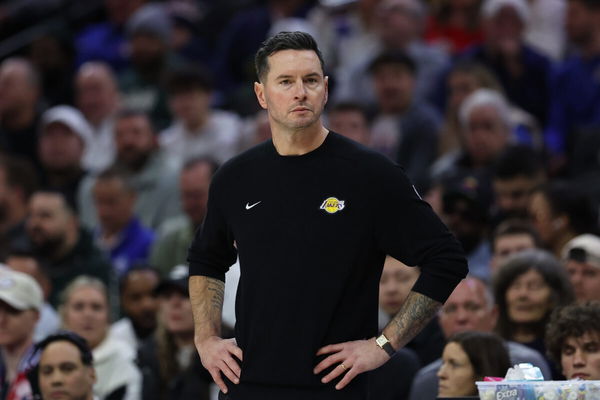
Dec 7, 2025; Philadelphia, Pennsylvania, USA; Los Angeles Lakers head coach JJ Redick looks on during the second quarter against the Philadelphia 76ers at Xfinity Mobile Arena. Mandatory Credit: Bill Streicher-Imagn Images
This wasn’t just about one loss. Redick’s framing speaks to a recurring issue: a veteran-heavy Lakers roster operating with almost no margin for error against younger, faster teams that treat these matchups as statement opportunities.
The Lakers are a measuring stick historically, culturally, and emotionally. But in a league driven by pace and legs, that legacy can cut both ways. When energy dips even slightly, teams like Charlotte can turn respect into fuel.
For Redick, the challenge isn’t convincing opponents to take nights off it’s preparing his group to withstand that constant intensity. The Lakers don’t get many casual games, and this loss was a reminder of how quickly things can unravel when energy and execution slip.
The narrative Redick referenced isn’t going away. The only question now is whether his Lakers can adapt fast enough or whether nights like this become less of an anomaly and more of a warning sign as the season grinds on.
Written by

Edited by

Ved Vaze