
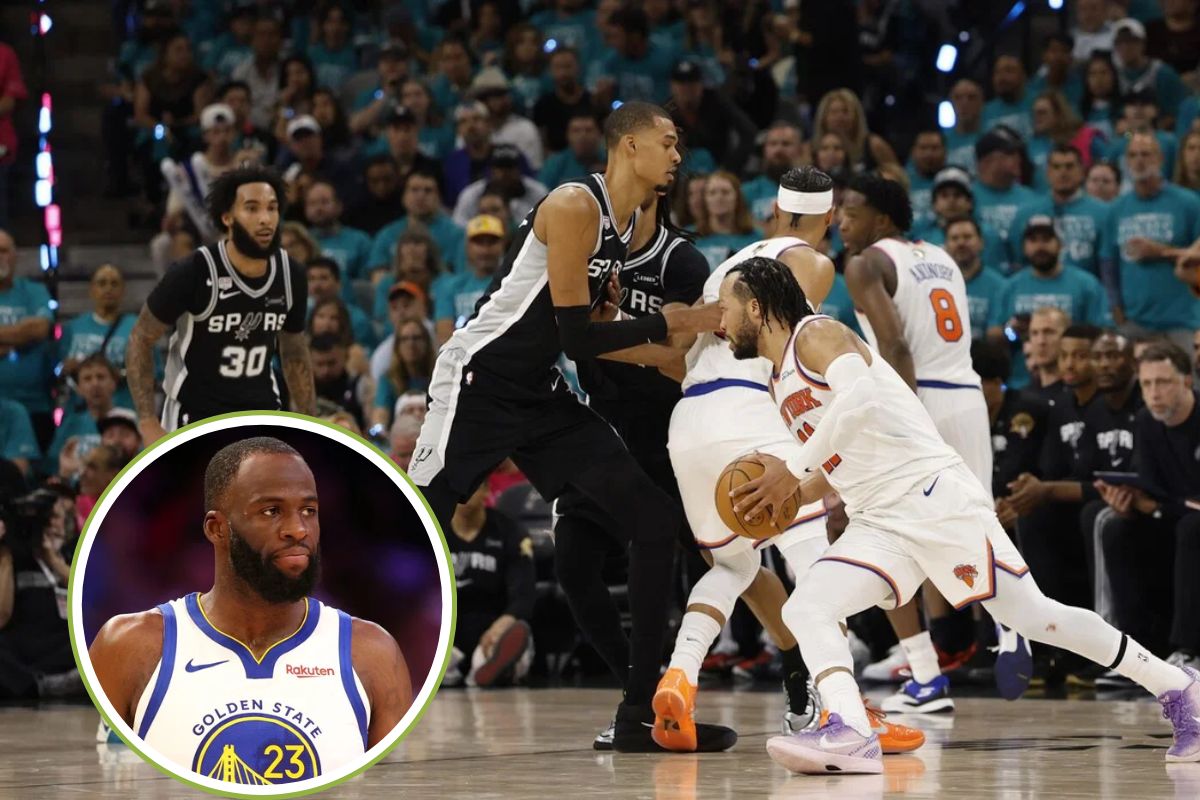
For the second straight episode of his podcast, Golden State Warriors veteran Draymond Green has found himself at the center of the Victor Wembanyama discourse. But this time, he wasn’t escalating the debate. He was redefining it. After facing criticism for condemning the Spurs’ post-Finals walk-off, Green returned to explain that his issue was never about sportsmanship. It was about surrendering a psychological edge.
Watch What’s Trending Now!
Following Game 5 of the NBA Finals, where the New York Knicks captured the championship, Wembanyama and and the young San Antonio Spurs players immediately walked off the floor without shaking hands, and almost perfect recreation of the Celtics-Pistons and Pistons-Bulls drama of the ’80s. After Green initially slammed the exit on his podcast, public backlash accused him of being a hypocrite and overly obsessed with traditional sportsmanship. According to Green, that interpretation completely missed the point.
“I feel like people are just splitting hairs because number one, actually, I never said anything about sportsmanship.”
Draymond addressed the criticism with, “So, everybody’s like, ‘Oh man, sportsmanship is overrated,’ or ‘Sportsmanship, who cares? I just lost. I’m mad. I don’t want to talk to you.’ … Everybody’s trying to point to sportsmanship, but that wasn’t the point.”
“The point was actually what everyone’s saying, which is, ‘I’m mad. I don’t want to talk.’ And that’s okay,” Green continued. “Except what I said was look your killer in his eyes and say whatever it is that you want to say, but look your killer in his eyes is what I said. So what I said is more about a competitive advantage… not sportsmanship. I don’t give a [f—] about sportsmanship.”

Draymond clarifies his comments regarding the Spurs walking off the court without shaking hands “You can't have front-runner behavior, it does not win in this league and running off the court after you lose in a series is front-runner behavior, and here's why it's front-runner Show more
That distinction changes the entire conversation. Green wasn’t advocating for a ceremonial handshake line. Championship rivalries are built in uncomfortable moments, when defeated stars are forced to confront the team that just took everything from them. Walking away allows the winner to own the final image and potentially the psychological upper hand heading into the next chapter.
For Green, the Spurs missed an opportunity. After meeting the Knicks in both the NBA Cup and the NBA Finals, San Antonio had the ingredients for a rivalry that could define the league’s next era. Instead, the lasting image became a team heading for the tunnel while New York celebrated.
By shifting the narrative away from etiquette to psychological warfare, Dray highlighted a massive philosophical divide in how modern superstars handle the bitterness of a championship defeat.
Victor Wembanyama’s rivalry with the Knicks could get reshaped
Draymond Green felt compelled to issue this clarification after the basketball community was divided over his original reaction to the Finals’ conclusion. Immediately after the Knicks secured their 94-90 title victory, Wembanyama chose to bypass the handshake line, gave his former teammate-turned-opponent Jeremy Sochan the cold shoulder, and was standoffish during the post-game presser.
The optics became a story of their own, overshadowing what should have been the defining celebration of the Knicks’ title run.
Where this behavior created fanwars and rivalries between the Celtics, Bulls, and Pistons decades ago, it created a different debate in the modern NBA world. The spectrum of arguments ranged from Wemby’s lack of sportsmanship being indefensible to his supporters demanding grace for a young athlete in his first championship run.
Robert Horry, who’s been there seven times, dismissed it as a natural human reaction rather than a character flaw. Most compared him to Isiah Thomas snubbing Michael Jordan. Karl-Anthony Towns was unbothered by it and only praised Wemby as a generational talent.
Green made his stance clear, initially labeling the Spurs’ conduct as “disheartening” and “disappointing.” In that original episode, Green had openly questioned San Antonio’s inexperienced leadership.
“I’ll blame it on youth,” Green had remarked. “I’ll blame it on lacking the leader to show them that ‘hey, this is what you do. Not walk off’… There’s a way to win and there’s a way to lose. And walking off the court, not looking your killer in his eyes, ain’t the way to lose.”
Some in the media and former players, like the guys in Gil’s Arena, immediately pushed back, citing Green’s own history of unsportsmanlike conduct.
That’s also underlining the fact that Green has been equally dismissive of Jalen Brunson in the past.
Dray, however, isn’t backing away from the substance of his argument. His belief is simple: when a player refuses to face the team that beat him, the winner leaves believing they broke something. That’s the “competitive advantage” he keeps referencing.
Whether Wembanyama agrees is almost irrelevant now. The moment has already become part of the Knicks-Spurs story. And if these teams meet again on a championship stage, Green believes the memory won’t belong to the loser who walked away- it will belong to the winner who never had to look away.