Imago
unlicensed image
Imago
unlicensed image
LeBron James has spent two decades conquering the NBA from the court. Now, he may be positioning himself to control it from the owner’s suite. With expansion looming in Las Vegas and retirement no longer theoretical, his next move could redefine not just his legacy, but his influence over the league itself.


In summarizing the various routes James can take, one involves NBA ownership. The league expansion is on the horizon. Several reports have claimed that the Lakers star is eyeing ownership in Las Vegas. According to Fortune, that could cost $7 billion, with the construction of an arena in mind. So, Bleacher Report assumes James could have some help.
Watch What’s Trending Now!
“One line of thinking is that he might retire, and his agent, Rich Paul of Klutch Sports, might sell the rest of his agency to UTA (United Talent Agency). With financial backing, they then might look to step into ownership roles,” Bleacher Report wrote.
Imago
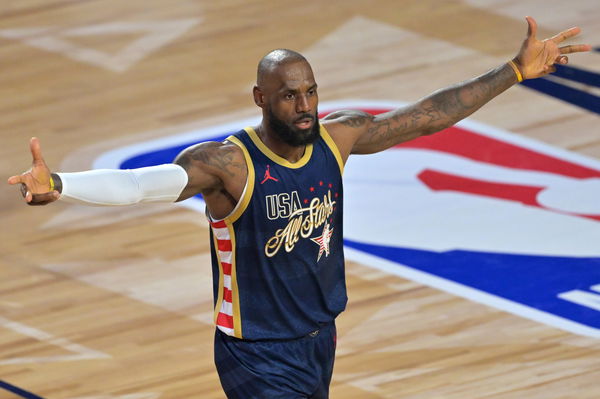
Feb 15, 2026; Inglewood, California, USA; Team USA Stripes forward LeBron James (23) of the Los Angeles Lakers celebrates after game two during the 75th NBA All Star Game at Intuit Dome. Mandatory Credit: Jayne Kamin-Oncea-Imagn Images
UTA has already invested in Klutch Sports back in 2019. Paul, one of James’ closest friends and agents, currently sits at the top of the company. However, if a business opportunity arises, he might decide to sell his company outright. We know LeBron James is waiting for some news from Adam Silver.
During the All-Star break, the NBA Commissioner did touch on the subject. He revealed that league officials will discuss the expansion further in their March meeting. Las Vegas and a possible return to Seattle are seen as the most popular hubs. Whenever it happens, LeBron James is surely going to be in line to be an owner.
After a storied NBA career, that’s the only thing he desires – a link to the sport he loves. But there might be one big issue. Rich Paul may not be so keen.
Rich Paul views NBA ownership as a risk
Everybody assumes Rich Paul will follow LeBron James. Their close friendship and business partnerships bring those narratives. But Paul doesn’t identify solely with his good friend. Last year, when speaking about James’ ownership interest, the famed agent said he doesn’t want any part.
“I don’t want to be an owner, just to be clear. I know people always think like everything he does, we’d just ‘throw me in’ it. No, no. And I think you’ll see a lot more of the athletes wanna be in an ownership space. I think it’s a slippery slope, I really do,” he said on the Pivot Podcast
The Klutch Sports CEO has an empire. He’s the most prominent NBA agent, with high-profile clients under his wing. Ownership could be the more profitable profession. However, Paul’s views on the new CBA, which allows players to invest in NBA owners’ businesses to a certain extent, make him doubtful about stepping into that space.
What’s revealing about Paul’s language here isn’t just the refusal – it’s the strategic clarity behind it. When he calls ownership a “slippery slope,” he’s identifying a structural tension that most overlook: an agent’s power is built on undivided loyalty to his clients.
The moment Paul becomes an owner, even a minority stakeholder, his interests become entangled with the very league infrastructure his clients negotiate against. That’s not a conflict of interest he can manage quietly; it’s one that could erode the trust that made Klutch dominant in the first place.
Paul has built his leverage precisely by operating outside traditional power structures, not by joining them. Ownership would absorb him into the establishment, making him less disruptive and more institutional.
For an agent whose brand is built on athlete empowerment and independence, that trade-off isn’t just financially questionable, it’s philosophically incompatible with everything Klutch represents.
While Rich Paul resists the ownership path, history offers a stark counterpoint: Michael Jordan. In 2010, Jordan became the majority owner of the Charlotte Hornets, a move that seemed like a natural extension of his brand. But the reality was far more complex.
He paid $275 million for a controlling stake, a figure that ballooned to over $3 billion when he sold the team in 2023. Yet behind the headlines, Jordan faced intense scrutiny over team performance, front-office decisions, and player development, all while balancing his global brand. His tenure as owner was marked not by seamless success but by strategic missteps, public criticism, and the burden of being both an icon and an executive.
LeBron James still has other connections or could partner with somebody to fulfill his dream. But it doesn’t look like Rich Paul would be willing to sell his company.
Written by

Edited by

Tanay Sahai