
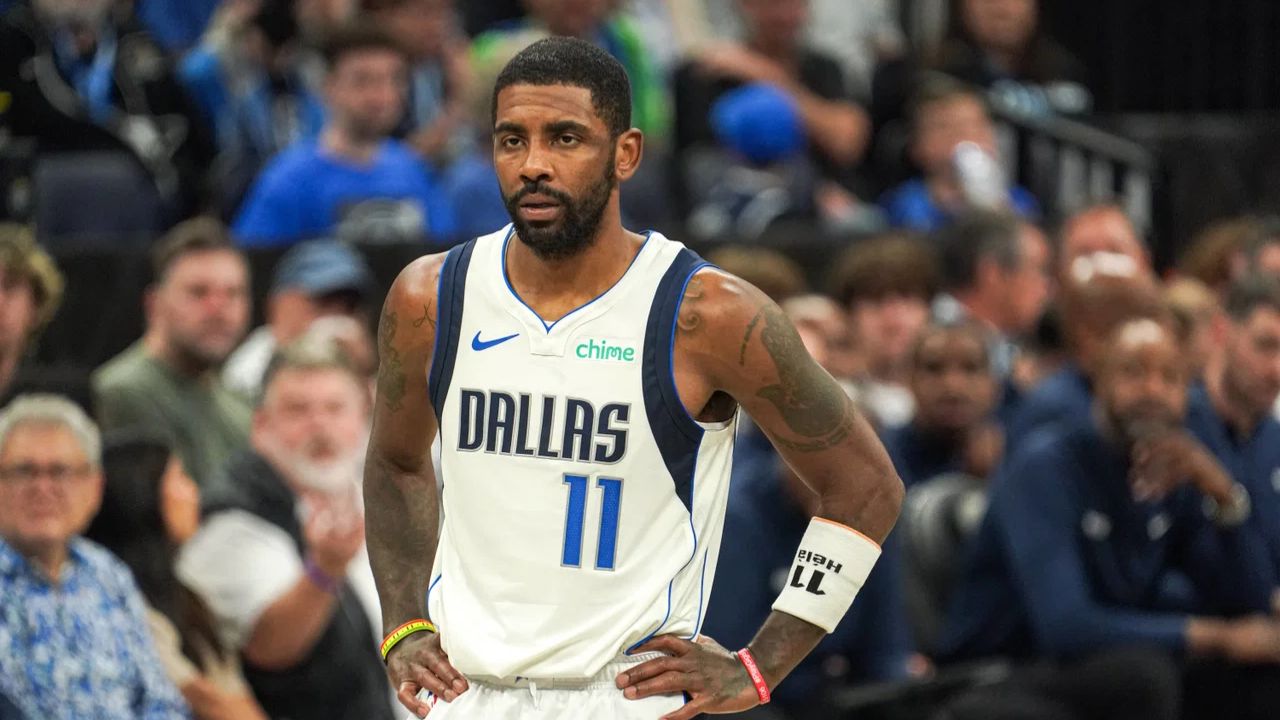
When Kyrie Irving was 17, Australia had a real chance of getting him to wear its national colors. The young guard had seriously considered an invitation to join the country’s under-18 team. Then Mike Krzyzewski stepped in. The Duke coach, who also led Team USA, had a different future in mind for Irving: one that could put him in the starting lineup for an American Olympic team.
Watch What’s Trending Now!
Irving chose the United States. He went on to win the 2014 FIBA World Cup, earning tournament MVP honors, and Olympic gold at Rio 2016. But the Australian option never quite disappeared. More than a decade after that teenage decision, the country where he was born is back in his plans. There is just one major complication: his history with Team USA makes this far more difficult than simply choosing which jersey he wants to wear.
“You know that I’m still trying to sneak onto the Australian team you know that,” Irving said via Damien Peters. “I’m still trying to sneak onto the team. But it’s been an amazing experience to be able to travel this past year as much as I have. And I did have Australia penciled in early September, but I had to come back to Dallas and get acclimated and just make sure I was hanging with my teammates. So trust me, at the end of this next or this season coming up, Melbourne is on top of the list.”
The Choice That Still Follows Him
Australia’s connection to Irving is more than a convenient detail on his biography. He was born in Melbourne on March 23, 1992, while his father, Drederick Irving, played for the Bulleen Boomers in Australia’s South East Australian Basketball League. The family returned to the United States when Kyrie was about two, but he retained Australian citizenship alongside his American citizenship.
The possibility of representing Australia surfaced when Irving was still a teenager. Looking back during the Rio Olympics in 2016, he explained just how seriously he had considered the offer.
“It was very serious… It was a legit thing, until Coach K intervened. He strong-armed me. As a young fella, he did tell me I had a chance to be a part of something bigger than myself. He said, ‘You could be the starting point guard on the U.S. Olympic team.’”
Irving later returned to the subject during a Twitch stream in 2023. “I consider myself an international player even though I played on Team USA… I wanted to play for Australia, but it just didn’t happen.” He also pointed to Krzyzewski’s influence, adding, “Coach K wasn’t going to let that happen either.”
Those achievements cemented Irving’s place in Team USA history. They also created the complication at the center of his current ambition: his senior international appearances are the reason a switch to Australia cannot be treated like an ordinary roster decision.
The Australian possibility resurfaced publicly in October 2024, when Irving told The Athletic, “I would love to entertain playing for Team Australia, man.” Earlier that year, he had missed out on Team USA’s 12-man roster for the Paris Olympics. He was disappointed, but his response did not suggest a falling-out with the program.
“I wish my brothers the best. I just wasn’t a good fit for this team,” Irving said in April 2024. “The deliberation process was tough. But again, I have nothing but respect for those guys at USA (Basketball). At this point in my career I think my focus should be on winning a championship.”
By February 2025, Irving was speaking more specifically about what it would take to make the Australian option possible. “We’re in the process of that right now, just trying to figure out the best route for me to be eligible. There’s a lot of paperwork… Honestly, if I can be an Aussie at one point in my career and play for the Australian team, that would be great.”
But exploring the process is only the first step. Irving’s past with Team USA creates a much harder question: does FIBA’s rulebook leave him a route to represent Australia?
The Roadblock Is Bigger Than a Passport
The biggest obstacle is not Irving’s connection to Australia. It is the international career he has already built with the United States. Holding Australian citizenship does not automatically make him eligible to represent the Boomers after playing for another country in senior international competition.
Under FIBA’s national-status rules, a player who has represented a country in a senior official competition is generally tied to that national federation. Irving played for the United States at the 2014 FIBA World Cup and the 2016 Olympics, putting his case in a very different category from that of a player who has only represented another country at youth level.
A change is not simply a matter of obtaining a passport or submitting paperwork as an individual. The research into FIBA’s current regulations indicates that a request would need to come through the relevant national federation, with an exceptional change requiring authorization from FIBA’s Secretary General. The rules also consider the wider interests of basketball development and competitive balance.
There is another important detail: USA Basketball has said it had not been approached about a change of basketball nationality. Irving’s comments about exploring the process therefore should not be mistaken for confirmation that Australia has submitted a formal request or that FIBA is considering a completed application. No public evidence in the research establishes that an approval or rejection has been issued.
What Irving Could Bring to Australia
The potential reward explains why the idea has drawn interest in Australia. Andrew Gaze, the former Australian captain, initially had reservations about players representing countries with which they had little connection. Irving’s birthplace and long-standing affinity for Australia made this case different. In February 2025, Gaze said, “I would say do whatever you can to make it happen.” He also acknowledged that the prospect remained a “real, real long shot.”
Brian Goorjian, the former Boomers coach, identified a specific basketball reason to pursue Irving. “To have Kyrie, a guy that can make a play when it’s close on his own… it’s just a piece that the Boomers don’t have,” Goorjian said in February 2025. He added, “If he is eligible, I definitely could see him welcomed with open arms.” Goorjian also stressed that Irving would have to buy into the team culture that has defined Australia’s recent international success.
The timing matters because Australia is not starting from scratch. The Boomers won their first Olympic basketball medal, bronze, at Tokyo 2020, held in 2021. At Paris 2024, they reached the quarterfinals but fell to Serbia, 95–90, in overtime after leading by 24 points in the second quarter. They finished sixth. The result showed how close Australia could get to a major breakthrough, while also underlining how painful a narrow exit can be.
Irving’s potential value is not simply that he can score. Australia has developed NBA-level talent, including Josh Giddey, Dyson Daniels, Josh Green and Jock Landale. Irving could give that group another proven late-game creator, someone capable of generating a shot when a set play breaks down or the clock is running out. That is the role Goorjian was pointing to. It would not guarantee a gold medal, and the eventual 2028 roster is far from settled, but it gives Australia a clear basketball reason to consider the possibility.
There is still a practical question about whether Irving can be ready for that stage. He tore his left ACL on March 3, 2025, underwent surgery later that month and missed the rest of the 2024–25 season as well as the entire 2025–26 campaign. By early October 2026, he had been cleared to train without physical restrictions and was expected to return in preseason. He will turn 36 in March 2028, a few months before the Los Angeles Olympics. His age alone does not rule him out, but his health, form and availability will matter far more than the idea of an Australian jersey.
When Irving was 17, Coach K helped steer him toward Team USA and an Olympic gold medal. Nearly two decades later, Irving is still looking toward Australia. Whether he gets there will depend on more than his desire to wear the green and gold. The question now is whether the rules will give him a path to the country where his story began.