
Imago
Mar 8, 2025; Boston, Massachusetts, USA; Los Angeles Lakers head coach JJ Redick reacts after a technical foul during the fourth quarter of a game against the Boston Celtics at the TD Garden. Mandatory Credit: Brian Fluharty-Imagn Images
Imago
Mar 8, 2025; Boston, Massachusetts, USA; Los Angeles Lakers head coach JJ Redick reacts after a technical foul during the fourth quarter of a game against the Boston Celtics at the TD Garden. Mandatory Credit: Brian Fluharty-Imagn Images
The whistles started early, and they never really stopped. By the end of the night in Portland, the Los Angeles Lakers had another lopsided loss on the books and another quiet frustration simmering beneath it. But instead of blaming injuries or effort, head coach JJ Redick aimed his postgame focus somewhere else entirely.


Not on his roster. Not at the score. The way the game was officiated and what that says about a league-wide problem. Saturday’s loss to the Portland Trail Blazers marked the Lakers’ 16th defeat of the season and their fourth loss in five games. The pattern has been clear: when things go wrong, they go wrong fast. Most of their losses haven’t been close, and this one followed the same script.
Watch What’s Trending Now!
From the opening quarter, Portland lived at the free-throw line. The Blazers attempted 22 free throws in the first 12 minutes alone, the most by any team in a first quarter since 2011. Five different Lakers picked up two fouls apiece before the game had any chance to settle. Afterward, Redick revealed something that shifted the conversation.
“I got an admission from them,” Redick said, explaining that the officiating crew acknowledged a poor start to the game. That admission mattered, and Redick didn’t let it stop there.
Redick was careful not to frame the issue as personal or malicious. Instead, he widened the lens. “You’d probably have to ask the other 29 coaches,” he said, “but it feels like the inconsistency night-to-night, even within the same game, has been there for most of these crews.”
That single line is where this stopped being a Lakers gripe and turned into something larger. Redick didn’t claim conspiracy. He didn’t demand accountability. He pointed to a shared experience one nearly every coach in the league has quietly voiced this season.
The numbers back up why the night felt so jarring. Portland finished with 34 free-throw attempts, just the sixth time all year the Lakers have allowed 30 or more. Entering the game, Los Angeles ranked second in the NBA in free throws attempted and among the league’s best at avoiding foul trouble defensively.
That contrast is what fueled Redick’s frustration.
Imago
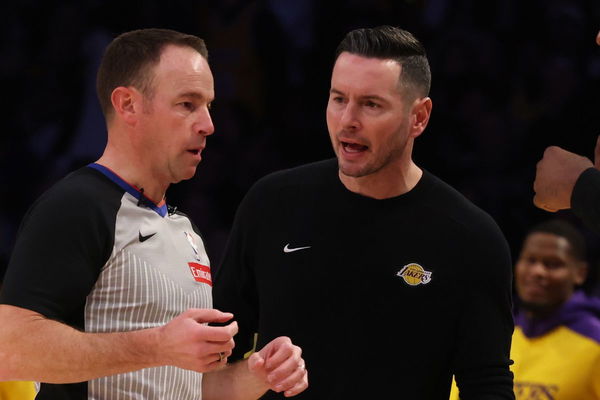
Feb 19, 2025; Los Angeles, California, USA; Los Angeles Lakers head coach JJ Redick talks to NBA referee Josh Tiven (58) during the third quarter against the Charlotte Hornets at Crypto.com Arena. Mandatory Credit: Jason Parkhurst-Imagn Images
Redick still refused to hide behind availability. Even LeBron James framed the night diplomatically. “Every night is different,” James said, calling the game an “uphill battle.” The message from the locker room was consistent: the Lakers didn’t lose because of whistles alone, but the whistles tilted the floor early enough to make the climb steeper than usual.
This Isn’t Just a Redick Complaint
Redick’s measured tone stood in contrast to several recent blowups around the league.
Chris Finch was caught on camera unloading on referee Zach Zarba during a December loss, screaming about multiple missed calls in the final minute. Days later, J.B. Bickerstaff publicly questioned referee objectivity after a chaotic loss in Dallas that featured multiple technical fouls and an ejection.
Then came the sharpest example. After an overtime loss to Denver, Ime Udoka labeled the game “the most poorly officiated” he’d seen in a long time. The NBA’s Last Two Minute Report confirmed three incorrect calls in overtime, and Udoka was fined $25,000 for saying so.
Against that backdrop, Redick’s approach felt deliberate. Redick didn’t yell. He didn’t name referees publicly. He didn’t escalate. Instead, he pointed to an admission, cited league-wide inconsistency, and left the rest unsaid.

Imago
Mar 24, 2025; Orlando, Florida, USA; Los Angeles Lakers head coach JJ Redick looks on against the Orlando Magic in the second quarter at Kia Center. Mandatory Credit: Nathan Ray Seebeck-Imagn Images
That restraint matters. Coaches know the fines. They know the lines they can’t cross. Redick still managed to echo what many of his peers have already made clear: trust in nightly officiating consistency is wearing thin.
By referencing “the other 29 coaches,” Redick didn’t rally them with a call to arms. He aligned himself with a quiet consensus that already exists. This won’t trigger an immediate rule change or public response from the league office. That rarely happens in January. But the pressure is building. Fines are rising. Outbursts are increasing. And now, even the measured voices are saying the same thing.
For the Lakers, the focus turns back to surviving injuries and stopping the bleeding in the standings. For the NBA, the spotlight stays on the whistle and whether the league can restore consistency before frustration turns louder. Redick didn’t shout. He didn’t accuse. He just said what everyone else has been thinking. And that might be the loudest signal yet.
Written by

Edited by

Ved Vaze