
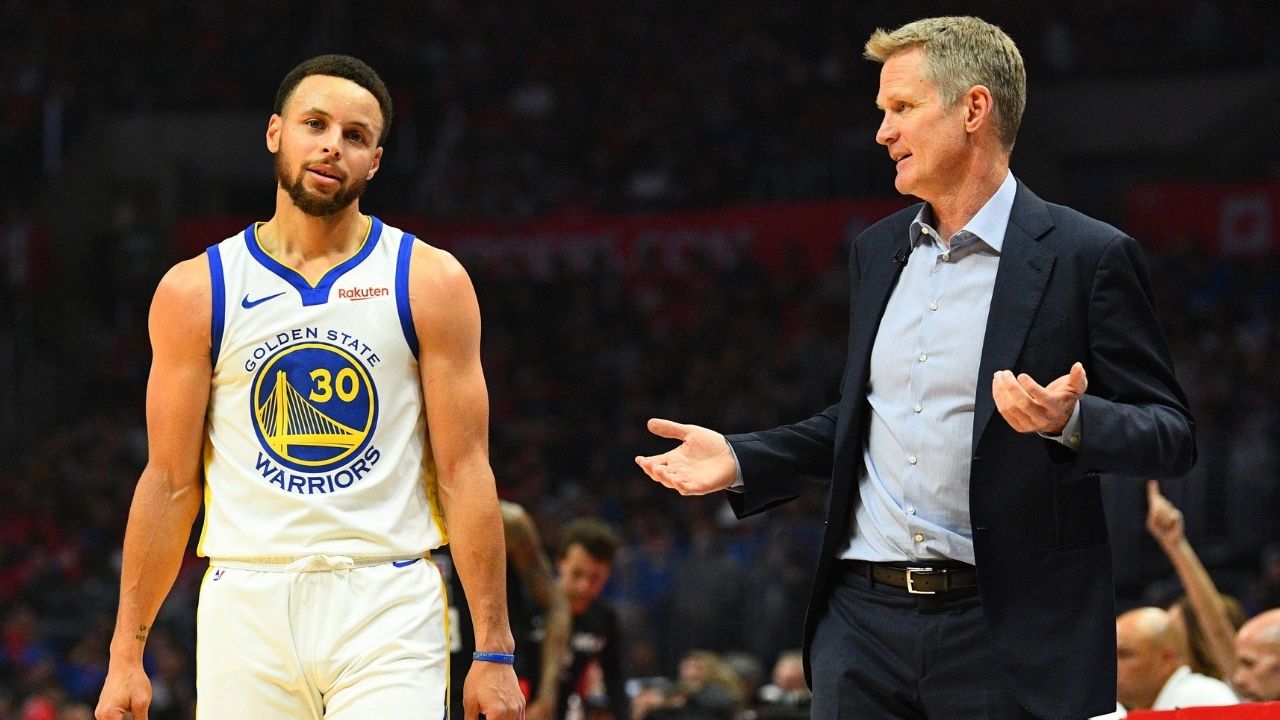
The physical grind of an NBA season is easy to measure. Emotional fatigue is not. That distinction has put Steve Kerr in the uncomfortable position of defending his decisions to rest Stephen Curry during certain back-to-backs. A practice that can draw plenty of criticism from fans who expect superstars to play whenever they are healthy.
Watch What’s Trending Now!
But Kerr believes that is more behind those nights off than simply managing Curry’s minutes.
“It’s more just like the almost like a baseball player getting a day off,” Kerr said, speaking on the Tom Tolbert Show. The Dubs HC pushed back after Tom Tolbert joked that players could handle a second game with a few juice boxes and orange slices. Kerr explained that the issue is not simply how many minutes Curry plays.
“You just need a reset. You need an emotional reset when you’re not out there.”
That distinction is central to Kerr’s approach. He is not necessarily trying to protect Stephen Curry from the physical act of playing 20 or 30 minutes. He is trying to prevent the accumulation of pressure that comes with being the Warriors’ primary engine and emotional center.
Kerr specifically pointed to what happens when Curry reaches that point.
“For guys like Steph. Like, you know Steph really well. When he gets tired, it’s like an emotional fatigue, and he starts to turn the ball over left and right. That’s not the minutes. Yeah. It’s he’s fried emotionally. Like he competes so hard. We rely on him so much. It may sound soft.”
For the Baby-faced Assassin, the responsibility goes beyond scoring. Every possession can require him to create offense, handle defensive attention, make decisions under pressure, and keep the Dubs competitive.
That constant demand is difficult to capture through a minutes-per-game number.
Steve Kerr also acknowledged exactly how the explanation would sound to an old school. Tolbert immediately gave him the answer Kerr expected: “I get it, but it’s still soft.”
But Kerr’s point was never that Curry is physically incapable of playing. It is that sometimes the most useful thing a coach can give a veteran is distance from the game.
Why Steve Kerr believes the reset matters?
That philosophy becomes especially relevant now that Stephen Curry is in the later stages of his career. The Warriors still depend heavily on him, but the organization cannot reasonably expect the 4x champ to carry the same emotional and physical workload forever.
Rest, in Kerr’s view, becomes less about reducing effort and more about preserving the quality of that effort.
The clearest example of Kerr’s point came against the Orlando Magic in 2024. When refs ejected Draymond Green 4 minutes into the game, Steph’s reaction caught attention. He shook his head in disappointment, buried his face, and appeared to hide his tears.
It showed the emotional weight he can carry beyond the box score.
That is why Steve Kerr doesn’t view fatigue solely in terms of minutes. Curry is constantly moving, reading defenses, and cr
eating offense while carrying the pressure of being the Warriors’ centerpiece. When the emotional battery runs down, Kerr believes it can eventually show through sloppy decisions and turnovers.
The Dubs’ current roster also gives Kerr more room to manage that burden. Brandin Podziemski, Will Richard, Gui Santos, and Yaxel Lendeborg represent a younger group that can gradually take on more responsibility alongside Stephen Curry. Lendeborg, the No. 11 pick in 2026, adds another intriguing piece to the Warriors’ developing core.
The young players cannot replace Curry, but they can prevent every problem from becoming their responsibility. That matters for a team trying to compete while preparing for its next era.
If a night away from the court gives him the emotional reset he needs, Kerr believes it is worth the criticism.