
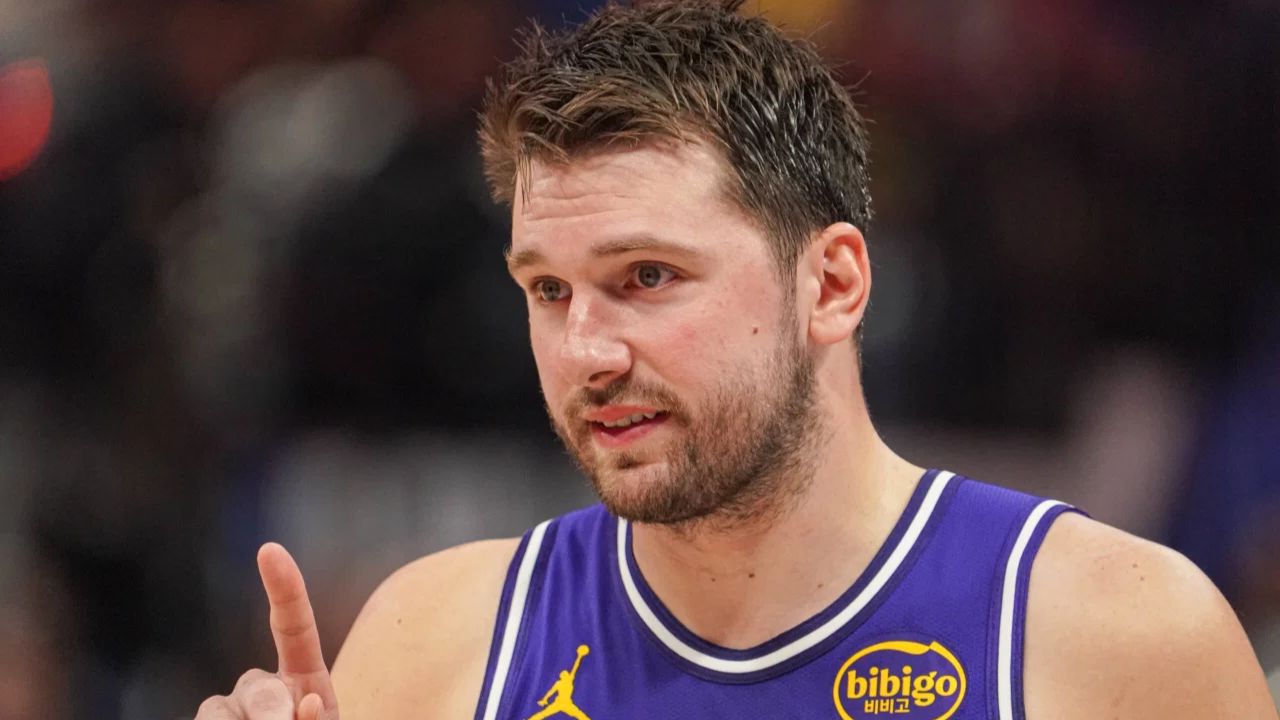
At one point during his final months with the Dallas Mavericks, Luka Dončić was reportedly carrying close to 270 pounds. Now, as he prepares for a new season in Los Angeles, a report from Slovenia claims he has reached a target weight of 105 kilograms—or roughly 231.5 pounds.
Watch What’s Trending Now!
For perspective, the 270-pound figure was around 20 pounds heavier than LeBron James’ commonly listed weight of 250 pounds. Dončić’s reported target, meanwhile, is nearly 20 pounds lighter than that same benchmark.
The numbers are not from identical types of measurements. The 270-pound figure came from reports citing Dallas sources, while 250 pounds is LeBron’s listed NBA weight and 105 kilograms is a reported offseason target. Still, the comparison offers a clear picture of the physical change Dončić appears to be working toward.
And that change matters now more than ever. With LeBron James leaving for Philadelphia, the Lakers are no longer simply building around Luka. They are handing him the responsibility of leading the franchise.
From 270 Pounds to a Reported 105-Kilogram Target
The discussion around Dončić’s weight began after his shocking February 2025 trade from Dallas to Los Angeles.
ESPN reported at the time that Mavericks sources believed Dončić’s weight had “ballooned to the high 260s” and reached “as much as 270 pounds.” The report connected those concerns to questions about his diet, conditioning, and availability.
However, the figure was not an official weigh-in. Dallas had continued listing Dončić at 230 pounds on its roster, meaning the reported 270-pound number came from internal estimates rather than a publicly verified measurement.
That distinction is important. The number became part of the conversation surrounding the trade, but it should not be treated as an exact record of Dončić’s body weight.
What is more concrete is the change that followed.
In September 2025, ESPN’s Dave McMenamin reported that the Lakers listed Dončić at 244 pounds on their training camp roster. That number created confusion because it was heavier than the 230-pound figure Dallas had used for years. But compared with the reported 270-pound peak, it represented a significant drop.
Now, the latest report from SportKlub Slovenia suggests Dončić has reached another milestone.
Martin Pavčnik reported that Dončić reached his target weight of approximately 105 kilograms while working through an individual offseason program in Ljubljana. The program was overseen by Anže Maček and focused on rehabilitation and conditioning.
The report also made clear that Dončić had not yet returned to contact work or full-speed team drills at that stage.
That detail may be just as important as the number on the scale. Dončić is not simply trying to look lighter. He is trying to arrive at training camp in a condition that allows him to handle the demands of an entire NBA season.
The Weight Loss Is About More Than Appearance
Dončić has never needed elite straight-line speed to dominate. His game is built around pace, balance, footwork, strength, and the ability to stop defenders with sudden changes of direction.
But that style also places a heavy physical burden on his body.
Every step-back, hard stop, drive, and change of pace requires his legs to absorb force. Carrying less body mass could help reduce some of that load, especially during the repeated movements that define his offensive game.
The potential benefits are not limited to scoring. Better conditioning could help Dončić remain active defensively, recover between possessions, and maintain his energy deeper into games. It could also help him handle the long NBA schedule more consistently.
His Slovenian teammate Edo Murić previously offered an encouraging assessment of Dončić’s physical progress.
“Yeah, he’s faster and jumps more,” Murić said. “This year, I expect him to be the best version of himself.”
That does not mean weight loss automatically guarantees better health or a championship. Basketball performance depends on far more than a number on a scale. But the reported transformation suggests Dončić understands that his body has to support the role he is about to take on.
The timing is especially significant because his recent Lakers seasons have ended with questions about whether he could remain available when the stakes were highest.
The Injury Problem the Lakers Cannot Ignore
Dončić’s first full season with the Lakers showed why the franchise is willing to place so much responsibility on him.
He averaged 33.5 points, 7.7 rebounds, and 8.3 assists across 64 games during the 2025–26 regular season. He shot 47.6% from the field, 36.6% from three-point range, and 78.0% from the free-throw line.
Those numbers made one thing clear: the Lakers did not acquire a player who needed time to become their offensive engine. Dončić was already capable of carrying that role.
The problem was keeping him available.
On April 2, 2026, Dončić suffered a Grade 2 left hamstring strain against the Oklahoma City Thunder. The injury ruled him out for the remainder of the regular season and the entire postseason.
That absence changed the Lakers’ playoff run. Los Angeles defeated Houston in the first round but lost to Oklahoma City 4–1 in the second round. Dončić did not play a single postseason minute.
The previous postseason had also ended in disappointment. In 2025, the Lakers were eliminated by the Minnesota Timberwolves in the first round, losing the series 4–1.
So, while Dončić’s individual production has remained elite, his Lakers tenure has yet to produce a deep playoff run with him fully available.
That is why the current conditioning report carries more weight than a routine offseason update. The Lakers do not simply need Luka to be brilliant in January. They need him healthy and effective in April and May.
A Private Jet, a Slovenian Camp, and a Different Luka
One of the clearest signs of Dončić’s growing leadership came during the offseason.
He reportedly spent a six-figure sum to bring 14 Lakers players and members of the team’s staff to Slovenia for a five-day minicamp. Reports stated that the trip involved a private jet costing approximately $18,000 per hour, with the total expense reaching close to $500,000.
The gathering included players such as Reaves, Kessler, Quentin Grimes, Collin Sexton, and Bronny James. The activities combined workouts with team-building events, including golf, private dinners, and time spent meeting Dončić’s family.
That was not just an expensive vacation. It was an effort to build relationships before the season began.
Dončić’s leadership claim is easier to understand when paired with that action. He was not merely saying that he had taken responsibility. He was investing his own time and money to bring his teammates into his world and help create chemistry before training camp.
The next step is making sure that personal investment translates to the court.