
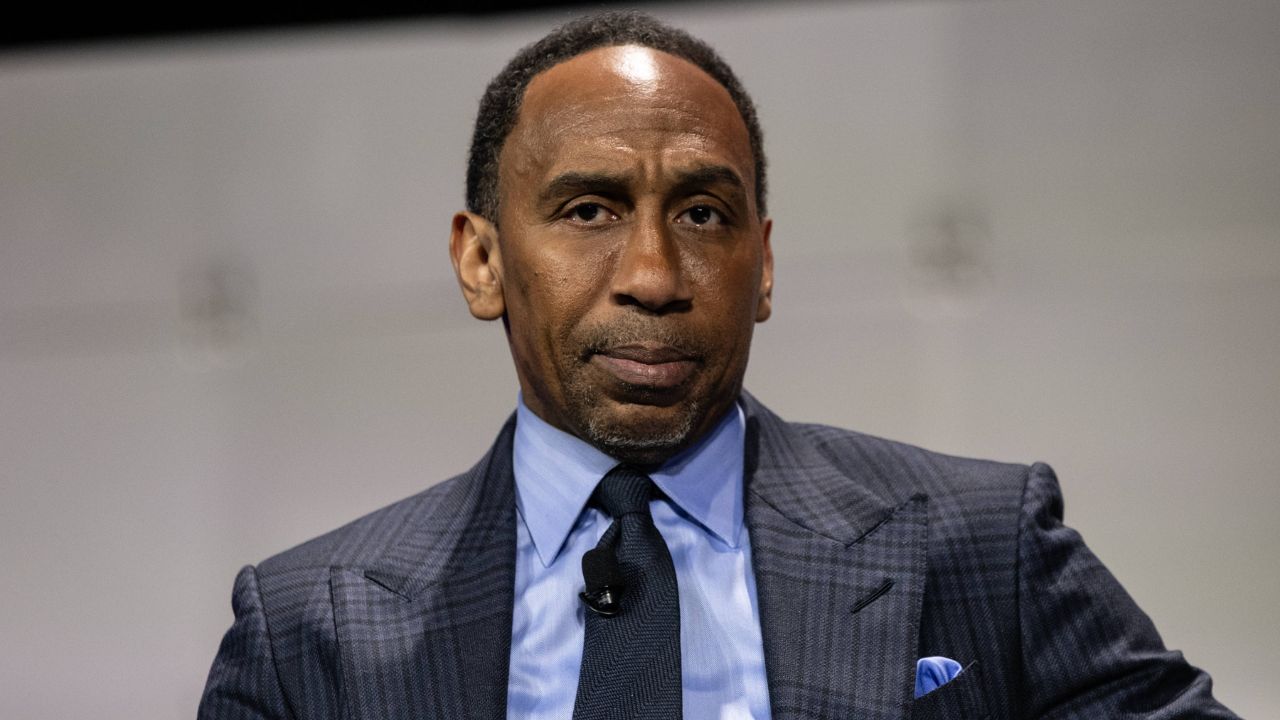
Ahead of his campaign trip to Georgia, President Donald Trump revealed that he had welcomed some unexpected guests for dinner at the White House. Stephen A. Smith later addressed the visit on his YouTube show, confirming that he had dined with the president on Thursday evening, October 15, alongside comedian Bill Maher and musician Kid Rock.
Watch What’s Trending Now!
The gathering brought together media personalities, political commentators, and entertainers with sharply different views, making the dinner an unexpected talking point. But while the meeting raised questions about Smith’s relationship with Trump, the ESPN personality revealed that he had a more important reason for accepting the invitation.
Addressing the circumstances behind the dinner, Smith explained how Maher secured the invitation and why he agreed to meet the president despite their public disagreements. But the ESPN personality also had a more personal reason for showing up, one that went beyond settling political differences. Smith wanted to use the opportunity to advocate for Historically Black Colleges and Universities (HBCUs), an issue he has supported for years.
“I felt compelled to come on the show today, doing my YouTube show, to talk to you because by now I’m assuming most of you have heard the news that on Thursday evening, October 15th, yours truly was at the White House with the President of the United States of America, Donald Trump.”
Smith explained that the gathering stemmed from an ongoing dialogue between Trump and Maher, who had previously met at the White House.
“Just to give you some background of how it took place: The president, approximately a year plus earlier, had met with Bill Maher, host of Real Time on HBO—Bill Maher, longtime political pundit/comedian, somebody that was recently, you know, honored in the nation’s capital at the Kennedy Center. Bill Maher and the president had met with one another over a year ago. Bill Maher had revealed they had a very, very pleasant conversation. He expressed his views, the president expressed his views, and in the aftermath of that, months later, the president was seen going off on him, calling it a complete waste of his time that Bill Maher was even brought to the White House. And from that moment on, they were going back and forth, back and forth with one another, saying whatever it is that they wanted to say about one another.”
The dynamic shifted roughly six weeks ago, SAS revealed, when the White House re-engaged Maher, inviting him back to Washington.
“And then approximately six weeks ago, Bill Maher received a call, and it was the President of the United States inviting him back to the White House. And according to Bill Maher, the president invited him to bring anybody he wanted, even one of his lunatic leftist friends. And Bill Maher said, ‘I got one better for you. I’m going to ask Stephen A. Smith to join me.’ And the president did not object to that, even though, from what I was told, he wondered whether or not I would show up.”
Smith accepted the invitation without hesitation. The ESPN commentator explained that he wanted to address his disagreements with Trump face-to-face.
“When Bill Maher informed me of that, I immediately accepted that invitation. And I accepted it for a variety of reasons. Number one, there’s a lot that I have to say to the president. There’s certainly a lot that I say about him—most of it not too flattering—and I certainly wanted to be able to say those things face-to-face, man-to-man.”
Smith also revealed that he had known Trump long before his political career began, having attended boxing events at the president’s Atlantic City casinos.
“It’s a bigger subject here and it’s something bigger to talk about because we can’t escape it and we’re not going to try anymore. There are matters and issues that need to be resolved. And this notion that you get to resolve those issues and take steps inches forward to resolve them by not talking to one another, by not trying to have a conversation, is foolish. It’s childish, and I’m not going to do that.”
Smith said the dinner went well, with Trump remaining welcoming despite their previous clashes. The group discussed several contentious issues, including the war in Iran and the economy. However, Smith had one subject he was determined to raise with the president: funding for Historically Black Colleges and Universities (HBCUs).
Stephen A. Smith reveals HBCU mission behind Trump dinner
The dinner came months after Trump publicly criticized Smith in June 2026 following the commentator’s remarks about his attendance at a New York Knicks NBA Finals game. The president questioned Smith’s aptitude and referred to him as an “arrogant fool” and a “low IQ individual.”
Despite their contentious history, Smith described the atmosphere inside the White House as welcoming.
“President’s going to be the president with the cameras off behind the scenes. He could not have been more hospitable. He could not have been nicer. He could not have been more complimentary, even towards somebody whose aptitude he just questioned weeks ago,” Smith said.
However, the ESPN personality made it clear that the dinner was about more than putting their differences aside. In a follow-up explanation of the visit, Smith took to X to clarify his main objective.
“Let me be clear! My NUMBER ONE reason for going to the White House was to address HBCUs directly with President Trump!” Smith wrote.
Smith has served as an ambassador for HBCU Week since 2019. The initiative, founded by Ashley Christopher, has helped generate more than $150 million in scholarships for over 12,500 students, according to Smith.
For him, the invitation offered an opportunity to bring concerns about funding and employment directly to the president.
“My mission is always to look out for my community as best as I possibly can,” Smith explained.
Smith explained that his concerns extended beyond funding to employment disparities and federal job cuts. He cited unemployment rates of 7% among Black Americans, compared with approximately 3.7% among white Americans and a national average of 4.2%, arguing that economic challenges often hit Black communities harder.
He also raised concerns about the impact of federal job cuts and the administration’s approach to diversity, equity and inclusion (DEI), arguing that the combination could leave more Black workers, particularly Black women, without employment opportunities.
According to Smith, Trump disputed his assessment. The president’s communications director, Steve, was seated beside him and presented figures that Smith said contradicted his claims. Smith recalled Trump arguing that some former federal employees had moved into private-sector jobs where they were earning more than before.
But employment was only part of Smith’s argument. He also wanted to discuss how the administration’s stance on DEI could affect private-sector contributions to HBCUs.
Smith acknowledged the administration’s past support for HBCUs, pointing to the FUTURE Act, which made $255 million in annual federal funding permanent for eligible minority-serving institutions, including HBCUs. He also noted that HBCUs have received additional federal funding beyond that guaranteed amount.
Smith argued that federal funding alone could not meet every institution’s needs. He was also concerned that the administration’s approach to DEI could make private companies hesitant to continue supporting HBCUs through donations and other initiatives.
According to Smith, Trump acknowledged the concern and said he would look into it.
“That’s a good point. I’m gonna talk to my team next week. And I’m gonna get your number two because I might call you,” Smith recalled the president telling him.
Smith stressed that he was not seeking a political role or trying to turn the conversation into a personal victory. Instead, he wanted the president to consider the potential consequences for institutions that rely on outside support.
The issue was personal for Smith, who graduated from Winston-Salem State University, an HBCU in North Carolina. He also referenced a viral incident involving the university’s football field, where a worker was filmed spray-painting uneven yard-line markings ahead of a game against Bowie State on October 10.
Winston-Salem State athletic director Eric Burns subsequently accepted responsibility for the poor markings, saying the university had secured additional field-preparation support and introduced new checks. Smith referenced the incident as an example of the practical challenges facing HBCUs, although the field-marking issue alone does not establish that funding shortages caused the problem.
“It’s just that simple,” Smith said of his commitment to helping HBCUs. “If that means going to the White House and talking to the president of the United States, assuming I’m invited to do so, I am going to do that.”
For Smith, the White House dinner was about more than putting aside political differences. It was an opportunity to bring HBCU funding concerns directly to the president and push for support that could benefit students and institutions like his alma mater. Despite their history of public clashes, Smith made it clear that he was willing to have that conversation if it meant helping his community.