
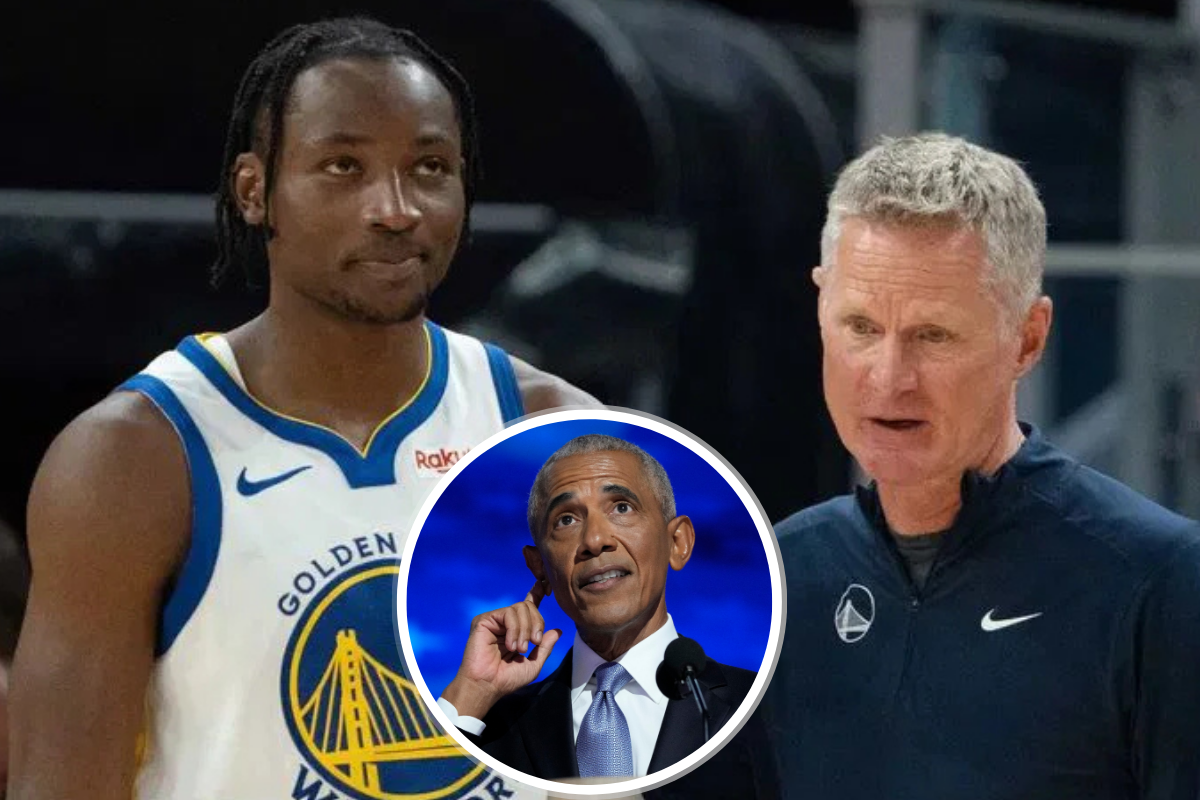
By the end of last summer, Jonathan Kuminga’s uncertain future with the Golden State Warriors had become impossible to escape – even for Steve Kerr. Questions about the former lottery pick followed the Warriors everywhere as stalled contract talks, trade speculation, and growing frustration over his role turned into one of the NBA’s loudest offseason storylines. Kerr had spent years trying to balance Kuminga’s raw talent with a system built around Stephen Curry’s movement and spacing, but the disconnect never fully disappeared.
Watch What’s Trending Now!
Soon, the drama surrounding Kuminga wasn’t just dominating basketball circles anymore – it had reached people far outside the locker room.
‘What’s gonna happen with Kuminga?’
That was the question former President Barack Obama casually tossed at Steve Kerr during a dinner in Aspen last summer – proof that the Kuminga saga had grown far beyond a normal contract dispute. Kerr later admitted he laughed at the moment because he never expected Obama to immediately bring up the Warriors forward upon seeing him.
Kerr said, “That was when he was a free agent, that was last summer. We have a mutual friend, and we had dinner and literally walked up and said, ‘What’s gonna happen with Kuminga?’ He was talking about the contract.”
What made the interaction fascinating wasn’t necessarily the question itself – it was what the question represented. By that point, Kuminga’s uncertain standing with the Warriors had become symbolic of a much larger issue surrounding the franchise: whether Golden State could realistically compete for championships with Stephen Curry while also developing young talent. Obama, like many around the league, was essentially asking the same thing fans had debated for months.
Kuminga, whom the Warriors drafted No. 7 overall in 2021, consistently flashed elite athleticism and scoring upside, but the fit inside Kerr’s offense never fully stabilized. Kuminga thrived in transition, downhill attacks, and isolation-heavy possessions, while Kerr’s system prioritized spacing, quick reads, constant off-ball movement, and role discipline around Curry. The philosophical disconnect lingered for years and eventually became impossible to ignore.
Negotiations only added more tension. As extension talks dragged through the offseason, Kuminga searched for a larger role, while the Warriors hesitated to fully commit financially to a player Kerr still struggled to maximize. Trade conversations surfaced repeatedly, but Golden State resisted moving him until the relationship finally deteriorated beyond repair.

Q: Steve, what did Obama want to know about Kuminga? Steve Kerr:
The fit concerns also appeared statistically. Lineups featuring Kuminga alongside Jimmy Butler and Draymond Green struggled badly in limited playoff action, posting a -36 net rating across 105 minutes. Without Kuminga, that same core reportedly jumped to +180 over a significantly larger sample. While small-sample lineup data can sometimes be misleading, it reinforced growing concerns about spacing and rotational chemistry.
Eventually, the two sides reached a temporary resolution when Kuminga signed a two-year, $46.8 million contract with a 2026-27 club option before his qualifying offer deadline expired. At the time, many expected the agreement to reset the relationship between player and franchise.
Instead, the tension only deepened.
Kuminga’s scoring average later dropped to 12.1 points per game, and he appeared in just 20 games before falling out of the regular rotation entirely. By January, the relationship had reportedly deteriorated enough for Kuminga to request a trade on the first day he became eligible to do so. Before the deadline, Golden State finally ended the experiment by sending Kuminga and Buddy Hield to the Atlanta Hawks in exchange for Kristaps Porzingis.
Steve Kerr will work on plans that he never made for Jonathan Kuminga
Golden State enters the offseason holding the No. 11 pick in what many executives view as one of the deepest draft classes in recent years. But unlike previous seasons, the Warriors may no longer have the luxury of slowly developing young talent behind established veterans. Jimmy Butler is expected to miss significant time recovering from a torn ACL, while Moses Moody is also working his way back from injury.
“It’s obvious where we are with the injuries to Moses [Moody] and Jimmy [Butler], you look at our depth on the wings, [the No. 11 pick] has to play. He’s gotta earn it, but we’re committed to the development of our young players,” said the Warriors head coach.
That statement carried extra weight because of everything that happened with Kuminga. For years, critics questioned whether Kerr truly trusted young players enough to let them develop through mistakes. The Kuminga saga amplified those criticisms louder than ever.
Now, with the Warriors entering a transitional phase around an aging core, Kerr appears determined to show that the organization has learned from one of the most polarizing player-development stories of his tenure. Whether the Warriors changed too late, or whether Kuminga simply was never the right fit for their system, will remain one of the defining “what ifs” of Golden State’s post-dynasty era.