
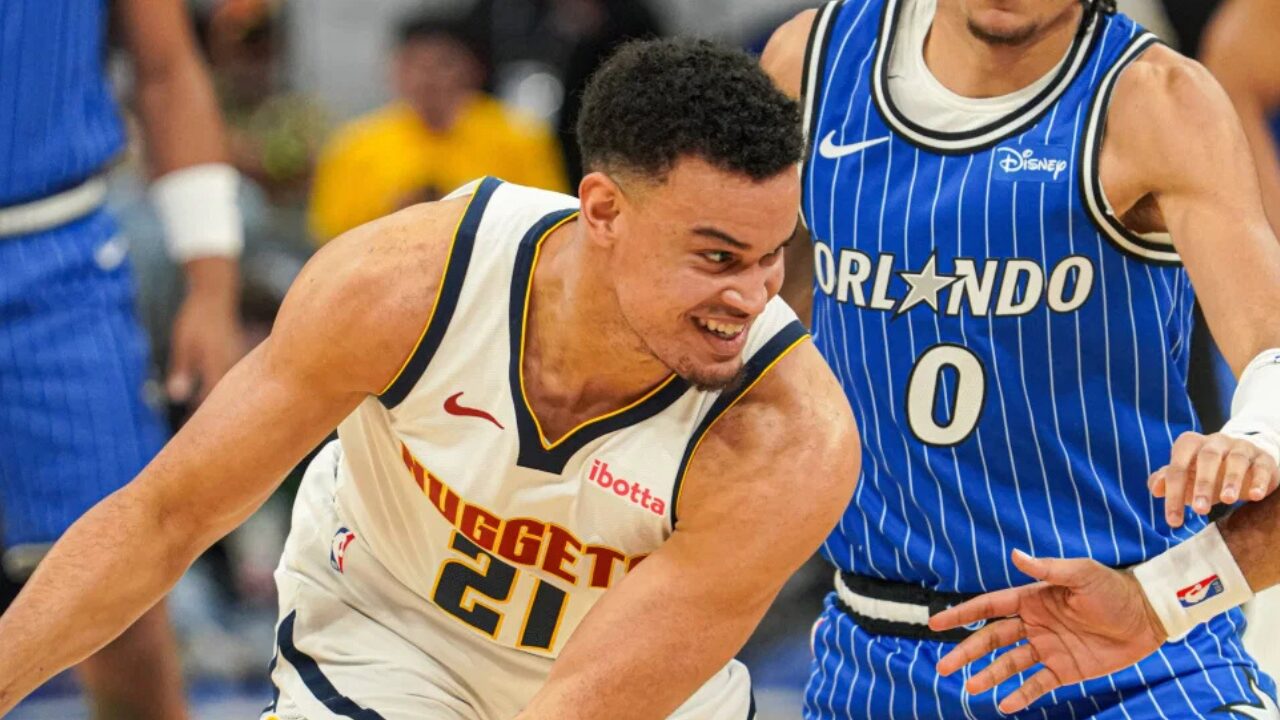
In the end, Sam Presti didn’t need to sign Spencer Jones to make life difficult for the Denver Nuggets. The Oklahoma City Thunder president simply had to force Denver into a decision. By extending a two-year, $12 million offer sheet to the restricted free agent, Presti left the Nuggets with two choices: lose one of their promising homegrown forwards to a Western Conference rival or match the deal and cross into the NBA’s dreaded second apron. In the end, Denver chose the latter. But for the Nuggets, this victory came with a hefty price.
Watch What’s Trending Now!
NBA insider Shams Charania reported that matching Oklahoma City’s offer will increase Denver’s current luxury tax bill from $36 million to $68 million while making them the league’s only second apron team. But the important thing is that this move doesn’t just inflate Denver’s payroll. It also strips away several of the roster-building tools contenders rely on, leaving Denver with far tougher decisions as it continues trying to maximise Nikola Jokic’s championship window.
According to the 2023 Collective Bargaining Agreement, they now face restrictions when constructing their roster. Like their ability to combine salaries in trades, the right to move draft picks, certain trade exceptions, and the ability to send cash in deals. In other words, keeping Jones didn’t just become an expensive decision; it also made improving the roster considerably more difficult.
However this decision also reflects the approach Denver’s front office hinted at earlier this year.
“I think everything’s on the table, outside of trading Nikola,” team president Josh Kroenke said following the Nuggets’ postseason exit.
By matching Jones' sheet, the Nuggets face a $32 million increase in current luxury taxes ($36M to $68M) and enter the second apron. They are deep in tax bills but could shed money via trades in season. Next Denver order of business: Navigate retaining RFA Peyton Watson while Show more

The Denver Nuggets are matching the Oklahoma City Thunder's two-year, $12 million offer sheet on Spencer Jones, retaining the key forward in restricted free agency, sources tell ESPN. Nuggets valued keeping their homegrown player whom they landed on an undrafted deal in 2024.
Matching Jones’ offer simply shows that the Nuggets are willing to absorb the financial pain if they believe continuity gives them the best chance of competing around Jokic. Denver entered the offseason balancing two big priorities.
On one hand, it wanted to preserve the championship core built around Nikola Jokic. On the other hand, it also faced growing financial pressure after committing significant money to several key contributors over recent years.
Following Jamal Murray, Aaron Gordon, and Cameron Johnson (trade), the team extended Christian Braun’s deal with a 5-year, $125 million offer. Now, Jones is also part of that equation. After arriving in 2024, the forward earned the coaching staff’s trust and established himself as valuable depth.
After initially signing a two-way contract as an undrafted free agent, Jones earned a standard NBA contract in February 2026 and then continued to carve out an important role in the rotation.
Jones appeared in 64 games last season, averaging 5.5 points and 3.3 rebounds across 22.1 minutes per game, while shooting 50.4% from the floor and 39.6% from deep. His postseason performances simply reinforced his value, most notably when he produced 20 points, three steals and three blocks in Game 5 of the Nuggets’ first-round series against the Minnesota Timberwolves.
So, rather than allowing the OKC Thunder to add a young rotational player, the Nuggets chose continuity despite the financial consequences. However, that decision is certainly not the end of their financial misery.
Charania also reported that Denver’s next priority is restricted free agent Peyton Watson. Retaining him will strengthen the team’s rotation. Still, the Jones decision has made those negotiations even more complicated, especially with reported interest from the Atlanta Hawks, Milwaukee Bucks and Los Angeles Clippers.
According to league insider Marc Stein, Watson is considering the prospect of playing next season on a qualifying offer worth $6.5 million. Now, while that appears baffling because the player is leaving millions on the table, there’s a backstory to it. Denver’s initial pitches to him were in the $70 million range over four years. However, Watson was “hoping” to exceed his teammate Braun’s $25 million per year earnings.
Going the qualifying offer route will also allow Watson to potentially explore unrestricted free agency next summer. The Nuggets, who witnessed flashes of brilliance with a career-high 35-point outing against the Washington Wizards and a 30-point game against the Celtics last season, wouldn’t want to reach that uncontrollable stage with Watson.
However, the reality is that even Jokic hasn’t committed to signing an extension yet. Insider Bobby Marks reported that by waiting until the 2027 season, the Serb will be eligible to sign a five-year, $359.5 million contract as a free agent. He is currently eligible to ink a four-year extension worth $280 million, but Jokic hasn’t gotten down to signing a new deal since his 2022 super-max extension.
Jokic, though, has verbally committed his future to the Nuggets, acknowledging the delay in inking a deal.
“My idea and desire is to stay in Denver. I’ll probably sign next year,” Jokic said earlier this month. “The decision is strictly business-oriented. My wish is to stay and play for Denver the rest of my career. It’s on them if they want me.”
Meanwhile, they’ve waived Jonas Valanciunas and lost Tim Hardaway Jr and David Roddy. The Nuggets added Marvin Bagley and Alpha Diallo, re-signed Tyus Jones, and drafted two second-rounders, Trevon Brazile and Bryce Hopkins, before the Jones development.
It is a confusing one with the Nuggets. They’ve been making minor moves in the offseason, but their playoff and title hopes will only change if their top five earners remain fit and consistently deliver the value they’re being paid for in game-winning performances.
They haven’t gone past the conference semifinals since winning the championship in 2023. Should this pattern continue, it wouldn’t be surprising if Jokic starts looking elsewhere as well.