
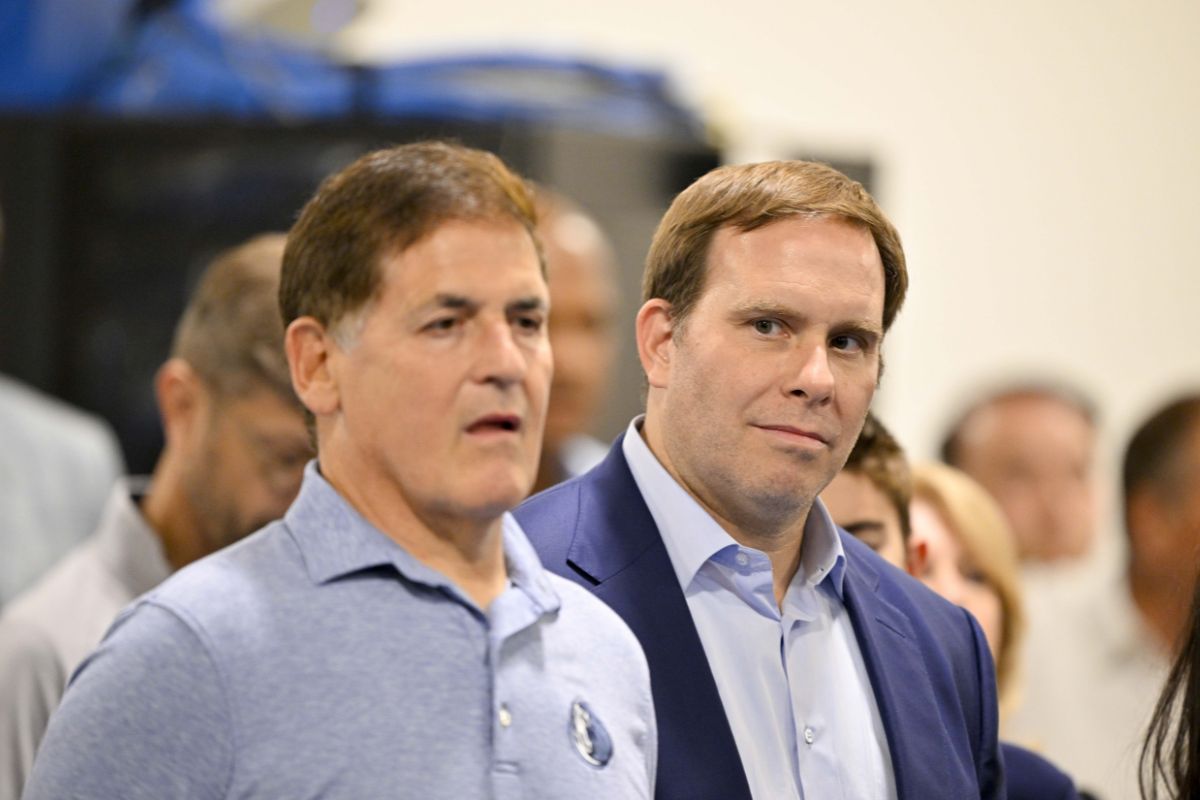
When Mark Cuban sold his majority stake in the Dallas Mavericks in 2023, we anticipated a major change. But the organizational overhaul has caused an unexpected internal clash within the ownership group. Cuban, who remains a minority owner of the team, has filed a suit against the team’s governor, Patrick Dumont. This disagreement is directly related to the Mavericks’ next home, a situation that has even upset Dallas residents.
Watch What’s Trending Now!
According to a report by The Dallas Morning News, Cuban has filed a legal petition in Dallas County District Court, accusing the franchise’s majority leadership of systematically freezing him out. His lawsuit alleges that Dumont engaged in “adversarial business practices” in connection with this relocation.
The lease for the American Airlines Center, home of the Mavericks and Dallas Stars for 25 years, expires in 2031. Dumont’s team has already finalized the new site for the team’s relocation. If confirmed, the Mavericks will move out of downtown Dallas to about 10 miles north at the former site of the Valley View Mall. Last month, the Mavericks even signed an option agreement to purchase approximately 104 acres in north Dallas for the proposed new arena.

From @ChhetriDevyani and I: Mark Cuban goes to court for records on Dallas Mavericks' Valley View arena deal dallasnews.com/news/politics/… via @dallasnews
Cuban still holds a 27% stake in the organization following his historic majority sale in 2023 to the families of Miriam Adelson and Dumont. He asserts that his businesses were “contractually entitled to participate” as equity investors in any future stadium ventures, describing it as “a unique investment opportunity.”
The legal petition is filed as a pre-suit ‘Rule 202’ discovery tool (to conduct discovery, such as the production of documents). It seeks to compel Arena Development Intermediate LLC, an entity tied to Dumont, to disclose internal documents, financing details, and all details of the real estate transaction.
Cuban’s court filing also revealed a deeply fractured partnership behind the scenes. The billionaire discusses the “handshake” agreement that he’d remain part of the basketball framework after the $3.5 billion sale. Here’s how.
The 67-year-old claims their agreement included “the clear division of responsibilities: Cuban would retain authority over the Mavericks’ basketball operations, while Dumont would oversee the business side of the franchise, including real estate development and the pursuit of an integrated, destination resort casino in Dallas.”
However, the seismic Luka Doncic trade of 2025 revealed that former GM Nico Harrison exiled Cuban from the operations, leaving him out of that trade discussion.
“When I discussed this with Dumont over the phone, he told me: ‘Why would I give you control of a $4 billion asset?'” Cuban alleges in the document.
The internal disconnect perhaps also became obvious when Dirk Nowitzki, who has a 23-foot bronze likeness at AAC, revealed he is not involved in the Mavericks’ decisions.
Notably, Harrison was fired in November 2025, and Cuban has since reportedly taken on a substantial role in basketball operations. However, earlier in 2026, the billionaire investor made a major revelation about the partners he had sold the Mavericks to. This statement came at a time when fans were urging him to buy the franchise back.
“I don’t regret selling,” Cuban said. “I regret who I sold to. I made a lot of mistakes in the process, and I’ll leave it at that.”
Cuban has previously said that the financial pressure of funding an NBA contender was his primary reason for letting go of majority control. He said it had been too much of a financial burden for a “middle-class billionaire” like himself…
But the real question now is, how can Cuban give Dallas what it wants by stopping the Mavericks’ relocation?
Spokespersons from both the Mavericks organization and Cuban have declined to issue official public comments regarding the ongoing litigation. Meanwhile, this adds another layer to the franchise’s contentious relocation.
Diehard loyalists, who are still reeling from losing Doncic to LA, did not take the news of the Mavericks’ relocation well. The team has been based in downtown Dallas since entering the NBA as an expansion team in 1980. City leaders want Dumont to reconsider the decision, as the Mavericks have been the city’s heartbeat, supporting many local restaurants, bars, and businesses.
Meanwhile, Dumont has an ambitious development plan to build a state-of-the-art basketball-only facility at the new site by 2031. That ruled out any plans to renew the lease at ACC.
Their co-tenants, the NHL team Dallas Stars, also have no intention of staying. They have plans to build an exclusive arena in Plano. Locals are furious with both teams for the real estate, economic, and emotional upheaval.
However, Cuban is not specifically trying to stop it or support the city’s attempt to keep the Mavericks in the ACC. Observers note that the legal push may be an attempt by the billionaire to protect his financial positioning.
The initial purchase contract for the Mavericks contains a specific clause allowing the Adelson and Dumont families to buy out an additional 20% of Cuban’s remaining 27% share. However, it’s not a straightforward corporate buyout.
The filing asserts that Cuban’s business entities are “contractually entitled” to be involved in the new arena project. Using the legal discovery tool, Cuban’s attorneys could find a breach of the 2023 agreement and effectively halt the relocation until the lawsuit is resolved.
As the Dallas County judge reviews the request to compel financial disclosures, the public rift underscores a sharp philosophical divide over who will ultimately decide the Mavericks’ financial and structural future.