
Imago
Credit: Forbes
Imago
Credit: Forbes
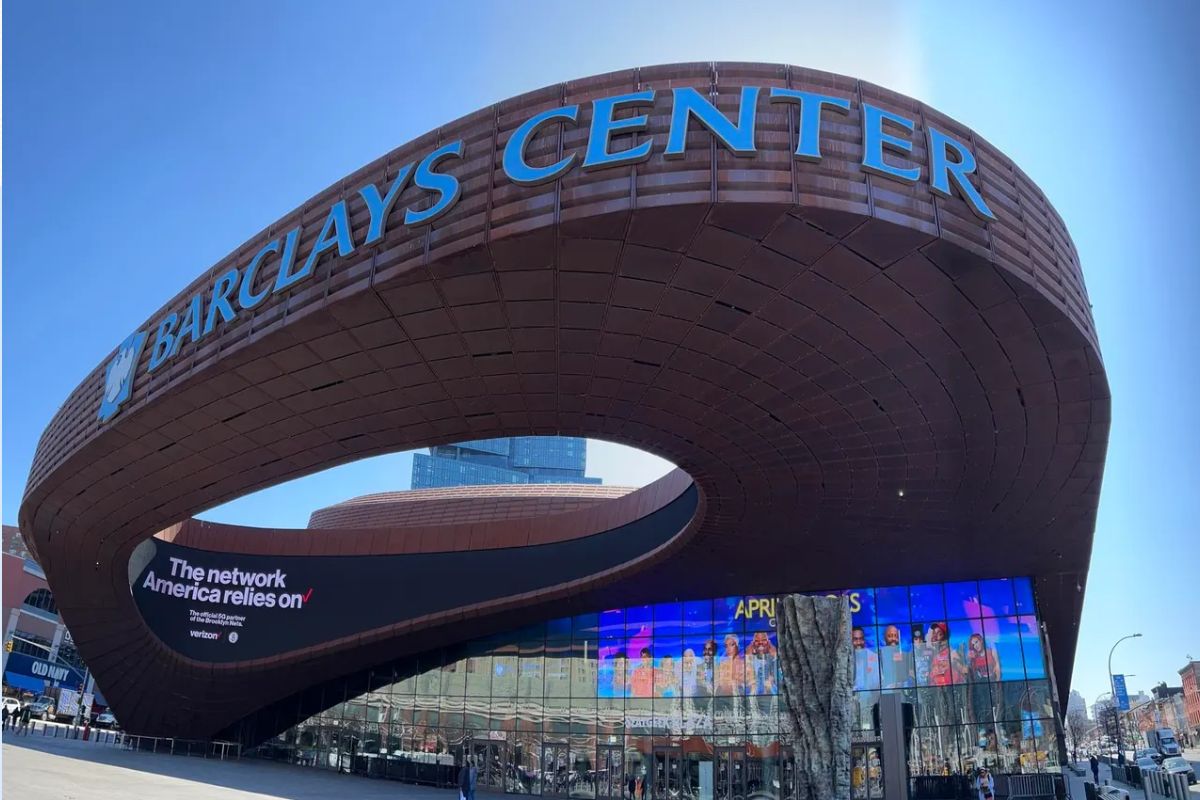
For every college star chasing a lifelong dream of reaching the NBA, one stage stands above all others. Every June, future franchise cornerstones walk across that stage, shake the commissioner’s hand, and officially become professionals. For more than a decade, that moment has unfolded inside Barclays Center in Brooklyn.
Watch What’s Trending Now!
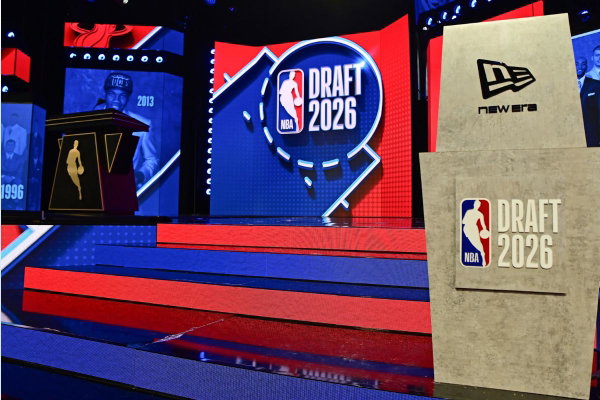
The NBA Draft did not always have a fixed address. The event bounced between New York, Portland, Vancouver, New Jersey, and other cities throughout the 1990s before settling at Madison Square Garden from 2001 through 2010. After a brief stay at Prudential Center in Newark, the league moved the Draft to Barclays Center in 2013.
That decision turned out to be far more than a venue change. When announcing Brooklyn as the host of the 2013 NBA Draft, then-Commissioner David Stern said, “We are excited to be holding the NBA Draft in Brooklyn, a borough long associated with great basketball talent.” Barclays Center CEO Brett Yormark added, “Brooklyn has become a major NBA market.” More than a decade later, those comments still explain why the league continues to return to Brooklyn every year.
Barclays Center: The home of the NBA Draft night
The logic behind Barclays Center extends well beyond geography. The arena opened in 2012 as a state-of-the-art basketball venue and quickly offered something the NBA could not easily replicate elsewhere: modern broadcast infrastructure, direct transit access, premium hospitality spaces, and a location at the center of the league’s business ecosystem. While the NBA has never formally designated Barclays as the Draft’s permanent home, the arena has become the event’s de facto anchor since 2013.
Meanwhile, the NBA’s global office is at 645 Fifth Avenue in Manhattan, and the league’s NBA Entertainment and NBA TV studios are in Secaucus, New Jersey. Both remain within easy reach. As a result, broadcasters, executives, and production crews could move around New York with remarkable ease, turning logistics into one of Brooklyn’s biggest hidden advantages.
That convenience becomes even more important on Draft night. ESPN builds an enormous production operation inside Barclays Center, deploying Game Creek Video’s production trucks, RF transmission facilities, roaming broadcast crews, and remote camera systems throughout the building. The venue effectively transforms from a basketball arena into a live television studio capable of delivering hours of prime-time coverage to a global audience.
The arena’s layout is equally valuable. Barclays places the Draft green room directly on the court surface, allowing cameras to capture prospects and their families moments before their names are called. Unlike a traditional theater setting, the arena’s steep seating bowl surrounds those tables with thousands of fans, creating the emotional scenes that often define Draft broadcasts. ESPN Senior Operations Manager Tommy Mitchell once described the Draft as both a basketball event and a human-interest showcase, explaining that telling the personal stories behind every prospect is “part of what makes the Draft compelling.”
Barclays Center has become Brooklyn’s new identity
Barclays blends into Brooklyn in a way few arenas manage. Its entrance and plaza flow naturally into the neighborhood, while local food vendors and community-inspired touches give the venue a distinctly Brooklyn feel. Moreover, the arrival of the Nets and later the New York Liberty helped restore major sports to the borough. Thus, turning the building into a cultural symbol rather than another corporate address.
That cultural connection was one of the reasons the NBA embraced Brooklyn in the first place. When the Draft arrived in Barclays Center in 2013, league executives viewed the borough’s basketball heritage, fashion influence, and growing sports identity as a natural backdrop for introducing the next generation of stars. More than a decade later, prospects still describe Draft night in Brooklyn as a career-defining experience. No. 1 pick AJ Dybantsa called the moment “super surreal” and said it was exactly how he imagined getting drafted as a child.
Meanwhile, the arena keeps busy year-round. Beyond the NBA, it welcomes the WNBA, college basketball, concerts, family shows, award ceremonies, and the NBA Draft. It has also staged more than 250 boxing events and dozens of title fights. At the same time, accessibility adds another edge.
Imago
Credit: SB Nation
Accessibility remains another major advantage. Barclays Center sits directly above Atlantic Terminal, connecting visitors to multiple subway lines and the Long Island Rail Road. That setup allows thousands of fans, media members, sponsors, and league personnel to move through the venue efficiently without the transportation bottlenecks that often accompany major events.
Consistency also benefits the NBA’s business partners. Unlike leagues that move their drafts from city to city, the NBA can offer sponsors a familiar environment each year. State Farm, American Express, New Era, Google Pixel, Wilson, and Michelob Ultra have all built recurring Draft activations around Barclays Center, allowing them to refine experiences instead of rebuilding them from scratch every summer. The result is a more predictable and commercially efficient showcase for both the league and its partners.
Barclays slow resurgence after a $76M loss 3 years ago
Money has remained a lingering concern around Barclays Center. The arena recorded a $76 million loss for the fiscal year ending in June 2023 after absorbing another $78 million setback the previous year. Meanwhile, profits still fell short of covering construction bond obligations. As a result, the Brooklyn Nets owner, who has operating rights of the arena, Joe Tsai, stepped in. He personally shouldered the burden, keeping the books balanced while the venue searched for stronger returns.
Three years later, the picture is slightly kinder as the arena has experienced a mixed first half of FY 2026. Q1 brought $7.2 million in suite and sponsor payments and $51.4 million in ticket revenue, compared with $5.4 million and $40.3 million a year earlier. However, Q2 cooled off, with $10.8 million and $41 million versus $10 million and $57.4 million previously. Thus, producing an overall dip of $2.7 million. Fresh clubs and premium seats could still shift the scene later.
Meanwhile, revenue reached $67.8 million against $55.8 million in expenses, leaving almost $12 million in NOI. A year earlier, those figures stood at $77.8 million, $58.3 million, and $19.5 million. Last year ended with $31.6 million in NOI and roughly $11.5 million in profit after $20 million in interest. Even with projections near $24 million, Brooklyn Sports & Entertainment keeps gaining value thanks to the rarity of owning an NBA franchise.
Barclays is still a top spot for events
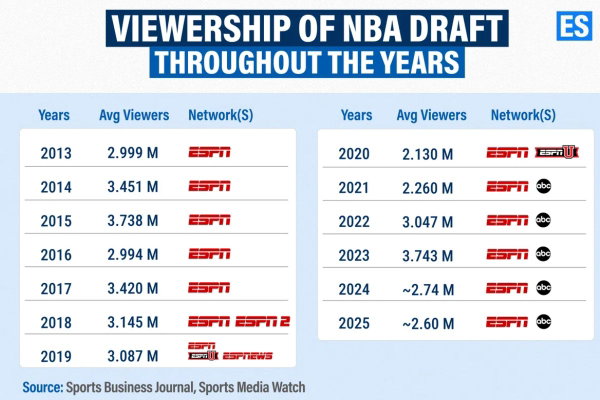
Of course, finances alone are not determining Barclays’ situation in a greater perspective. Since the Barclays Center took over in 2013, NBA Draft audiences have swung between 2.130 million and 3.743 million viewers. ESPN carried every edition, while ESPN2, ESPN U, ESPN News, and ABC joined at various points. Interest peaked at 3.738 million in 2015 and climbed again to 3.743 million in 2023. This surge proved the event still commands national attention to some extent.
However, viewership slipped to around 2.74 million in 2024 and 2.60 million in 2025, reminding everyone that the NBA Draft must keep earning the spotlight. Even with annual Draft duties, Barclays still faces the challenge of keeping its spotlight bright and maintaining its place in a fiercely competitive entertainment landscape. At the same time, the arena lives in one of the fiercest entertainment races in America.
Sports Business Journal describes New York as a battleground where MSG, Prudential Center, Barclays Center, and UBS Arena chase the same events. Meanwhile, UBS benefits from extra space, easier parking, and smoother logistics. Thus, forcing Brooklyn to work even harder for concerts and special attractions. The challenge has shown up on the books too, with Barclays reporting a $76 million loss for the fiscal year ending June 2023, while ticket totals have often lagged behind MSG and, at times, even Prudential.
That makes NBA Draft night incredibly valuable. Unlike open market events, the showcase arrives every year with global television coverage, sponsors, and premium experiences. While the New York Knicks, Rangers, Islanders, and Devils anchor rival venues, Barclays leans on the Nets and major league events to keep its calendar and identity strong.
NBA Draft’s impact on local and small businesses
The NBA Draft night creates a lively ripple around the Barclays Center. With around 15,000 to 18,000 people inside a building that seats 17,732 for basketball, nearby neighborhoods such as Prospect Heights, Fort Greene, and Downtown Brooklyn come alive. Restaurants, bars, coffee shops, convenience stores, and late-night eateries often enjoy sales bumps of 20% to 40% within roughly 1 mile.
Sponsor events add to the buzz, too, with the 2025 draft bringing 90 Amex guests and several brand activations. However, the payoff stays mostly local and short-lived. Retail stores can benefit when visitors linger, although results vary by hours and customer habits. Rising rents and congestion also eat into gains. Looks like the draft delivers a welcome neighborhood boost rather than a city-changing economic jackpot.
In many ways, Barclays Center has become exactly what the NBA was looking for when it brought the Draft to Brooklyn in 2013. The arena sits at the center of the league’s media ecosystem, provides world-class broadcast infrastructure, offers sponsors a reliable platform, and delivers the kind of emotional television moments that define Draft night.
That does not make Barclays the NBA Draft’s official permanent home. The league has never formally designated it as such. Yet after more than a decade of hosting the event, surviving the pandemic interruption, and immediately reclaiming the Draft when in-person ceremonies returned, Barclays has become something arguably more important: the place most basketball fans now associate with the beginning of an NBA career.
Written by

Edited by

Ved Vaze