
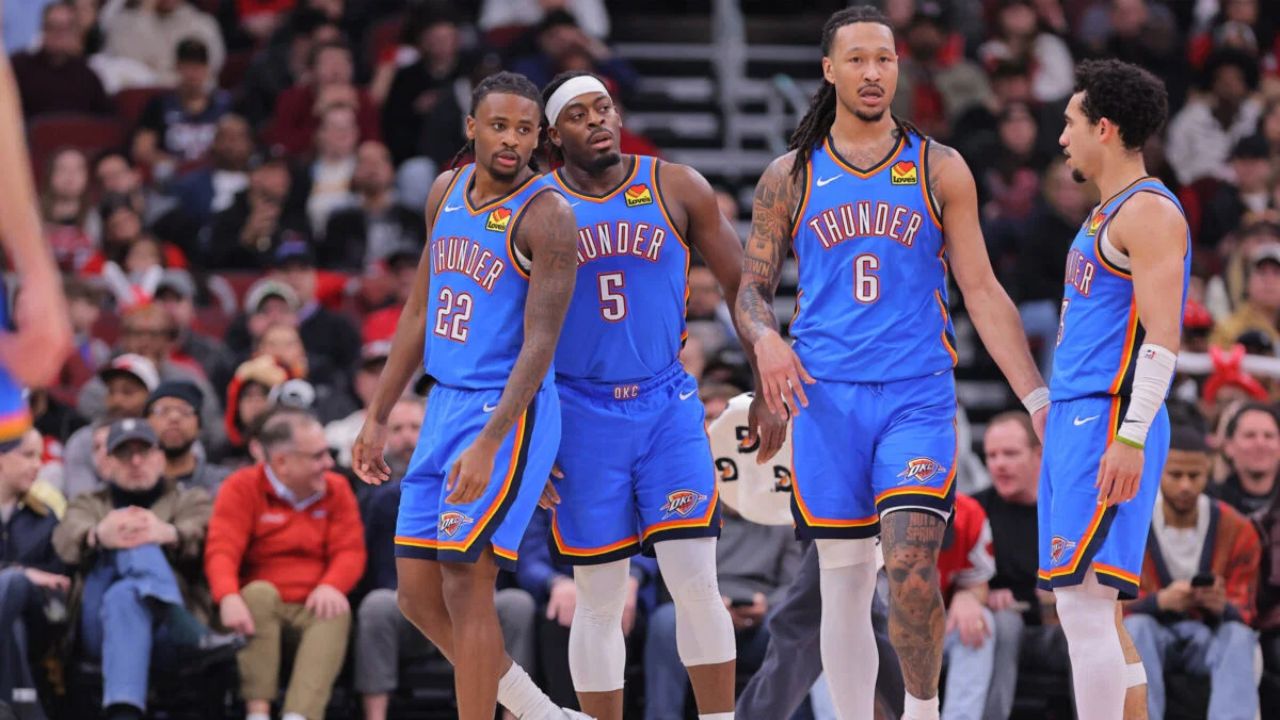
For two seasons, Thunder fans kept seeing the same person appear whenever one of Oklahoma City’s stars needed attention on the court. Now, that familiar face is gone and the timing has made the departure much more interesting than a routine staff change.
Watch What’s Trending Now!
Dr. Tobi Owotomo, who was listed by the Thunder as a Physical Therapist & Athletic Trainer during the 2024–25 championship season and 2025–26 campaign, is no longer with the organization. Her departure became public through an update to her professional profile, but neither Owotomo nor the Thunder has publicly explained why she left.
The timing matters because Owotomo’s exit comes as Oklahoma City continues to build a much larger high-performance operation around its players. Instead of relying on a traditional medical setup, the Thunder now have an integrated structure spanning athletic training, rehabilitation, performance, sports science, and data, with VP of Human & Player Performance Dr. Donnie Strack overseeing the department and new Athletic Performance Director Maral Javadifar joining the group. That bigger change is part of why the departure caught fans off guard.
@AyoBigtalkzu wrote, “We lost Dort, Wiggins, Joe. But this is the biggest loss since Russ or KD. We have had an injury crisis last 3/4 years, theres more things in life.” The same fan later added, “I was just saying it’s sad to see her go, whole team looks close. You see Tobi a lot on the sidelines of games, whether on a home broadcast or a national TV game. She does the gluing and bandaging up. Or, if players come off the court, you’ll see her go to them. I have no idea exactly why she left.”
Owotomo was more than a familiar face on the bench. Her Thunder roles included physical therapy, athletic training, player rehabilitation, manual therapy, pregame preparation, sideline injury care, and performance science work. Before leaving Oklahoma City, she had also been part of the organization’s performance operation as a Performance Science Doctoral Fellow.
Her background also made her a unique figure within the organization. Raised between Hamilton, Ontario, and Staten Island, New York, Owotomo competed in wrestling, volleyball, and rugby before representing Canada in rugby. She later earned her physical therapy degree from Stony Brook University and built credentials across athletic training, physical therapy, athletic therapy, and strength and conditioning.
The fan reaction is understandable, but it also raises a bigger question: what exactly is changing inside the Thunder’s performance operation?
The Thunder Are Building Something Bigger Than a Traditional Training Staff
That question becomes harder to ignore when you look at what happened to Oklahoma City’s core over the last two seasons.
Chet Holmgren suffered a fractured hip in November 2024. He went through a non-surgical rehabilitation program and returned in time to help the Thunder win the championship. He then played the entire 2025–26 season without another structural recurrence.
Jalen Williams’ path was far less straightforward. After offseason wrist surgery kept him out for the first 19 games of the 2025–26 season, he suffered a Grade 1 left hamstring strain in January. The same hamstring became a problem again in the playoffs, forcing him to miss six games after a recurrence against Phoenix. He returned for the Western Conference Finals, only to aggravate it again against San Antonio. Williams then missed four more games and played only 10 minutes in Game 6.
The same series created another problem. Ajay Mitchell had taken on a bigger role while Williams was unavailable, but he suffered a right soleus strain in Game 3 of the Western Conference Finals and missed the rest of the series.
None of that proves Owotomo’s departure was caused by injuries. There is no public statement from the Thunder or Owotomo establishing a reason for her exit. But it does explain why the organization’s performance structure matters more than it might at another point in the franchise’s timeline.
Oklahoma City is no longer trying to build a team that might become a contender someday. It already has the championship core. Now the challenge is making sure that core is still on the floor when the regular season turns into the playoffs and the playoffs turn into a championship series.
The people responsible for that job now stretch far beyond one athletic trainer. Dr. Donnie Strack oversees Human & Player Performance, while the department includes Director of Athletic Training Tony Katzenmeier, Director of Athletic Performance and Rehabilitation Andrew Paul, Director of Performance Science Jennifer Strickler, Athletic Performance Director Maral Javadifar, Athletic Performance Coach Sean Stoqua, and staff focused on data solutions and movement tracking.
A Super Bowl Champion Is Already Working on the Next Generation
One of the clearest signs of that change is Maral Javadifar. She joined Oklahoma City after seven seasons with the Tampa Bay Buccaneers, where she worked as Director of Rehabilitation and Performance Coach and was part of the staff that won Super Bowl LV. She also holds a Doctor of Physical Therapy degree and played collegiate basketball.
But the clearest glimpse of what Oklahoma City wants from her came thousands of miles away from the Thunder’s training facility.
After the Thunder selected 7-foot-3 center Aday Mara with the No. 12 pick in the 2026 draft, Javadifar traveled to Spain while Mara was with the Spanish national team. She worked with him on conditioning, lateral movement, and cardiovascular endurance, with the goal of preparing his 7-foot-3 frame for the pace of Oklahoma City’s system.
That is a useful glimpse into what the new structure can look like. The performance department is not only reacting when a player gets hurt. It is being built around how players move, train, recover, and prepare before they ever reach an injury report.
Maral Javadifar is not the only piece of the puzzle. Sean Stoqua shows just how deep the Thunder’s performance operation already runs.
Stoqua joined the Thunder organization in September 2024 as an Athletic Performance Coach for both the Thunder and the Oklahoma City Blue. His background includes professional basketball in Armenia, Germany, and Bulgaria, along with a stint as Performance Director for the Ottawa Blackjacks.
He also has a direct connection to Oklahoma City’s backcourt. Stoqua works with Canadian stars Shai Gilgeous-Alexander and Luguentz Dort on individualized strength, deceleration, and mobility work.
That matters because it shows how broad the Thunder’s performance operation has become. There is no longer one person whose job tells the whole story. Different specialists now sit across athletic training, rehabilitation, performance science, and data.
The Thunder have already gone through a similar transition.
In October 2018, longtime Head Athletic Trainer Joe Sharpe left Oklahoma City for Charlotte. Presti did not simply replace him with another athletic trainer. The organization elevated Dr. Donnie Strack and established a 10-year partnership with OU Medicine, now known as OU Health.
Seven years later, the structure looks much larger. What was once centered around a more traditional training operation now stretches across medical care, rehabilitation, athletic performance, sports science, and data.
That makes the current change look less like a simple replacement and more like another step in a process Oklahoma City started years ago.
That evolution has also been supported by the Thunder’s long-running relationship with OU Health. The partnership began in 2018 and gives Oklahoma City access to Level I trauma specialists, orthopedic surgeons, imaging facilities, and other medical resources.
The point is not that a new medical partnership suddenly appeared after Owotomo left. It is that Oklahoma City has been building the infrastructure around player health for years and the latest personnel changes fit into that longer evolution.
Presti has also made clear that the organization wants player availability to be treated as something it can actively work to improve.
“I think the worst thing we can do as a league is to start to believe that’s actually the way our fans think and feel. Because it’s all manipulated. We have to focus on building sustainable systems that stand the test of time, prioritizing the long-term health and availability of our players above everything else,” said Sam Presti
That philosophy carries more weight now because the players at the center of it are no longer prospects. Gilgeous-Alexander, Holmgren, and Williams are the foundation of a team that has already won a championship.
The Real Test Is What Happens to Shai, Chet and Jalen
The biggest measure of this new structure will not be how impressive the department looks on paper.
The real test will come when Oklahoma City’s best players are asked to survive another 82-game season and another deep playoff run.
Holmgren has already shown what a successful rehabilitation can look like. After his 2025 hip fracture, he returned in time for the championship run and then completed the following regular season without another structural recurrence.
Williams is the more immediate test. His recurring left hamstring issue followed him from the regular season into the playoffs and then into the Western Conference Finals. By the time he aggravated it against San Antonio, the Thunder were already relying on less of their preferred rotation around their two other stars.
The same series showed why availability goes beyond one star. When Mitchell went down with a soleus strain, the Thunder lost another important ball-handler at a time when Williams was already compromised.
And that is where Owotomo’s departure becomes part of a much bigger Thunder story.
For a team built around three long-term stars, keeping those players available is not a side project. It is part of the championship plan itself.
As for Owotomo, her next move remains unknown. Neither she nor the Thunder has publicly explained her departure or announced what comes next.
And that leaves one question the Thunder have not answered.
Why did Owotomo leave?
Neither she nor the Thunder has publicly explained it. It could be a personal career decision. It could be part of the organization’s evolving structure. Right now, the reporting does not establish either explanation.
What is clear is that Oklahoma City is changing the machinery around its players at the same time the franchise is entering the most important stage of its young history.
The Thunder are no longer waiting to see what this core can become.
They are trying to keep it together.
Owotomo’s departure may eventually prove to be a small footnote in Oklahoma City’s larger story. But the changes happening around it are harder to ignore.
A team that once had to build a contender is now trying to protect one.
The fans may remember Owotomo because they saw her on the sideline. The bigger story is what Oklahoma City is building behind it and whether that system can keep Shai Gilgeous-Alexander, Chet Holmgren, and Jalen Williams healthy enough to turn one championship into the start of something much bigger.