
The 2026 Basketball Hall of Fame (HOF) class brings together an unusually wide range of basketball stories. There are NBA Champions, transformative coaches, dominant WNBA stars, a legendary Olympic team, a college coaching institution, and one of the most recognizable referees in league history. Their careers unfolded across different eras and levels of sport, but each left a mark that extends beyond a box score.
Watch What’s Trending Now!
As the newest class takes its place among basketball’s immortals in the HOF, here is a look at the careers and legacies that earned each inductee a place in Springfield, Massachusetts.
The Visionary Coaches
1. Mike D’Antoni
Mike D’Antoni did not need an NBA championship to leave a mark on the game.
During his tenure with the Phoenix Suns, D’Antoni helped create the revolutionary “Seven Seconds or Less” offense. Instead of allowing defenses to settle into traditional half-court formations, his teams attacked immediately.
Steve Nash controlled the offense, Amar’e Stoudemire attacked the rim, and shooters surrounded them on the perimeter.
His teams looked to shoot within 7 seconds, leaving the defense scrambling in transition. And that ultimately became the blueprint for modern ball.
Ever since D’Antoni picked up the Phoenix Suns’ coaching duties in 2003, it became one of the league’s most entertaining teams while forcing opponents to rethink how they defended transition basketball.
The approach also helped Nash win consecutive MVP awards in 2005 and 2006. D’Antoni never captured an NBA championship, but his influence eventually became more important than the trophy. In his 16-season-long coaching stint in the league, the HOF coached 1199 games and won 672, winning at the rate of 56%.
Modern offense built around pace, spacing, three-point shooting, and versatile lineups owes a considerable debt to the principles he popularized.
Reflecting on his induction, D’Antoni acknowledged the one achievement missing from his resume while recognizing the broader impact of his work.
“Didn’t win a title, which is something that I hate. But they see it as, you know, what we influenced the game to the point where we made a little bit more fun, a little bit faster, a little bit brighter, and that players love playing this system,” D’Antoni said at the media interaction ahead of the formal induction. “There’s nothing better than thinking that players loved it, fans loved it, and I’m good.”
That influence is precisely why his HOF case extends beyond wins and losses.
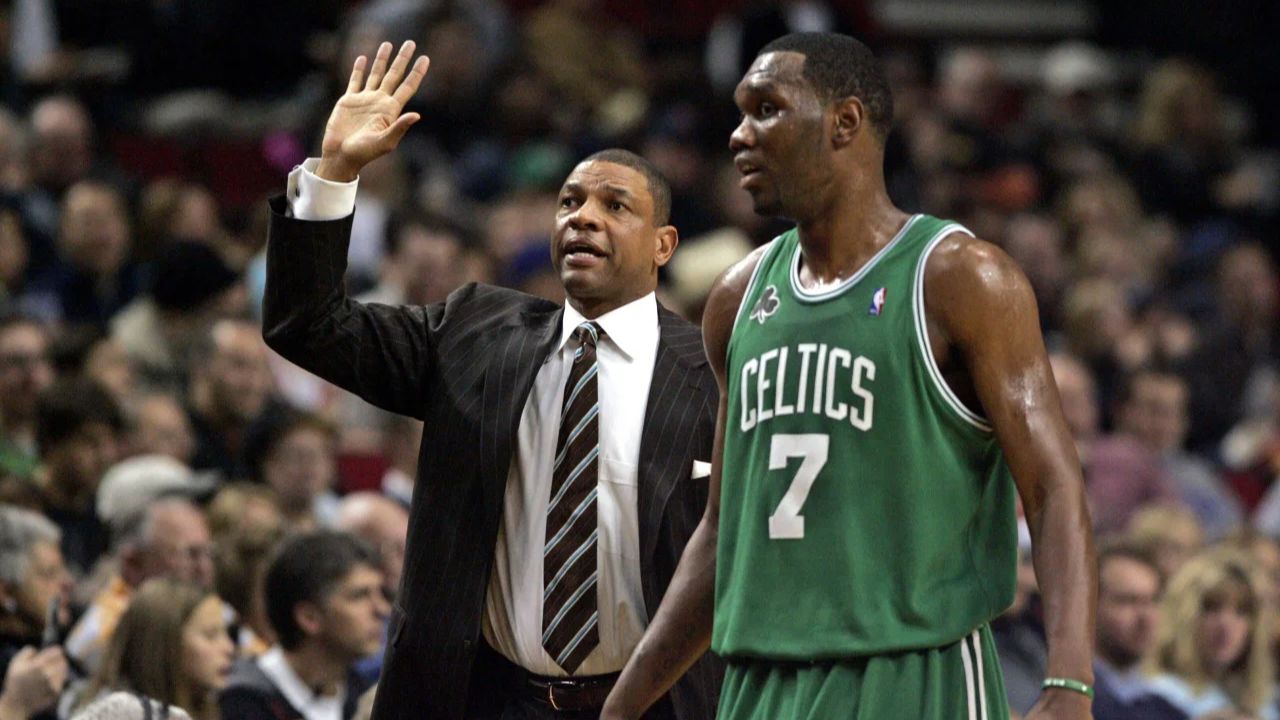
2. Doc Rivers
Doc Rivers brings nearly three decades of NBA experience to the Hall.
Rivers first established himself as an accomplished player before building an even larger legacy from the sideline. He became one of the league’s most respected coaches and eventually surpassed 1180 regular-season victories.
His notable achievement came in 2008, when he guided the Boston Celtics’ newly assembled Big Three of Kevin Garnett, Paul Pierce, and Ray Allen to an NBA championship.
Rivers’ greatest strength has often been his ability to manage personalities. He has coached championship teams and numerous star-heavy rosters, consistently emphasizing communication, accountability, and collective responsibility.
For someone who spent so much of his career around the game’s biggest personalities, becoming a HOF still felt uncomfortable.
“I’m uncomfortable. I love it, but it’s just too much attention. But it is cool. But come on. If you’re anything in sports, and they tell you you’re in the Hall of Fame,” Rivers said. “There is no other higher honor that you can get to. It’s the highest of the highest honors, and I embrace that.”
3. Mark Few
Mark Few built something at Gonzaga University that once seemed almost impossible.
After taking over as head coach of the Zags in 1999, Few transformed the program into one of college basketball’s most consistent national powers. Often discarded as an unknown school, Gonzaga became a fixture in the NCAA Tournament. Moreover, Few’s teams repeatedly competed for national championships.
The Bulldogs reached the national championship game twice under his leadership, turning what was once a relatively unknown program into a national basketball institution.
Few’s legacy also reflects a different kind of coaching success. He stayed.
Rather than constantly chasing a bigger job, Few dedicated himself to building Gonzaga into a program capable of competing with the traditional giants in the circuit. His induction recognizes that consistent effort can fetch you HOF.
The Pioneers of Women’s Basketball
4. Candace Parker
Candace Parker spent her career making noise with her versatility.
Standing tall at 6’ 4, she possessed the size of a dominant forward while handling the ball, passing, and also creating offense like a guard. That combination made her one of the most influential players of her generation.
At Tennessee, Parker won two national championships under legendary coach Pat Summitt. She later carried that success into the WNBA, where she won championships with the LA Sparks, Chicago Sky, and Las Vegas Aces.
Her induction also carries a personal connection because she enters the HOF alongside Elena Delle Donne and the 1996 USA Basketball Women’s National Team.
“Obviously, Elena Delle Donne and I grew up battling against one another and the ’96 team, I think we were all inspired by that. So I just think it’s truly special.”
5. Elena Delle Donne
Elena Delle Donne built one of the most efficient offensive careers in WNBA history.
The two-time MVP became the first player in league history to join the 50-40-90 club, combining elite shooting from the field, three-point range, and the free-throw line.
She never shied away from difficult assignments. In 2019, Delle Donne played through three herniated discs while leading the Washington Mystics to their first WNBA championship.
Apart from her tough fighting spirit, Delle Donne also owns a career free-throw % of 93.7.
Her HOF case rests on more than statistics. She became one of the league’s most recognizable stars, balancing skill, efficiency and versatility.
6. Chamique Holdsclaw
Before the WNBA had developed into the global league it is today, Chamique Holdsclaw shouldered a lot of weight.
She arrived in Tennessee under the weight of comparisons to greats and, in a way, justified it. She led the Lady Vols to three consecutive national championships from 1996 through 1998. She eventually earned the title ‘Michael Jordan of Women’s Basketball.’
The No. 1 overall pick in the 1999 WNBA Draft, she immediately became one of the league’s most recognizable young stars.
Her career also connects directly to Parker’s. Both players played under Pat Summitt at Tennessee, and both now enter the HOF in the same class.
Speaking of it, Candace Parker said, “I think Coach definitely wrote this in the stars for us to go in, in the same class.”
The Trailblazers and Game Changers
7. 1996 USA Basketball Women’s National Team
The 1996 USA Women’s National Team represents more than one dominant Olympic campaign.
The roster featured future legends such as Lisa Leslie, Sheryl Swoopes, and Dawn Staley. Before reaching the Atlanta Olympics, the team embarked on an extensive international schedule and built an extraordinary 60-0 record.
Then came the gold medal
Their dominance put the spotlight on women’s basketball. The success came just before the WNBA’s 1997 launch. It undeniably gave a boost to the emerging professional league of future stars.
8. Amar’e Stoudemire
Amar’e Stoudemire brought domination to the rim and speed to the frontcourt.
The 2003 Rookie of the Year quickly developed into one of the NBA’s most dangerous power forwards, eventually earning six All-Star selections. His partnership with Steve Nash became the engine of D’Antoni’s Phoenix Suns offense.
His best season came during the 2004-05 campaign, when he averaged 26.0 ppg and 8.9 rpg and earned an All-Star selection.
The pick-and-roll between the two was brutally difficult to defend. Nash could create space with his passing and shooting, while Stoudemire attacked the rim with explosiveness.
“In my career, I’ve had some ups and downs,” Stoudemire said. “Hopefully, that gives me a bid into the HOF. That was my goal as a teenager, was to become a Hall of Famer.”
9. Joey Crawford
Joey Crawford spent nearly four decades standing between NBA players and chaos.
From 1977 through 2016, Crawford officiated 2561 regular games and 50 NBA Finals games. Only a few referees became as recognizable as Crawford.
He officiated across multiple generations of basketball, working games featuring legends from different eras while upholding the game’s core.
His HOF induction recognizes longevity, consistency, and the enormous responsibility attached to managing an NBA game at the highest level.
The 2026 Hall of Fame class represents several different ways to influence basketball.
From fast-paced offenses to positionless stars and the expanding influence of women’s basketball, much of the modern game carries their fingerprints.