Ahead of Pat Riley’s Statue Unveiling, Mychal Thompson, Jamaal Wilkes and Gary Vitti Look Back at Showtime Lakers (Exclusive)

ADD US ON GOOGLE
Feb 22, 2026 | 9:00 AM EST
Imago
NBA.com
Imago
NBA.com
Imago
NBA.com
Imago
NBA.com

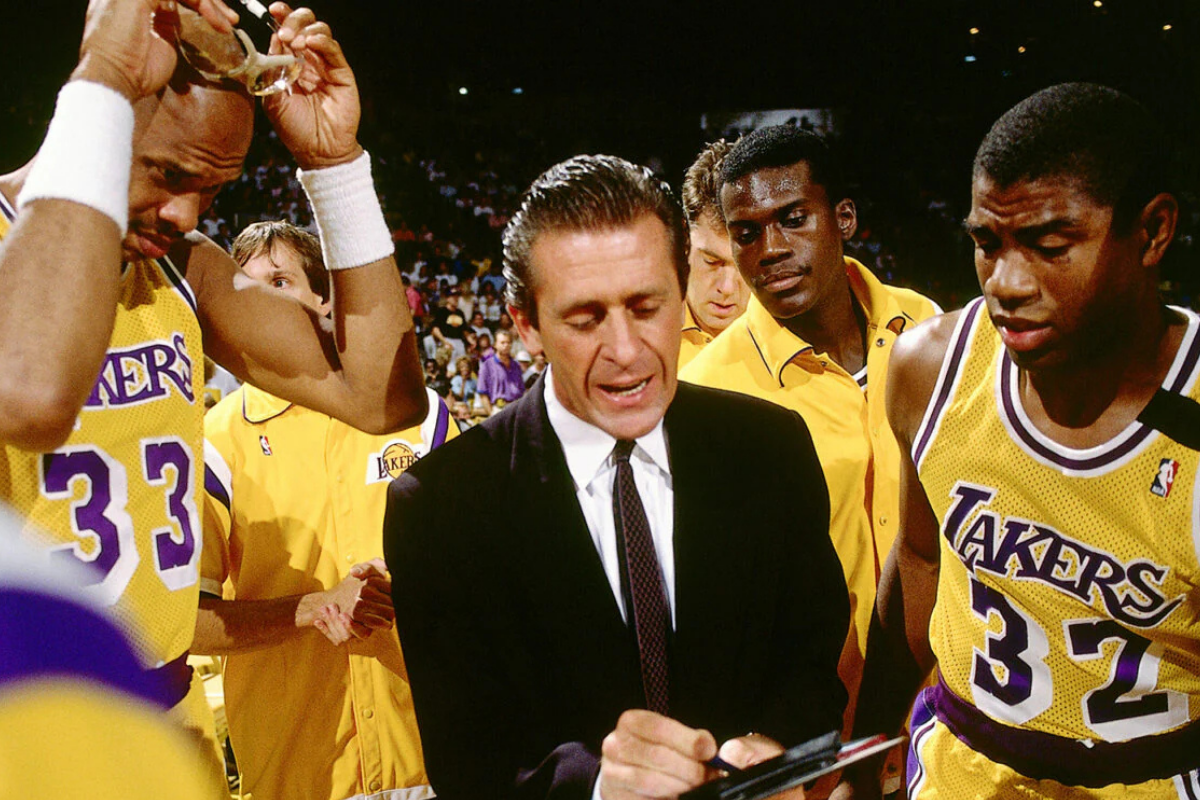
Undoubtedly, the ceremony will commemorate Pat Riley’s contributions in maximizing the “Showtime” Lakers’ Hall-of-Fame talent well enough to ensure four NBA championships.
When the Los Angeles Lakers unveil Riley’s statue outside Crypto.com Arena on Sunday before their rivalry game against the Boston Celtics, the new sculpture presumably will feature Riley’s slicked-back hair and dapper suits in a commanding pose.
That moment sparks an age-old debate far more substantive than statue ceremonies: who is the best NBA coach ever?
Phil Jackson has won the most NBA championships (11) after former Boston Celtics coach Red Auerbach kept that distinction through multiple decades (nine). Riley, former Minneapolis coach John Kundla and former San Antonio Spurs coach Gregg Popovich (five) can fit enough jewelry on one hand.
Yet a few Showtime Lakers argue that Riley deserves GOAT status among coaches. The reasons go beyond personal biases for when they experienced part or all of Riley’s four NBA title runs in seven Finals appearances with the Lakers. Former Lakers forward Jamaal Wilkes (1977-85), former Lakers forward Mychal Thompson (1987-91) and former Lakers head athletic trainer Gary Vitti (1984-2016) all explained to EssentiallySports why Riley’s coaching acumen reflect more than just wins and losses.
Editor’s note: The following one-on-one interviews were conducted separately. They have been edited and condensed.
What was your reaction when you heard that the Lakers would honor Pat Riley with a statue?
Wilkes: “Excitement for him. He’s had a long and successful career. He was with the ‘Showtime’ Lakers and then went to the [New York] Knicks and the [Miami] Heat. It’s just been a great run for him. He was quite impressive. He came in and was very astute and open-minded. We had a veteran group, and so he leaned on us and looked to us. But he was really sharp from day one.”
Thompson: “It’s long overdue and about time. There have been decades that he’s been gone from the Lakers and has been around in the NBA. But it’s better late than never. So it’s good that he’ll be here to experience the joy of it. I think the statue will be him in a suit, of course, with his hands on his hips, with his coat open. That was his stance on the sideline.”
Vitti: “It was no surprise. If anybody belongs up there, along with Jerry West, and it’s the players – Jerry West from a player and management situation – then you have to put Pat Riley up there. ‘Showtime’ doesn’t exist without Jerry West and Pat Riley. Bottom line.”
Where does Pat rank among all NBA coaches and why?
Wilkes: “He certainly belongs in that group. Of course, I’m biased. I played for him, saw him up close. I saw him meet the challenges along the way. The other coaches are great, no doubt. But he certainly belongs in that group. It’s hard to compare situations with different teams. But Pat had a remarkable run. He cared about his players. He deeply cared. He was a very good communicator. He was always well-organized, too. That’s something I truly appreciated about him. He was pretty clear on what his objectives and expectations were. That’s all you can expect in any situation.”
Thompson: “He’s the best to me. He doesn’t have the most championships. That belongs to Phil [Jackson]. But Riles is the best because of the way that he could adapt to different styles to coaching and to different teams. He coached the ‘Showtime’ fast-break Lakers to the physical, beat-them-down Knicks and to the Miami Heat with the different styles that they had with LeBron James and Dwyane Wade, as well as with Wade with Shaq [Shaquille O’Neal]. He’s more adaptable to different styles compared to all of the other great coaches.”
Vitti: “No. 1. No hesitation. Immediately, No. 1. Absolutely. It’s not always about the number of championships, although he’s got plenty of rings to prove it. But it’s the way he did it. I never saw Pat degrade anyone or mistreat anyone. That doesn’t mean we didn’t make mistakes. But when he did, he got you alone and talked to you with great respect. I learned so much from the man. I wrote in the book that for a criticism to work that you have to give three or four compliments. He told you not only when you screwed up. He told you when you were doing well. So when you did screw up, it meant something because you respected him so much.”
USA Today via Reuters
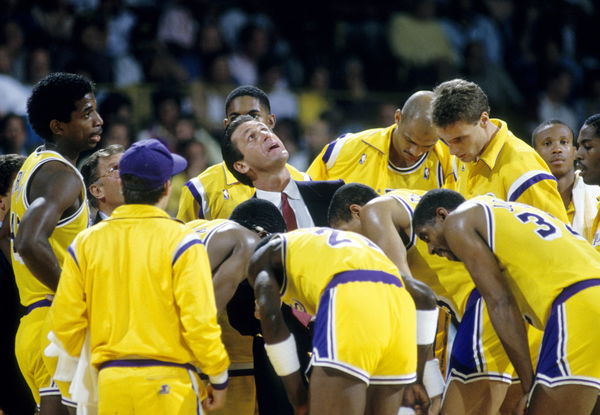
Jun 1988; Los Angeles, CA, USA; FILE PHOTO; Los Angeles Lakers head coach Pat Riley looks the the scoreboard as he huddles with his team against the Detroit Pistons during the 1988 NBA Finals at The Forum. Mandatory Credit: MPS-USA TODAY Sports
Riley was known to have intense practices. Can you paint a picture on what those practices were like and what Riley had you all do?
Wilkes: “That’s something that I hear a lot that he could overdo it sometimes and could be overdramatic. But when I was playing for him, I don’t think it was much. All of that happened after [I was waived in 1985]. But he was real strong with not having to police the players. The players always policed themselves. If you couldn’t, then he would step in. He wasn’t looking for stuff to rail into guys about or get upset about, unless it got to a point where he felt he had to do so.
In practice, he didn’t think about what he was going to do. He knew going in the points that he would make. Unless something unexpected happened, he was just always prepared. He always had drills that underscored balance with catching the ball, passing the ball and running. It was a very orchestrated practice.”
Thompson: “The games were easier than the practices. It was three-hours of NAVY Seals training. It was running, running, running, drilling, drilling, drilling for three hours. You had to be in shape to play for Pat Riley. You could not be out of shape. That’s why my favorite moment was when he would say, ‘Bring it in.’ I remember flying from Los Angeles to Cleveland on a commercial flight. We went straight from the airport to Cleveland State’s gym to practice for three hours. It was a hard practice. NBA players today should all experience that. Every NBA player should experience that for one day. Then they’ll never complain about the schedule or anything else again.”
Vitti: “There was blood. Mostly, it was Mitch Kupchak and Kurt Rambis. They would compare who had more stitches. A couple of times, Kareem [Abdul-Jabbar] walked out of practice because Mitch’s job was to bang on Kareem, and there were times that he wasn’t having it. Mitch has a raspy voice, and part of that is because Kareem was elbowing him in the throat. There was always a blue team (reserves) and the gold team (starters). With our blue team, a lot of those guys could start for other teams. So they were really competitive. It came out in practices. Those were the practices that Pat generated. There’s nothing we can really do to recreate a game in practice. But boy, Pat sure tried. It got really, really competitive.
The game in those days was a lot more physical, and we were always chasing that ring. It was always going to be either going to the Finals against Boston or Detroit. Both of those teams were nasty. We were a running time and were considered ‘Showtime’ and got some undeserved reputation that our guys were soft and those guys were the lunch-pail crew. If you didn’t see one of Pat Riley’s practices, you may think it’s all glitz and glamour. But those were hard-nosed practices with a lot of running. Pat didn’t just have hard-nosed competitive, contact practices. There was a lot of running. If you played for the Lakers, you were in shape. You were not going to lose because another team ran you out of the gym. We ran other teams out of the gym.”
Even when taking into account the Hall-of-Fame talent he had, what did Riley do to manage players, bring the best out of them and hold them accountable?
Wilkes: “Having been a player himself at a high level, he understood that the individual is first. You’re a human being first. So he dealt with you individually. He didn’t just have a blanket rule. He had a goal that he wanted. Then he pushed certain buttons with each guy to reach that goal.
I think the key thing with Magic [Johnson] and Kareem was having them just get along. These guys had accomplished a lot before they got there, and they were going to continue to accomplish a lot. So it wasn’t about motivating them so much as it sometimes having to smooth things over when things got out of joint. I think his experience as a player and having been around the Lakers in the broadcast booth really helped him address those issues as they came up.”
Thompson: “He showed what a great leader he was. He had everybody’s respect. He coached four Hall-of-Famers with the ‘Showtime Lakers’ but he still commanded everybody’s respect. That shows you what a great coach, man and great coach he is.”
Vitti: “That’s a tough question, and probably one suited for the players. But Pat wasn’t the kind of guy that would embarrass you. He would pull you to the side and talk to you. Not all coaches are like that. He was a hard-nosed and very intense guy. But he did it with a lot of class. From my perspective and position, it was very important to gain the respect of Pat Riley and Jerry West. I had so much respect for both of them with how they handled their jobs and how they handled me. I don’t think I’m me without the influence of Pat Riley and Jerry West.”
Imago
Bildnummer: 02806207 Datum: 06.06.1988 Copyright: imago/Icon SMI
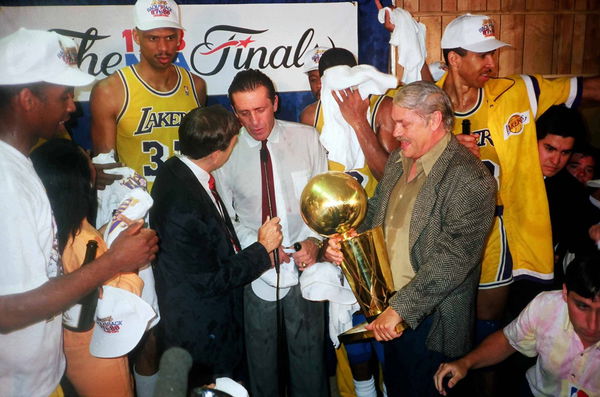
Head Coach Pat Riley (mit Krawatte), Teambesitzer Jerry Buss (mit Pokal) und Karrem Abdul Jabbar (2.v.li., alle Los Angeles Lakers) beim Interview anlässlich des Gewinns der NBA Meisterschaft 1988 – PUBLICATIONxINxGERxSUIxAUTxHUNxRUSxONLY (Icon37122176); Aufnahmedatum geschätzt, Vdia, quer, Headcoach, Eigentümer, Inhaber, Besitzer, Eigner, Owner, Teambesitzer, Teameigner, Teamowner, Pokal, Trophäe NBA 1987/1988, L A Lakers, US amerikanischer Meister Los Angeles Basketball Herren Mannschaft USA Gruppenbild Randmotiv Personen Objekte
What is your favorite example/story that showed how much Pat hated the Celtics?
Wilkes: “I’m 45 years removed from it. But we hated them due to the competitive nature of the game and the business. I can’t think of one example. But Pat correctly sized it up and kept it in the forefront. He didn’t ever let us forget. He drove his point home.”
Thompson: “To this day, the Lakers want to beat the Celtics and the Celtics want to beat the Lakers. But back then, it was really ratcheted up at the highest level of intensity that Pat Riley led with. There was a lot of suffering that he went through as a player, going against the Celtics and losing to them so many times.
He carried that into his coaching career. He wouldn’t say anything publicly to the press. But you could tell how much this meant to him, Magic and Kareem. They were the leaders on the team. Obviously, the Celtics were our standard and our measuring stick. We respected everybody else in the NBA. But we knew if we wanted to win a title that we would have to go through Larry Bird and the Celtics.
Vitti: “It was the whole thing. There wasn’t one day the hate came out. Every day, the hate came out. We believed that they hated us as much as we hated them. They weren’t just rivals. They were our nemesis. The game was elevated because of that. I have three rings with Pat and five with Phil [Jackson]. Even with the 2010 win against the Celtics, I never felt the anxiety and tension that I did with the series against the Celtics and the Pistons in the ’80s. It was just different. When we lost to Boston in 2008 and lost to Detroit in 2004, that didn’t hurt as much as losing to the Rockets in ’86 and the Pistons in ’89.
I never lost to the Celtics with Pat. I lost in 2008 with Phil. It hurt. But the wins didn’t feel as great, and the losses didn’t hurt as much as they did with the Showtime team. That was truly a family, and you lived and died with your family. That was created by Pat and Jerry West working in tandem to build what they built. There is no ‘Showtime’ without those two guys.”
What do you recall about how Riley challenged everyone, including Kareem, during the film session following the Lakers’ Game 1 loss to the Boston Celtics in the 1985 NBA Finals that contributed to a strong performance in Game 2?
Wilkes: “He was pretty blunt (laughs). He didn’t mince words. He got right to it. He was upset and disappointed. We all were. But I think his leadership at that point was really key. It helped us as a group to get over it and focus on the next game and hopefully do better. It was a wake-up call. It wasn’t very pleasant. It wasn’t very nice. It was very direct. But it was a wake-up call.”
Vitti: “It started out first where Kareem had already accepted responsibility. So he made it easy to call him out. Pat rarely called Kareem out. But Kareem already had taken ownership. That paved the way for Pat to call them out in the film session. That gained the respect of the other players that he was willing to call out his historic scoring leader of all time in front of the whole team. Kareem wasn’t the easiest guy to criticize. But Pat was willing to do that. You have to give them both credit. Kareem was willing to accept the criticism. As a result, you saw what happened.”
What do you remember, what Riley’s emotions were when the Lakers beat the Celtics in the ’85 Finals, given the significance with both winning an NBA title and with the Lakers finally beating Boston?
Wilkes: “We all knew how big it was, especially him. He fought for us. He galvanized everything he could. It was a sense of accomplishment. But it was also a sense of relief. With it being the first time, you’re glad that the streak is finally over.”
Vitti: “I remember we went back to the hotel. We all cleaned up because we were all full of champagne. Pat came down with a tuxedo on (laughs). I remember being at the hotel after beating them in Boston in ’85.
How did you all react when Riley guaranteed you all would repeat during the 1987 championship parade?
Thompson: “We’re supposed to repeat when we have Kareem, Magic, James Worthy, Michael Cooper and Byron Scott. With the roster we had, you’re supposed to expect and believe you’re going to win a championship. When you look at that roster, you should think that nobody can beat you. You see the great Hall-of-Famers that were in that locker room. You’re supposed to think that way. When the Warriors had Kevin Durant, do you think anybody thought they could beat them? No.
You had to show up in shape. You couldn’t use training camp to get into shape. You had to show up in shape. If you came into training camp out of shape, you would be throwing up and not be able to keep up. Everybody knew a month before camp opened that you better be ready to hit the ground running on the first day. I would go on the track and run, run, run. I felt like I was Michael Johnson, an Olympic sprinter, just to keep my cardiovascular shape up. You don’t just go out and play basketball. You have to get to the track and run sprints and put some miles in to get in shape for a Pat Riley training camp. It was amazing the physical conditioning that we were in. We were the best conditioned team in the NBA, probably ever.”
Vitti: “Oh boy. Everybody was surprised that he did that. But after it sank in, it made a lot of sense. What Pat did was he set the tone early. He then started to communicate with the players and coaches on what he felt they could do to be better to win the back-to-back. So it wasn’t just about showing up at training camp in day one. This was right after we won it. He was already writing letters to everybody saying, ‘This is what I need from you next season.’ Literally the day after the championship, he’s setting up short-term goals, mid-term and long-term goals on how we can win. It was very calculated. It was brilliant, absolutely brilliant. He was intense. He was tough. But he was fair and he was respectful. I never saw him talk down to anybody.”
Riley held a reunion for the Showtime Lakers in Hawaii in 2022. What were your favorite memories of Riley during that trip?
Wilkes: “I had some health issues and wasn’t able to attend. But I’m doing better. So I didn’t go. But it’s fitting. That was his beginning. His time with the Lakers was very successful. I don’t think he’ll ever forget that. It all led to everything else. It opened all the other doors for him.”
Thompson: “It showed how much he cares about everybody. He was a tough leader, but he was a compassionate leader. He cared about everybody. It wasn’t just about the stars. It was from Kareem to Magic to right down to the guys on the end of the bench. He treated everybody the same with the same type of respect and expectations. He had us do some walk-through practices, and I emphasize ‘walk.’ We walked through some plays that we had. We went through the old plays. It was great. It reminded us how old we are. But it wasn’t easier. Even after that practice, we had to go back and take a nap.”
Vitti: “The whole thing was great. I spent a day on a boat with Kareem and Michael Cooper. We had a really good time with being around the guys and telling stories. We ate pretty much with a different group every night. So by the end of the seven days, we pretty much had dinner with everybody that was there. Everybody wanted to break bread with everyone. Then Pat did a walk-through with the players at practice. I was just hoping that nobody got hurt (laughs).”
Mark Medina is an NBA insider for EssentiallySports. Follow him on X, Blue Sky, Instagram, Facebook and Threads.