
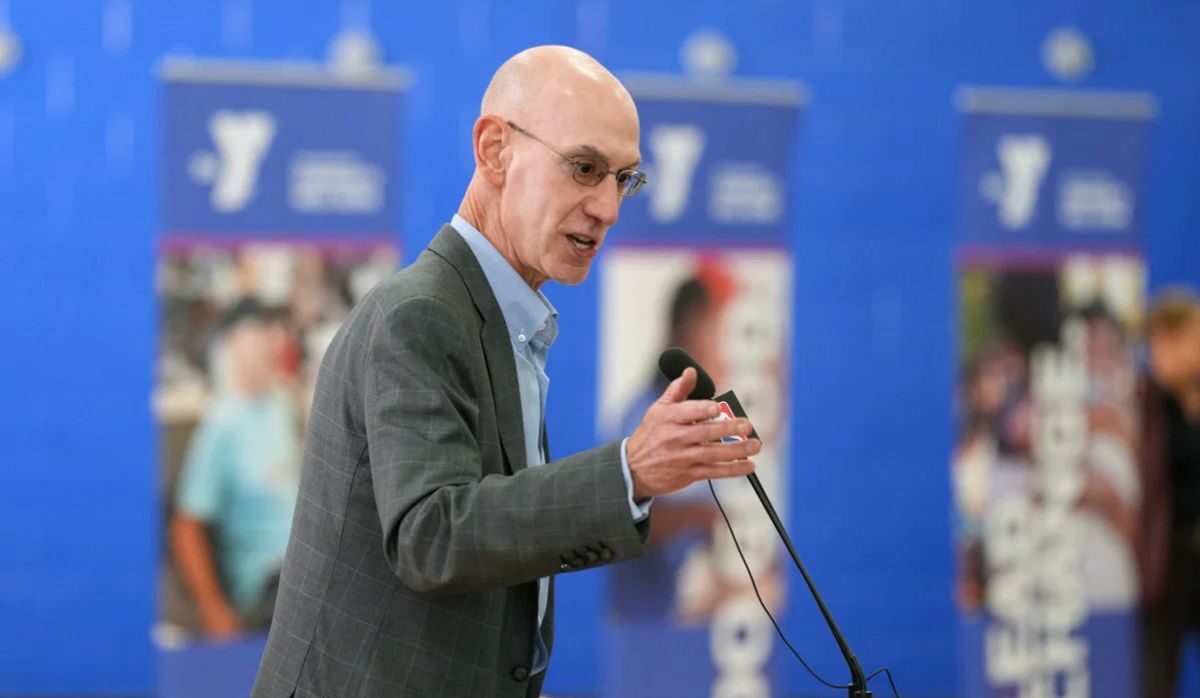
It appears the screaming, crying, yelling about objective officiating did reach the NBA Commissioner. Adam Silver’s interview with Pat McAfee amid an intense Western Conference Finals indicated he’s heard all the outcry about tanking, draft lottery positioning, officiating, flopping, and yes, even the latest contentious non-call from Game 5 between the Oklahoma City Thunder and San Antonio Spurs. The 2026 playoffs have been marred by a string of officiating disputes, with multiple series producing viral moments that have eroded fan trust in the league’s refereeing consistency. Unlike the questionable initiatives to curb tanking, he apparently has a better resolution to inconsistent calls and flopping. He has announced that the league is officially prepared to transition objective officiating responsibilities to automated technology.
Watch What’s Trending Now!
He directly referenced what is being seen as a massive refereeing blunder in the Western Conference Finals after Pat McAfee brought up the fallout from a viral, highly controversial sequence in Tuesday night’s game. Rather than defending the human error, Silver confirmed they’re taking inspiration from the tennis world and making a massive shift toward artificial intelligence.
“We’re going to move to a system… where that whole category of calls will be automatic,” Silver confirmed. “Those calls will be done by an AI automated system with cameras lined around the court, and it’ll take all those so-called objective calls out of the hands of the referees. It’ll just be instantaneous. This will be automatic. Just play on, you know, let’s go, you know, Spurs inbound and and you’ll move on.”
The Commissioner showed this isn’t a new phenomenon. Tennis and more sports have been reliant on Sony’s Hawk-Eye technology, a computer vision system of high velocity cameras to objectively track a game, from a ball’s trajectory to player posture. MLB has similarly integrated its Automated Ball-Strike System (ABS) to dictate the strike zone, converting a formerly subjective human element into an entertaining stadium display.


Adam Silver believes NBA will move to an automated replay system, via @PatMcAfeeShow: "We're going to move to a system like [Hawk-Eye] ... [Objective] calls will be done by an AI automated system with cameras lined around the court … You won't have to deal with challenges on Show more
“You won’t have to deal with challenges on those calls, but it’ll also allow the officials on the more difficult subjective calls to give their full attention to those where, you know, because there’s often contact on every play. It doesn’t mean there’s a foul,” Silver explained. “They’re actually feeling the contact because they’re there on the floor with the players. So anyway, I think technology will really be helpful here.”
Silver expects a similar reception as MLB and NFL in basketball arenas as the new technology can separate objective rulings from subjective ones to significantly improve the flow of the game.
The NBA and Sony’s Hawk-Eye Innovations actually formalized a multi-year partnership beginning in the 2023-24 season to deploy Hawk-Eye’s 3D optical tracking technology leaguewide with the explicit goal of enabling automated calls on plays such as out-of-bounds and goaltending in future seasons.
While the tracking infrastructure is therefore already in place, Silver did not provide a specific rollout date for automated officiating, saying only that the league would get there “fairly quickly.”
Adam Silver acknowledged OKC-Spurs missed call
This has long been in development. There was no exact tipping point that spurred Adam Silver’s modernization of refereeing. But Silver and McAfee specifically cited the disastrous sequence of missed calls during the recent game to explain the league’s technological overhaul. Before confirming it, he did tell McAfee, “the very play that you were talking about, Chet’s foot, it’s a big deal.”
The incident occurred late in the third quarter as the Spurs were working to stay within striking distance while trailing 98-88. A baseline drive resulted in a ball clearly deflecting straight off the foot of Thunder center Chet Holmgren before flying out of bounds. Despite the obvious trajectory, the officiating crew initially awarded possession to the Thunder. It was indeed a “big deal” in real time.
Spurs head coach Mitch Johnson instantly erupted, frantically requesting a coach’s challenge.
What followed is where the sequence becomes disputed. Under NBA rules, a coach must first signal for a timeout and then issue the challenge – in that order.
NBA analyst Nate Duncan noted that Johnson appeared to signal directly for the challenge without first calling the mandated timeout, which would make the officials’ denial procedurally correct.
Johnson himself, however, told reporters after the game that officials simply “didn’t see me” – suggesting the crew never acknowledged him at all, regardless of the procedural sequence.
Whether the denial was a rules enforcement or a visibility failure remains unresolved, but the result was the same: the challenge was never granted, the Thunder kept possession, and Johnson was hit with a technical foul.
Shai Gilgeous-Alexander was essentially gifted the free throws, sending social media into a frenzy as fans criticized the officiating crew.
It can be argued that Johnson forgot to call a mandated timeout before legally challenging the missed call. It doesn’t discount the fact that his visible request was ignored. After the game, Johnson said he thought officials “just didn’t see me.”
That’s perhaps the kind of human error Adam Silver wants to get around with a Hawk-Eye like visual system. He told Pat McAfee the technology, when it’s implemented, should maintain the flow of the game and put the officials’ concentration on more difficult subjective calls.
By bringing AI automation to boundary lines and out-of-bounds plays, the NBA hopes to permanently remove these critical oversight blunders from human hands.