
Imago
Jun 5, 2025; Oklahoma City, Oklahoma, USA; NBA commissioner Adam Silver speaks to the media before game one between the Oklahoma City Thunder and the Indiana Pacers in the 2025 NBA Finals at Paycom Center. Mandatory Credit: Alonzo Adams-Imagn Images
Imago
Jun 5, 2025; Oklahoma City, Oklahoma, USA; NBA commissioner Adam Silver speaks to the media before game one between the Oklahoma City Thunder and the Indiana Pacers in the 2025 NBA Finals at Paycom Center. Mandatory Credit: Alonzo Adams-Imagn Images
Tanking has been a major topic this season in the league. While it’s not new, the way teams allegedly do it has reached a level that even the league’s own commissioner describes as a crisis. With a solution needed before June, the three proposals Adam Silver proposed to his board of governors have reportedly been met with little enthusiasm.
Watch What’s Trending Now!
According to ESPN’s Anthony Slater on Wednesday, who spoke with numerous players, coaches, and front office officials across the league, none of the anti-tanking reforms offered by the league received significant support. He wrote for ESPN, explaining the scope of the issue and how Silver’s suggested solutions were received. “In late March, ESPN reported the three comprehensive solutions the league presented to its board of governors in an effort to curb tanking. All three proposals widened the lottery to 18 teams and flattened the odds further to differing degrees. One proposal would weigh a team’s record across two seasons. Another is referred to as the ‘five-by-five’ method, giving the bottom five teams identical odds. None of them were embraced with much warmth around the league, sources told ESPN.”
The resistance is notable given the scale of the problem the NBA Commissioner, Adam Silver is trying to solve. The average margin of victory in NBA games this season is 13.1 points, which is the largest spread in league history, and a record 89 games have been decided by 30 or more points. Furthermore, at least eight teams have been engaged in an arms race to lose as much as possible in order to improve their lottery odds ahead of a loaded 2026 draft.
Top Stories





The strategies grew in audacity and even crept in earlier into the calendar. Some franchises initiated tanking tactics as early as January rather than the traditional late-season pivot. This led to the league fining the Utah Jazz $500,000 in February for benching Lauri Markkanen and Jaren Jackson Jr. in tight road games. In the two months since, the same midgame benching tactic continued without further league action. “Overt behavior like this that prioritizes draft position over winning undermines the foundation of NBA competition, and we will respond accordingly to any further actions,” Silver said at the time. However, no additional fines followed.
The following has been released by the NBA. pic.twitter.com/0JFQpOnOmF
— NBA Communications (@NBAPR) February 13, 2026
Silver was direct about his timeline and his frustration with the incremental nature of previous reforms. “We need to do something more extreme than we did with those incremental changes the last four times we’ve changed lottery rules,” he said at a late March press conference. “Certainly, going into next season, the incentives will be completely different than they are now.” The commissioner added that he desired a solution in place before June, giving front offices time to absorb new rules before the draft and free agency windows open.
The NBA’s Tanking Arms Race Has a Clear Blueprint — and It Starts in Oklahoma City
The resistance to Adam Silver’s proposals appears to make more sense when it is viewed against the outcomes tanking has produced. The strategy is not a fringe approach adopted by desperate franchises, as it is the documented origin story of the league’s best team. In the final four games of the 2021-22 season, the Thunder used three players described by Slater as “non-NBA level talents” in Georgios Kalaitzakis, Melvin Frazier, and Zavier Simpson, giving each of them 40-minute-per-night roles.
Oklahoma City was outscored by 85 points in Kalaitzakis’s court time, 92 in Frazier’s, and 95 in Simpson’s. The blowouts kept the Thunder at 24 wins. And on lottery night, they jumped to second and drafted Chet Holmgren. Holmgren then started at power forward for a title team three years later. Now, Utah, Memphis, and Washington have all deployed variations of the same playbook this season. “It’s a copycat league,” an executive on a currently tanking team told ESPN. “All the models and ideas, there are always further iterations. That’s what happens when it works.”
Imago
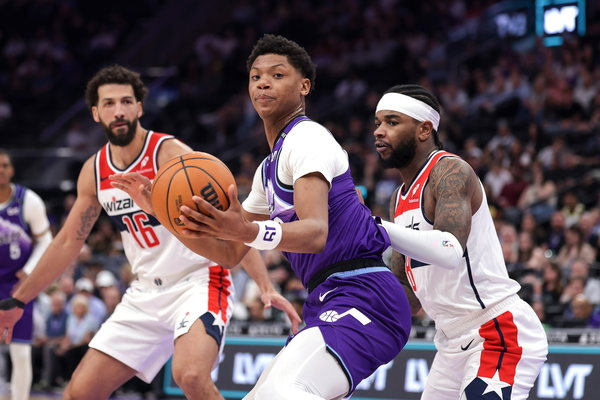
Mar 25, 2026; Salt Lake City, Utah, USA; Utah Jazz forward Ace Bailey (19) controls the ball as Washington Wizards guard Jaden Hardy (8) defends during the second half at Delta Center. Mandatory Credit: Chris Nicoll-Imagn Images
Golden State Warriors coach Steve Kerr, who has watched his team play against multiple opponents executing the strategy this season, put the league’s collective frustration plainly. “I hate it,” he said. Draymond Green was more direct about his preferred solution: “Just fine the hell outta people. They love taking money from players. Keep fining teams. I’ve seen two fines. As players, they snatch that money in a heartbeat. Why isn’t it the same? Everybody love money.”
The challenge Adam Silver now faces is that the people who are best positioned to explain why the proposals don’t work are the same executives who have built successful franchises by using the strategy the proposals are designed to stop. “These teams are doing the whole gamut: sitting guys in the fourth, playing analytically bad lineups, drawing up plays for bad shots,” one Western Conference general manager told ESPN. “The creativity is impressive, and I don’t blame them. It’s the best strategy to get better. Look at all the most promising teams in the league: Thunder, Spurs, Pistons, Rockets, Hornets. Years of being bad and building up on high picks. It’s painful but worthwhile.”
The league needs a fix before June, and what that fix looks like, after three proposals found no takers, remains unanswered.
Written by

Edited by

Ved Vaze