
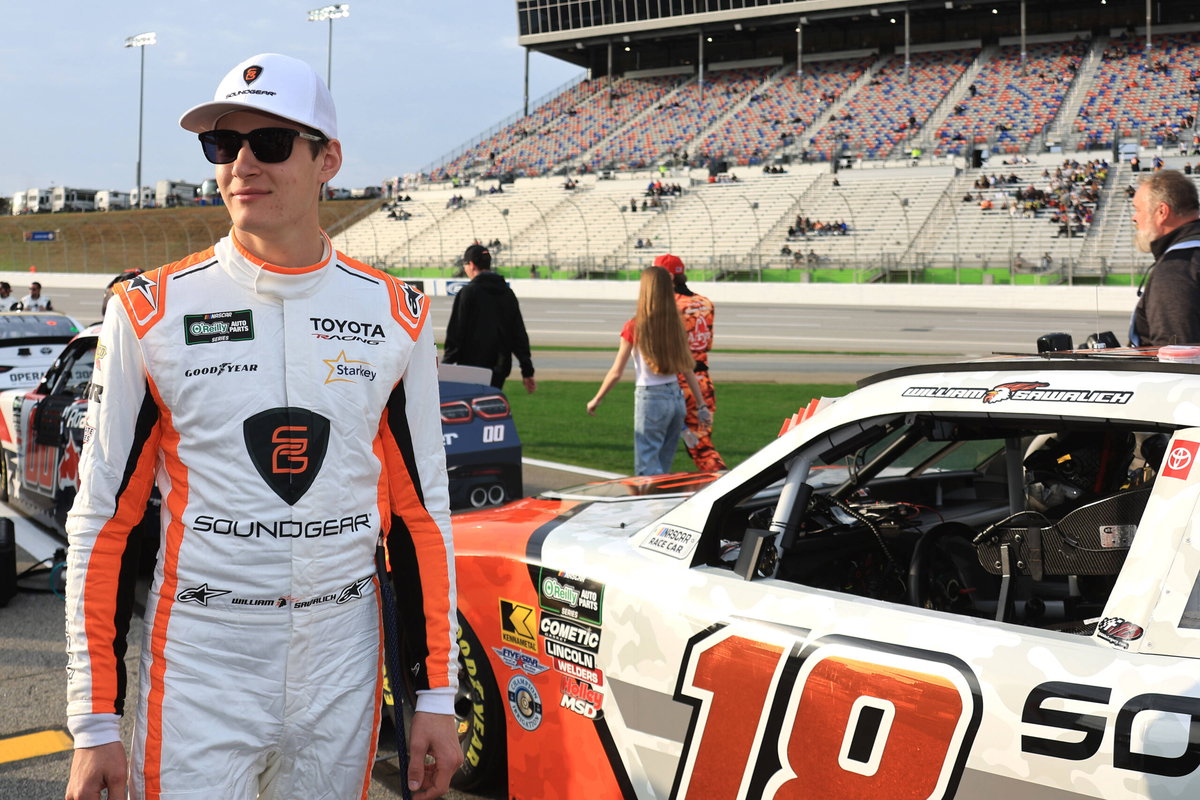
A week after Corey Day put William Sawalich into the wall at Darlington, the two crossed paths again at World Wide Technology Raceway at Gateway. This time it was Day eating the barrier. The question everybody’s asking now: was that just racing, or was it payback?
Watch What’s Trending Now!
The 2026 O’Reilly Auto Parts Series Chase kicked off at Darlington. Lap 68, Day’s No. 17 HendrickCars.com Chevy got into Sawalich’s No. 18 Joe Gibbs Racing Toyota and sent him straight into the outside wall. Night over for Sawalich. Day owned up to the contact afterward, saying he’d been trying to slide underneath Sawalich and got shoved up into him instead.
It’s what supposedly happened after the race that turned this into something bigger. According to Day, Sawalich walked up to him post-race and told him to go screw himself, then added a warning: they’d see how the rest of his Chase went. Day later told reporters he figured Sawalich would wreck him in a race that meant nothing to Sawalich but everything to him. That gap right now is one guy fighting for a championship, the other with no championship points at stake, is really what this whole story hinges on.
And Darlington wasn’t even where the bad blood started. Day and Sawalich had already tangled at Circuit of the Americas and Daytona earlier this year, so by the time the Chase rolled around, there was already plenty of history simmering.
Worth noting: that alleged threat was never caught on tape. It’s just Day’s word for it, and that detail matters a lot once you get into what NASCAR can actually do with it.
Gateway, and the hit that changed everything
Fast forward to the second Chase race. Lap 134 of 180, both cars running around fifth. Day dove down into Turn 1 next to Sawalich, except Justin Allgaier’s No. 7 was on his bumper, and Allgaier’s radio indicated Taylor Gray was pushing him forward.”
Day’s explanation after the race lines up with that version: he said he tried to pull down to the bottom but the 7 had him pinned up into the 18, nowhere to go.
So far, that’s just racing. Physics, traffic, nothing sinister. What happened right after is a different story. As the cars split apart heading down the backstretch, Sawalich turned left into the right side of Day’s car. Day spun into the inside SAFER barrier. Allgaier picked up right-front damage in the mess too. Day, who’d started the day fifth in points, finished 33rd. Sawalich’s car got banged up as well but he still brought it home 16th.
That’s the crux of it. The first hit came from circumstances neither driver fully controlled. The second contact came when Sawalich’s No. 18 moved left into Day’s right-side door. Why he made that move is exactly what NASCAR now needs to figure out.
Sawalich’s radio from that moment is telling in its own way. He told his team Day wasn’t actually the one who hit him first; that it was Allgaier’s 7 shoving Day into him. So he clearly understood what had just happened mechanically. He also sounded furious. What the radio doesn’t tell you is what he was planning to do about it.
Afterward, when reporters asked about the incident, all Sawalich offered was that he was focused on next week. He didn’t say anything else, and after his CW Sports interview, Sawalich declined further media questions.
“Retaliation from last week”
Allgaier wasn’t some innocent bystander watching from a distance. His car got torn up in the incident, he finished 13th, and he handed the points lead to Sheldon Creed by a razor-thin three points because of it.
He didn’t mince words afterward, calling it retaliation from the previous week. His comments:
“I watched what happened there. I don’t know if there’s something I can have a conversation for you, but my hope is those two can figure out what they got going on. As somebody that’s been in these same situations, I’ve made the same dumb mistakes. I’ve had contact with people that I shouldn’t have. The hard part about this sport is we race against each other too often. And every week we have a battle and a battle. So the last thing you want to do is start a problem with somebody because then it just festers on.”
Allgaier wasn’t watching from a broadcast booth, he was right there in the middle of it, which gives his read on the situation some real weight. Still, it’s his interpretation, not proof. NASCAR’s the one who has to line that up against the actual footage and data.
Day, for his part, played it pretty cool afterward. Asked if NASCAR should step in, he just said he wasn’t going to speculate. Asked if he’d talk things out with Sawalich, he said it’d be like talking to a wall. He also pointed out his car had been a legit top-five contender that night. Now, the crash dropped him to eighth in the Chase standings, 69 points behind the lead with seven races remaining.
What NASCAR actually has to work with
NASCAR isn’t stuck watching the same broadcast the rest of us saw. They’ve got SMT data tracking steering, throttle, braking, speed, trajectory, all of it, for every car, every moment. They can pull camera angles that never made TV. They can grab radio from every car in the mix. They can even compare how Sawalich was steering earlier in the race to what he did on Lap 134.
The real question comes down to this: once the cars separated on the backstretch, was Sawalich just holding his line or trying to recover the car, or did he deliberately turn back into Day? That’s not something you can settle by eyeballing a replay. That’s a data question.
Then there’s the alleged threat from Darlington, Day’s claim that Sawalich warned him during the Chase. It’s the most damning piece of the whole story, and also the shakiest, because there’s no recording of it anywhere. NASCAR only has Day’s account. That’s context worth considering. It’s not proof of intent.
The Preece precedent
Earlier this year at Texas, something similar played out between Ryan Preece and Ty Gibbs. Before making contact with the 54 car, Preece said on his radio, “When I get to that 54, I’m done with him.” NASCAR pulled that recording, matched it against video and data, and hit Preece with a $50,000 fine and 25 driver points under Sections 4.3 and 4.4.A of the rule book. He appealed, and the National Motorsports Appeals Panel upheld it.
That case laid down a pretty clear marker. Get caught saying you’re going to do something, then do it, and NASCAR has enough to act.
At that same Texas race, Kyle Busch and John Hunter Nemechek tangled too, and NASCAR looked into that one as well. No penalty for Busch. Officials found a reasonable mechanical explanation tied to the car damage, so intent just wasn’t there in the same way.
Then later in the year, Shane van Gisbergen and Austin Hill had their own dust-up at the Chicago Street Race. NASCAR dug through the SMT data, radio, video, steering, throttle, everything. No penalty came out of it. Plenty of people thought it looked intentional, but NASCAR decided the evidence didn’t clear the bar for an official finding.
So here’s the pattern so far: Preece, recorded threat plus contact, gets penalized. Busch, sketchy contact but a believable mechanical excuse, no penalty. Van Gisbergen and Hill, suspicious hit but not enough proof, no penalty.
Sawalich and Day fall somewhere in between all of that. The circumstantial case is honestly pretty strong, the history between them, the alleged private threat, the timing lining up perfectly, and Sawalich’s leftward turn right after the cars separated. Allgaier, who was practically inside the incident, called it retaliation. But the one thing that would really seal it, an actual recorded threat, only exists as something Day says was said to him in private.
A gap in the rules, not really a loophole
The real issue here isn’t that NASCAR’s rulebook has a hole in it. Preece already proved intentional retaliation gets punished when it can be proven. The tricky part is evidence.
If a driver threatens someone privately, keeps his mouth shut on the radio, and then just calls the resulting contact hard racing, how exactly is NASCAR supposed to prove otherwise? The rule isn’t broken. Proving it is just hard.
That’s a real problem worth sitting with. Not because NASCAR’s soft on this stuff, but because without a recording, everything rides on steering data and camera angles carrying way more weight than they should have to. If the Gateway data shows Sawalich clearly and deliberately cutting left after the cars split, that might be enough on its own. If it’s murky, NASCAR’s right back in Van Gisbergen and Hill territory.
Allgaier summed up the bigger picture well. These things fester because drivers see each other every single week. One block turns into old resentment resurfacing. One bump leads to another. Eventually somebody retaliates, and other people get dragged into it who had nothing to do with the original beef. He’d know, he got dragged into this one and lost his points lead over it.
And that’s really what raises the stakes past just these two drivers. A guy outside the Chase potentially wrecking someone inside it is bad enough. A guy outside the Chase potentially messing with the points leader’s standing, especially when that leader got caught up in the wreck through no fault of his own, is a bigger deal entirely.
As of now, NASCAR hasn’t announced anything against Sawalich for Gateway. That doesn’t mean nothing’s coming, it just means if there’s an investigation happening, it hasn’t wrapped up publicly yet. Bristol’s next on the Chase schedule, and Sawalich says that’s all he’s thinking about right now.
NASCAR doesn’t have to stamp out hard racing to deal with this. But if they actually want to crack down on intentional payback, drivers need to know exactly where that line sits. Preece showed what happens when there’s a recording. Van Gisbergen and Hill showed what happens without one. Now Sawalich and Day are the next test case, and how NASCAR handles it will matter well beyond just these two.